President Donald Trump on Tuesday credited himself with overcoming the economic “disaster” left by his predecessor and gave his economy an “A+++++” rating, but the experiences of most Americans paint a far gloomier picture of financial conditions in 2025.
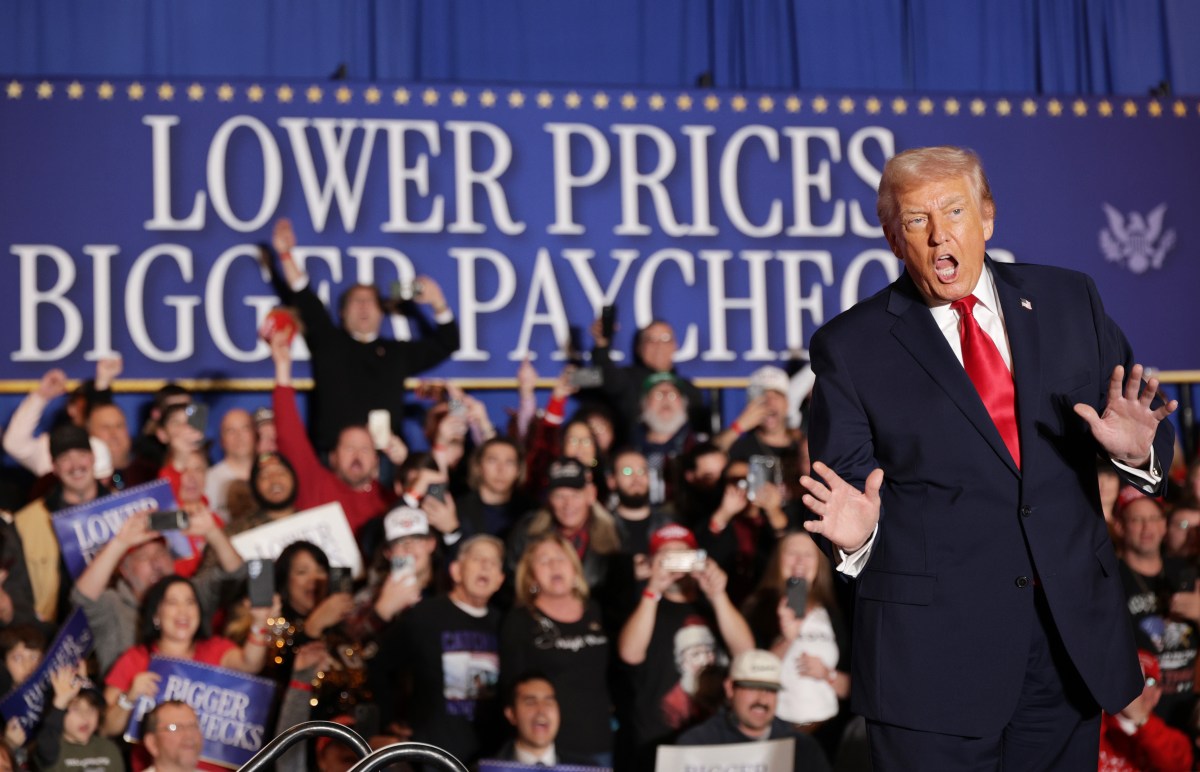
During a campaign-style event at a casino in Pennsylvania, while standing under a banner reading “LOWER PRICES BIGGER PAYCHECKS,” Trump said his administration was bringing costs down “rapidly” following “the highest inflation in history,” and once again declared concerns about affordability to be a “hoax” manufactured by his opponents.
Also on Tuesday, Politico released an interview with the president in which he awarded his economy the A+++++ grade despite having inherited “a total mess” from Joe Biden.
Why It Matters
Prices have continued to rise since Trump took office in January, and weaknesses within the labor market have weighed on Americans’ perceptions of the economy this year. As several polls and surveys of consumer confidence reveal, the public’s view of contemporary economic conditions contrasts sharply with Trump’s laudatory assessment, and some believe his strategy of denying affordability concerns could hurt the GOP’s chances in next year’s elections.
While the administration has taken steps it believes will lessen Americans’ economic burden, such as rolling back certain food tariffs and fuel-efficiency standards, Democrats have seized on the affordability issue, and some Republican voices have expressed unease about how the economy could impact their midterm success.
What To Know
During his rally on Tuesday, said to be the first in a series of affordability-focused appearances across America’s swing states, Trump said Democrats “blew up our economy,” but that it was now prospering like never before thanks to tariffs and the “unleashing” of American energy.
But this upbeat appraisal clashes with how most Americans currently feel about Trump’s economy.
Some 76 percent of Americans in a mid-November Fox News poll said the economy was either “not so good” or “poor,” and three times as many believe they have been hurt by Trump’s economic policies as helped by them.
A New York Federal Reserve survey of American households in November found that expectations of their current and future financial situations deteriorated further, though inflation expectations remained steady, and perceptions of employment conditions improved modestly compared to October.
And the Conference Board’s latest survey revealed that consumer confidence fell to its lowest level since April in November, as assessments of both the business and labor markets sank, and the Expectations Index dropped further below the threshold that signals an upcoming recession.
Jonathan Portes, a professor of economics at King’s College London, said there was little point commenting on Trump’s economic appraisals, and said the U.S. economy was performing “poorly, in part because of Trump’s policies on tariffs and immigration, but not disastrously, in part because of the AI investment boom.”
“His claim that ‘prices are coming down tremendously’ is obviously untrue,” Portes told Newsweek. “Prices are rising by about 3 percent a year, and that rate has accelerated slightly in the last year.”
But the White House continues to maintain that Trump is making “substantial progress” in addressing cost-of-living issues, citing lower gas prices, declining mortgage rates and moderate growth in real wages.
And nearly a year into his second term, the administration believes that many of the nation’s economic woes can still be attributed to Biden-era policies.
“President Trump and every member of his administration fully recognize how Joe Biden’s generational inflation crisis left American families behind,” White House Spokesman Kush Desai told Newsweek. “Turning the page on the Biden disaster has been a Day One priority for the Trump administration, and everyone is doing their part to deliver economic relief for the American people, from driving gas prices down by unleashing American energy to securing landmark working-class tax cuts to signing historic drug pricing deals.”
Though Portes believes the strategy of touting its affordability successes will do little to sway the opinion of an increasingly price-conscious public.
“Trump is p***ing on his supporters’ legs and telling them that it’s raining,” he said. “I doubt that’s a winning strategy.”
What People Are Saying
President Donald Trump said during his Pennsylvania rally: “They gave you high prices. They gave you the highest inflation in history. And we’re giving you—we’re bringing those prices down rapidly. Lower prices, bigger paychecks. You’re getting lower prices, bigger paychecks. We’re getting inflation. We’re crushing it. And you’re getting much higher wages.”
The White House, in a press release on Tuesday: “The Trump Administration’s whole-of-government effort will continue driving prices down, boosting take-home pay, and strengthening the economy so all Americans can feel relief.”
Senator Bernie Sanders told CNN on Tuesday: “If this is an A+++++ economy, God help us if we ever get to a B or a C.”
Economist Claudia Sahm told Newsweek: “To get top marks, the economy would need to be firing on all cylinders for the vast majority of Americans. That’s not the case now. Only one in five families says they are better off financially than a year ago—near an all-time low of a survey back to the 1960s. The macroeconomic data are not as downbeat, but it’s harder to find a job, wage growth has slowed, the unemployment rate has risen, and inflation remains elevated. That’s not worthy of top marks either. Telling people they are better off than they feel will be a hard sell, especially when President Trump’s signature policy of tariffs is raising prices.”
Moody’s Chief Economist Mark Zandi wrote on LinkedIn: “Many Americans are deeply unhappy with their financial situation, and with good reason. They are grappling with a severe affordability squeeze. Prices for many things, from groceries to car insurance, are high and continue to climb. Meanwhile, pay increases are slowing as job growth has stalled and unemployment is on the rise. Addressing the affordability squeeze will be challenging, but revisiting tariffs and immigration policy could help.”
What Happens Next
Tuesday’s rally in Pennsylvania kicked off a series of campaign-style events aimed at promoting Trump’s economic agenda to voters ahead of next year’s midterm elections, according to Reuters and Axios.
Update 12/10/25, 10:28 a.m. ET: This article was updated with comments from economist Claudia Sahm and the White House.