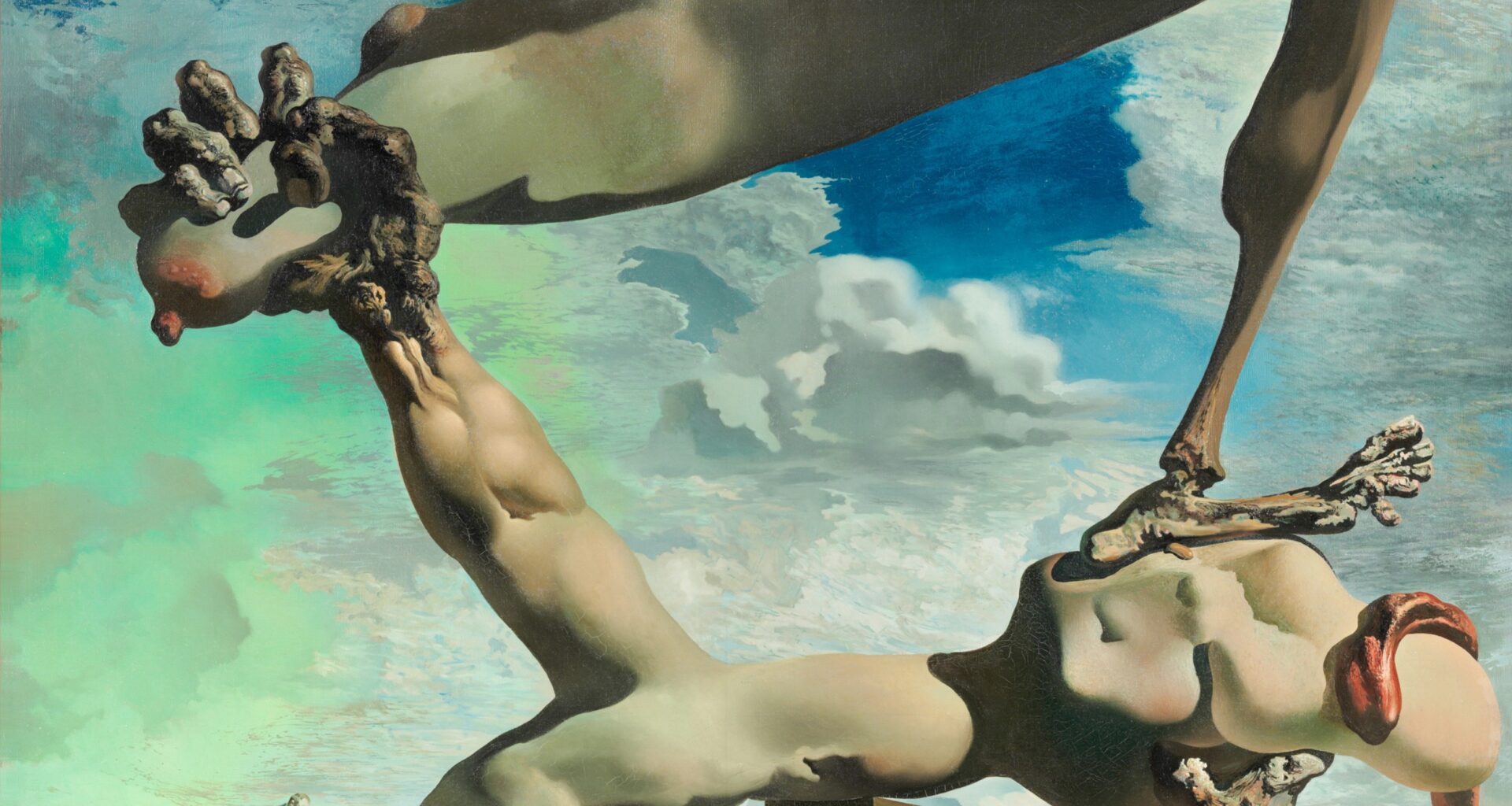
Dreamworld: Surrealism at 100
Philadelphia Museum of Art
November 8, 2025–February 16, 2026
Philadelphia, PA
Before the Great War, we lived in “a static world, where the values appeared stable and where the meanings of abstractions seemed permanent and reliable,” the literary historian Paul Fussell wrote. “Everyone knew what Glory was, and what Honor meant.”1 But by 1929 Ernest Hemingway could write in A Farewell to Arms that “abstract words such as glory, honor, courage, or hallow were obscene beside the concrete names of villages, the number of roads, the names of rivers….”2 After the violent upheavals of World War I and the unsettling events that immediately followed—the Spanish flu (which took between fifty and a hundred million lives worldwide), the political revolutions in Germany and Russia, and a crippling global recession that lasted through 1921—reality itself felt unstable.
The traumas of the teens prompted artists to create Dada, which swept reality away, the extreme cynicism of German “New Objectivity,” and Constructivism, which attempted to build an imagined utopia from the ruins. In Paris, the frenetic and uncertain reality produced Surrealism. And against the backdrop of the Roaring Twenties, hyperinflation and the market crash, flappers and cabarets, Surrealism turned inward toward the psyche, privileging unconscious emotions, fears, and fantasies. The architects of Surrealism were writers. Guillaume Apollinaire invented the term surréaliste in 1917 to describe his absurdist play Les mamelles de Tirésias (The Breasts of Tireseas); André Breton, Antonin Artaud, and Philippe Soupault inaugurated the journal Littérature in February 1919 as Surrealism’s first vehicle. Artaud described Surrealism as a “complete liberation of the mind.”3 Breton defined it as “psychic automatism…the dream state.”4
Surrealism began as a literary movement and only later burst into celebrity as an art movement. Nevertheless, the list of visual artists who signed on, formally or informally during the 1920s and 1930s, is a roster of giants. Among the seventy artists included in the Philadelphia Museum’s current exhibition, Dreamworld: Surrealism at 100, are such artists as Giorgio de Chirico, Marcel Duchamp, Man Ray, Jean Arp, André Masson, Max Ernst, Joan Miró, Yves Tanguy, Pablo Picasso, Alexander Calder, René Magritte, Salvador Dalí, Dorothea Tanning, Leonora Carrington, Joseph Cornell, and Claude Cahun. Still more artists came to Surrealism in the 1940s and 1950s, when automatism and metamorphic imagery lay the foundation for such major developments as American Abstract Expressionism and then international Pop Art respectively. This vibrant, dynamically evolving, often theatrical movement remained prominent for forty years.
Curated by Matthew Affron, Dreamworld: Surrealism at 100 now in the Philadelphia Museum, lays out the story of Surrealism—its themes, its central preoccupations and its various and evolving morphologies—with brilliant clarity. Moreover, as much as a third of the roughly 200 works come from the museum’s own collections. The Arensberg and Gallatin collections, which came in 1950 and 1952, made the Philadelphia Museum one of the world’s great collections of modern, and especially Surrealist, art. Each of the five venues for this show – previously in Paris, Brussels, Madrid, and Hamburg—undertook to tell a distinct variation of the story as it pertained to their own history and collection, making each showing unique. This in itself creates a dynamic dialogue and a rejuvenatingly fresh take.
Dreamworld: Surrealism at 100 in Philadelphia opens with the museum’s famous painting of The Soothsayer’s Recompense (1913) by Giorgio de Chirico. This object sets many of the themes of the Surrealist dreamworld – a world of illusions, with mysterious meanings, illogical juxtapositions, allusions to classical myth displaced into contemporary settings, and wonder at the extraordinary in nature. It’s all about freedom of thought and the re-enchantment of the everyday. Affron casts “Surrealism as a rebellious philosophy of life,” a way of “rethinking the human condition.”5 The first rooms show us the complex dreamscape that set the movement’s preoccupations. In the following rooms, the exhibition takes a deep dive into a half dozen of the defining concerns, which the Surrealists thought would liberate the mind, while the sequence also roughly tracks the movement’s chronology. These sections explore “the marvelous” in nature, sexuality and Eros, and the strange, terrifying monsters of Ernst, Masson, Miró, and Picasso that foreshadow the onset of totalitarianism and war in the 1930s; here, Dalí’s well-known Soft Construction with Boiled Beans (Premonition of Civil War) (1936) —also in the Philadelphia collection—stands out. The exhibition then follows the flight of the artists from Europe and their regroupings in New York and Mexico City.
The last section of Dreamworld, “Magic Art,” examines the Surrealists’ turn in the 1940s to an increasingly esoteric imagery of magical and alchemical beings, celestial figures, and symbols of the occult, as in such works as Maya Deren’s 1943 film The Witch’s Cradle and Dorothea Tanning’s 1942 Birthday. In the catalogue, Affron relates the story of Max Ernst’s visit to the studio of Dorothea Tanning, looking for works for an exhibition of women artists,6 and seeing this self-portrait on her easel,