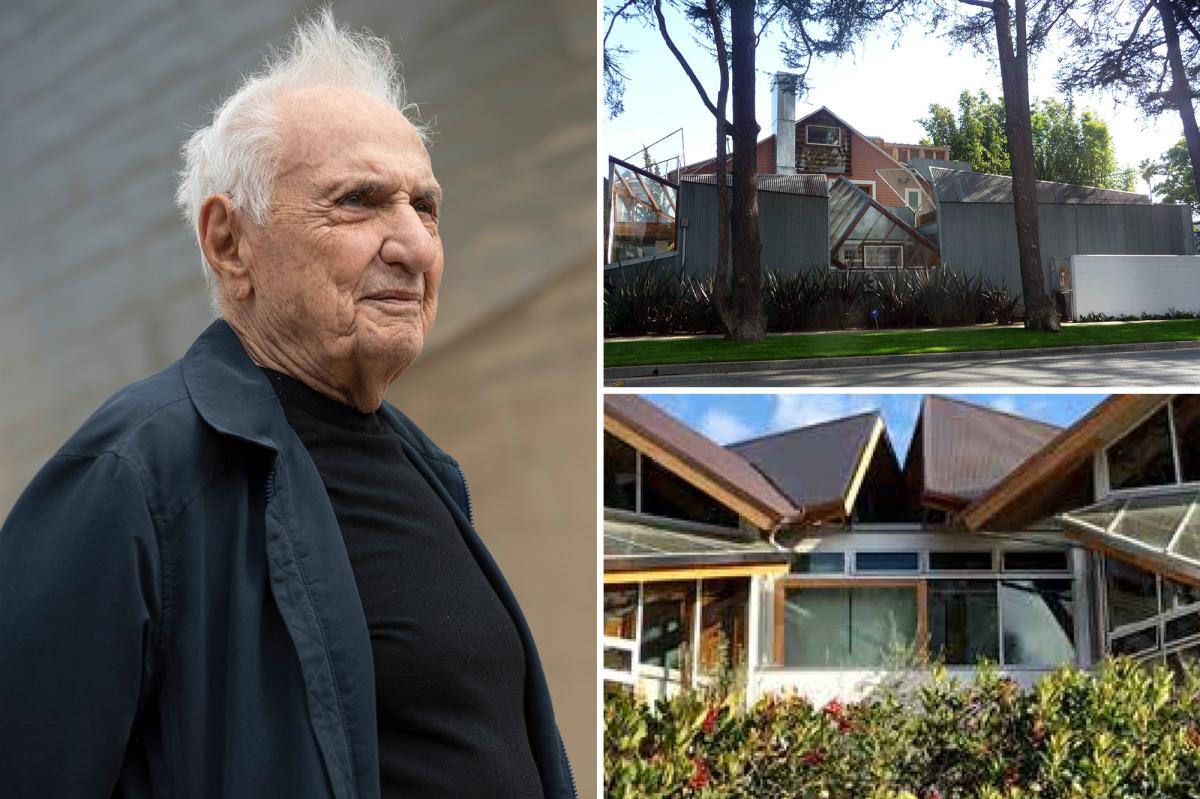
The late architect Frank Gehry was known for his ambitious, dynamic public buildings — but his little-known personal homes might have been his most daring projects.
Gehry passed away at his home in Santa Monica, California the age of 96 last week, following a brief respiratory illness. The Pritzker Prize-winning architect left behind a legacy of artful, flamboyant buildings that revolutionized modern architecture.
Before Gehry achieved international acclaim via the dazzling Guggenheim in Spain’s Basque Country, Disney Hall in Los Angeles or 8 Spruce St. in Manhattan, he took on a more humble project — a 1920s bungalow in Santa Monica where he resided.
Gehry’s first family home turned into a deconstructivist icon. AFP via Getty Images
The radically reformed property attracted the ire of neighbors, but the adoration of architecture fans. Los Angeles Conservancy
The famous home, recently profiled by the New York Times, is simply known as the Gehry Residence.
Gehry purchased the Dutch Colonial Revival in 1977 with his wife, Berta Gehry, for just $160,000 — some $846,000 today. He would later recall its unassuming pink facade to the Times, calling it a “sweet little house that everyone in the neighborhood liked.”
With just $50,000 ($264,500 today) — and a willingness to upset his suburban neighbors — Gehry turned the home an icon of deconstructivist architecture.
Paul Goldberger, the Pulitzer Prize-winning architectural critic and author of “Building Art: The Life and Work of Frank Gehry,” told The Post that the 1977 home actually brought Gehry to international attention.
“It was his laboratory for working out so many of his ideas — his interest in raw industrial materials like plywood, corrugated metal, and chain-link fencing, and his desire to use them to create a complex and pleasing emotional experience, the sort of thing you don’t associate normally with that stuff,” Goldberger said in an email.
Gehry with one of his sons, Alejandro, in the front yard of his Santa Monica home in 1980. Getty Images
Gehry experimented everyday materials like metal, plywood, chain-link fence and wood framing. Getty Images
The years-long project attracted global admirers — and neighbor complaints. Getty Images
Over the years, Gehry built a shell-like facade built around the original, unassuming home. The structure became increasingly complex, made up of materials that sparked Gehry’s interest, like chain-link fence and wood framing. Tilted glass cubes flooded the strange, indoor-outdoor environs with light.
“He wanted his design to surround and envelop the old house that he had bought, but not completely obliterate it, so that the new and old could be in dialogue with each other,” Goldberger said.
The final, striking effect was described by the Los Angeles Conservancy as “a sense of being perpetually under construction.”
The Gehry Residence was not everyone’s cup of tea, however. Gehry told the Times in 2021 that some of his neighbors were “really pissed off,” and one even attempted to sue him.
But no one can deny Gehry’s ambition.
Gehry built a new residence in Santa Monica at age 90, with the help of his son. AFP via Getty Images
The home on Adelaide Drive reflected the architect’s matured, but still artful style. Google
Douglas fir and high-end finishes took the place of plywood and chain-link fences. Ca.gov
Gehry’s nonconformist flair matured as his global star rose. His second Los Angeles home proved a testament to his decades of evolving experimentation.
At age 90, Gehry, with the help of his son and fellow architect, Samuel Gehry, built a new dream home on an idyllic plot overlooking Santa Monica Canyon and the Pacific Ocean.
The father-son-duo made use of the same unexpected angles, glass panes and sculptural qualities that so defined Gehry’s artistic style. Unlike 1977, Gehry enjoyed a much higher budget this time around — Douglas fir took the place of plywood.
For Gehry, the deeply personal project yielded a “once-in-a-lifetime” house, he told Architectural Digest in 2019.
Both properties are still held by the Gehry family.