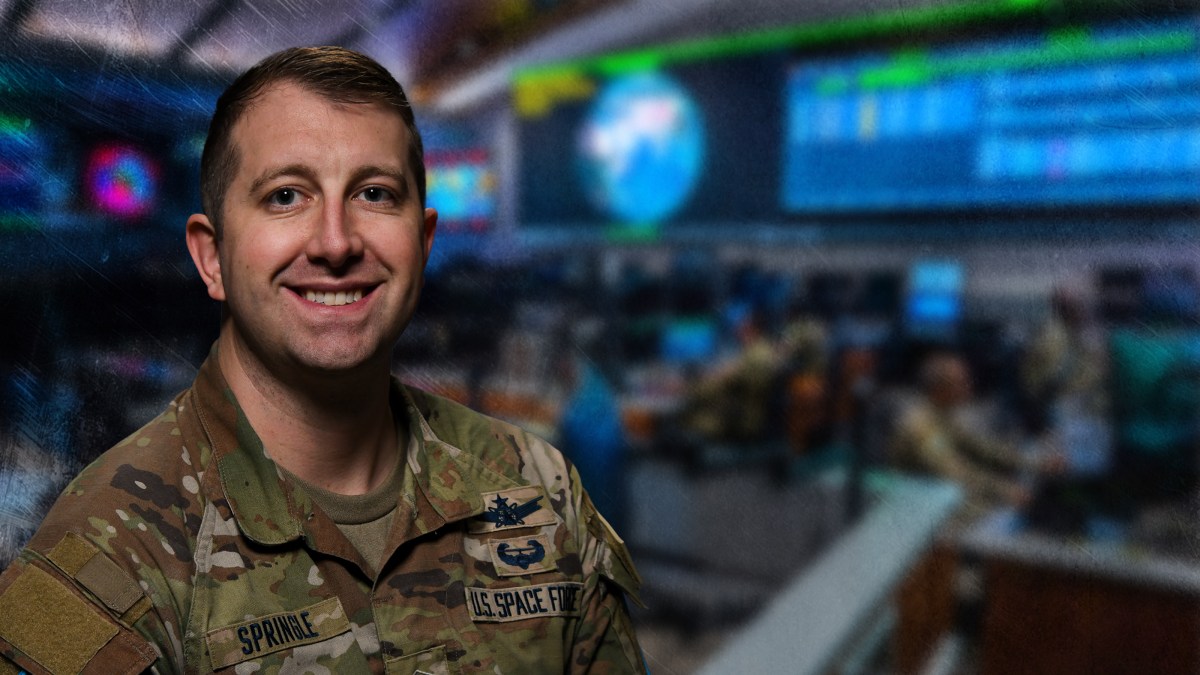
Space Force Tech Sgt. Garry Springle said he would not be alive were it not for a smartwatch that the service issued him for an ongoing fitness study it’s conducting.
Not long after starting the study, Springle noticed the smartwatch consistently told him he was falling short of the Space Force’s fitness standards. Specifically, the watch was saying he was not meeting his required intensity minutes — a measure of heartbeats during exercise.
In order to meet the intensity requirement, Springle needed to get his heart rate up to 70% of the maximum rate for his age. But no matter how hard he exercised, he couldn’t get his heart rate high enough. Other than that, he was not experiencing any physical symptoms that indicated what might be wrong.
“I always thought maybe something was wrong with the watch, but I kept at it, and I didn’t give up,” Springle said. “And come to find out, I had a heart problem, and it could have easily — very easily — taken me out.”
After Springle was advised to seek medical help, he learned he had an undiagnosed heart condition that would have killed him if it had not been detected.
Top Stories This Week
“The cardiologist and the electrophysiologist that I was being seen by and treated by, they both explained to me that if left untreated, my heart would have failed unexpectedly,” Springle told Task & Purpose. “I was not having any symptoms, so it was what I am calling a ‘silent killer.’ I didn’t know it was happening, but they explained to me that I’m very lucky that it was caught.”
Guardians like Springle were issued wearable devices as part of the Continuous Fitness Assessment, a voluntary study in which specific fitness benchmarks were constantly monitored. Initially, those guardians did not have to take fitness tests, but in October, the Space Force introduced a new PT test that everyone in that service is required to take.
As part of the study, guardians are required to exercise a certain amount each month, said Christine Heit, lead for the Space Force’s Holistic Health Approach, which includes the study.
Initially, the Space Force took some ribbing on social media for issuing expensive smart devices to its members and then promptly telling them they didn’t have to take a PT test. However, one of the study’s goals was to have guardians exercise routinely instead of waiting until shortly before a fitness test to start working out, Heit told Task & Purpose.
“There are some people who understand the benefit of working out regularly and do so because they find intrinsic value in it,” Heit said. “There are some who don’t. There are some who, a couple of weeks before their scheduled fitness test, they get off the couch, they start running, they choke out a physical fitness assessment, and then they’re sore for three weeks afterwards. We wanted to do away with that.”
Get Task & Purpose in your inbox
Sign up for Task & Purpose Today to get the latest in military news each morning.
Springle, who had spent more than seven years in the Army prior to joining the Space Force, said he found the notion of meeting the required fitness goals intriguing. But within weeks, it was clear he was facing a problem.
“I just felt like something was wrong,” he said. “Having to meet the intensity minute requirement each week, I was finding myself struggling with that, and I didn’t want to get prematurely kicked out of the program. So that’s when I started reaching out to as many people as I could, just to figure out what’s going on.”
Eventually, Springer brought his concerns to a Space Force physical fitness expert, who “noticed that my heart rate wasn’t increasing the way it should be” during a certain test and suggested that Springer see a doctor. He then went to his primary care manager and had an electrocardiogram test that records electrical signals in the heart, “and that’s when everything took off from there,” he said.
The formal name for the issue Springle was facing is premature ventricular contractions. In layman’s terms, his heart was literally skipping a beat.
“So, every other heartbeat that I was having was essentially a fake one, and my heart wasn’t actually beating,” Springle said. “So, my heart was only working about 50% of a normal person.”
It was a shocking revelation for Springle. At the time, he was working out five days a week and then hiking with his family on weekends. And yet, he had learned that he could have suffered heart failure at any moment because of his condition.
As for Springle, he said the whole ordeal — and the unexpected close call — taught him a valuable lesson: You have to be your own biggest advocate, and if you “notice something wrong,” he said, “don’t just brush it off.”
“Because you never know how something little can turn into something so big.”

Task & Purpose Video
Each week on Tuesdays and Fridays our team will bring you analysis of military tech, tactics, and doctrine.
Jeff Schogol is the senior Pentagon reporter for Task & Purpose. He has covered the military for nearly 20 years. Email him at schogol@taskandpurpose.com or direct message @JSchogol73030 on Twitter.