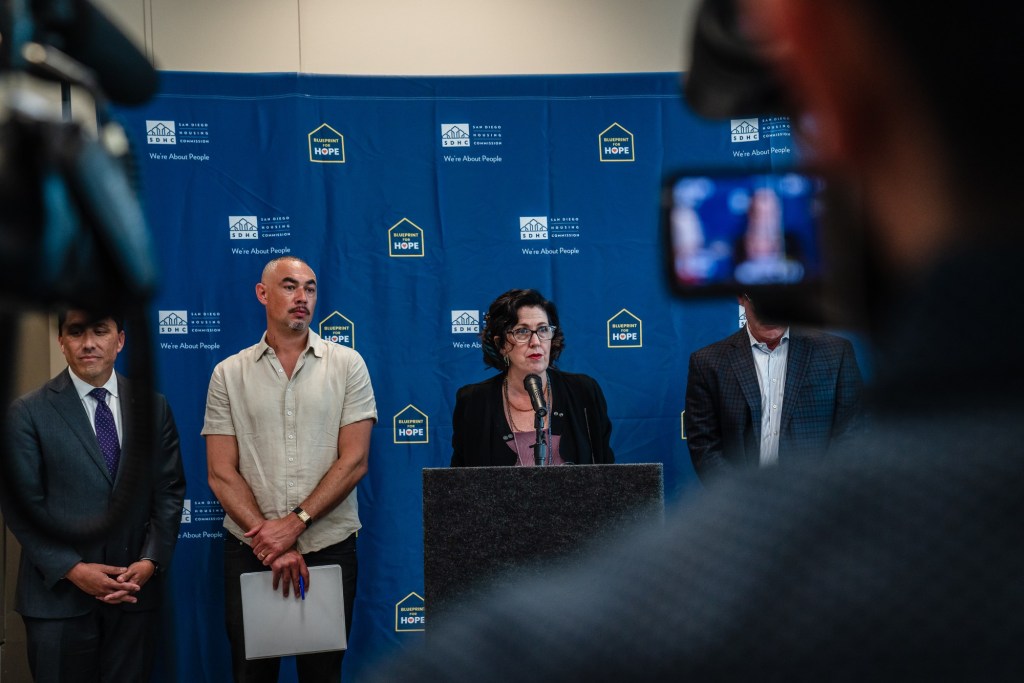
Thousands of low-income San Diegans will likely have to pay more in rent starting late next year after a vote this week by leaders of the city’s housing commission.
The move affects approximately 14,500 households that rely on federally funded housing choice vouchers, which are often known as Section 8 vouchers. In certain cases, residents who’ve been directing 24% of their income toward rent will be required to contribute 40%.
Local officials say the shift is the only way to offset a budget shortfall that might otherwise force some families out of the program completely.
“It’s gonna create some pain for some people,” San Diego Housing Commission board member Antoine Jackson said Thursday during a public meeting. “But the pain that we would create from more people getting kicked off the program …” He paused, then added, “It’s the most equitable solution for everybody.”
The vote was unanimous.
The changes must still be approved by the federal government, and San Diego leaders expect the U.S. Department of Housing and Urban Development to sign off on the measure by March. Higher rent payments would then take effect six to nine months later, meaning residents might see their bills go up around November 2026.
“I think it’s a fair solution,” Commissioner Stephen Cushman said from the dais.
The federal government has long failed to fully fund the vouchers, especially as inflation drives up the cost of housing. At the moment, San Diego’s program has a $26.6 million budget hole that’s being plugged with the commission’s reserves. Yet those reserves are expected to run dry by 2027, and federal leaders don’t seem eager to increase spending.
Unless the commission brings in more money from program participants, officials have said around 1,700 households — which amounts to about 6,000 people, including children — would lose all of their rental aid. That in turn could raise the risk that they face eviction and homelessness.
The voucher program overall is projected to cost more than $309 million in fiscal 2026.
The new amount a family might owe is affected by several factors, including the number of able-bodied adults in the home and how much money they’re making.
Some low-income households effectively pay a flat fee. When there’s one adult who can work, the proposal bumps their monthly payment from $400 to $580. Two able-bodied adults would move from $650 to $1,155. The plan also creates a category of households with three or more working adults that comes with a price tag worth $1,735.
Disabled and elderly residents currently sending 28.5% of their income toward rent are to instead give 32%.
Those paying nothing would likely continue to get free housing. Participants in the Veterans Affairs Supportive Housing program, or VASH, are exempted.
The public reaction to this shift has so far been muted.
No voucher recipients attended Thursday’s meeting to weigh in on the changes, and only a handful showed up to a public hearing in November. Commission staffers said they received 33 written messages during a recent public comment period, and many of those were simply queries about how specific families might be affected.
Two people receiving rental aid previously told The San Diego Union-Tribune that paying more would not be an insurmountable hurdle. Households facing certain hardships should additionally be able to ask that their rent increases be delayed.
Leaders partially attributed the lack of outcry to the outreach they’ve done to residents and community groups. The agency has sent out letters and emails about the potential changes and met with dozens of local organizations that work with area families, among other efforts.
The only member of the public to speak Thursday was a staffer from the San Diego Housing Federation, which advocates for affordable homes. Danté Golden thanked commission leaders for their work on the rent proposal and pledged to continue cooperating with the agency.
Officials have also promised to issue more notifications if the payment increases get federal approval.
“This is just the beginning,” said Lisa Jones, the commission’s president and CEO. “The more time folks have to transition,” the “more successful this is going to be.”