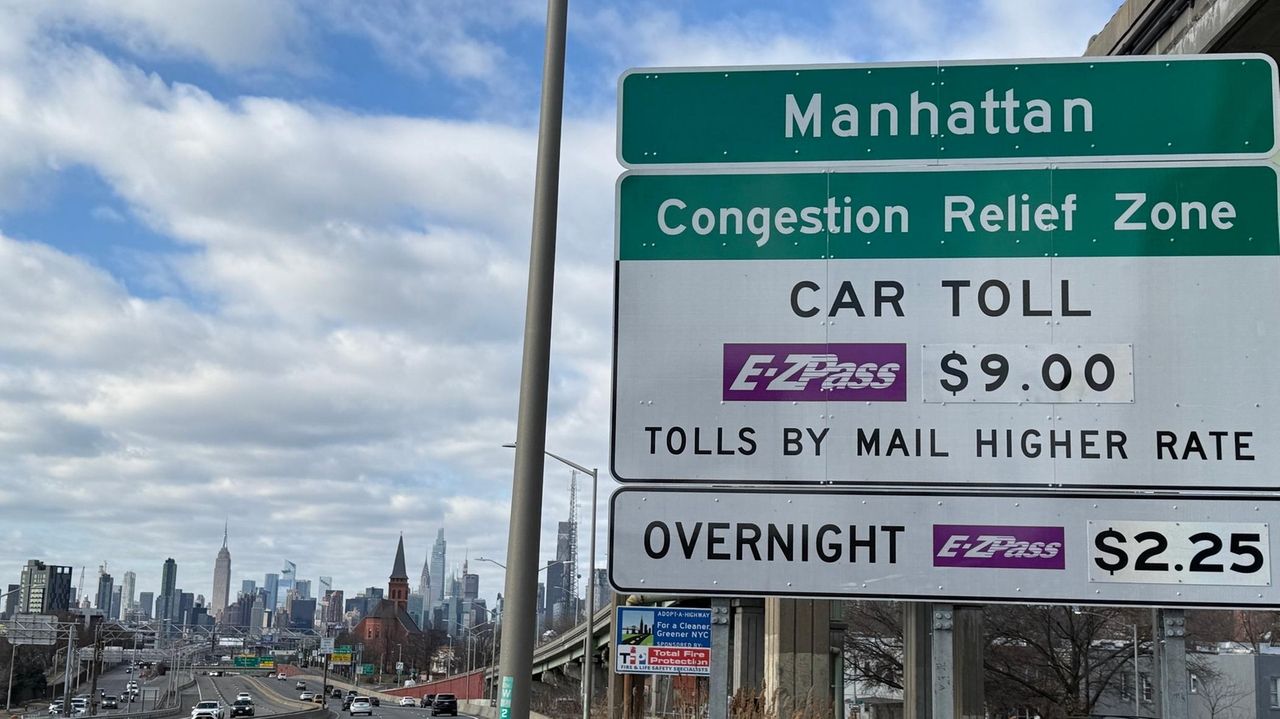
Particle pollution in New York City decreased significantly since congestion pricing tolls went into effect in January and had a “spillover” benefit to Long Island, researchers at Cornell University found — a result that proponents cited as a significant success for the program.
The effects were found not just within the congestion zone below 60th Street, but in all five boroughs and, to a lesser extent, the surrounding metropolitan region.
Timothy Fraser, the lead author of the study, told Newsday in an email that particle pollution on Long Island declined by nearly 10% as drivers changed their routes or took public transportation. That improvement in air quality was almost exactly the same as in the outer boroughs.
“This indicates that Long Island is also seeing some spillover air quality improvements from congestion pricing, which is very good news,” Fraser said.
WHAT NEWSDAY FOUND
-
Researchers from Cornell University found that after congestion pricing tolling started, particle pollution decreased by 22% below 60th Street in Manhattan and 10% on Long Island.
-
PM2.5 also declined in the outer boroughs and even in the surrounding metropolitan area.
- Contrary to expectations, the tolls have not diverted car and truck traffic, and their emissions, to the outer boroughs.
New York City was the first in the United States to introduce tolls to reduce gridlock and air pollution and raise funds for its public transportation agency, a strategy that has been implemented in London, Milan, Stockholm and Singapore. The rules went into effect in January after decades of study and in spite of vigorous opposition from officials in suburban New Jersey and Long Island. Opponents have argued that the toll — $9 for most vehicles driving in the zone during peak hours — would add an additional expense for a region struggling with its high cost of living.
Congestion pricing has faced opposition from the Trump administration’s Department of Transportation and Secretary Sean Duffy has described the program as “a slap in the face to working class Americans and small business owners.” The department rescinded federal approval for it earlier this year, but a federal judge in June imposed a preliminary injunction keeping the program alive, Newsday has reported.
At least 12 lawsuits have been filed seeking to end the program.
Long Islanders interviewed at the Huntington Long Island Rail Road station on Thursday had mixed feelings about congestion pricing. When Mary Delli Carpini recently drove from Huntington into the city to bring a coat to be repaired in the fur district, the business compensated her for the congestion pricing charge.
“I had to pay it originally, and then they reimbursed me,” Delli Carpini, 79, said at the Huntington train station. “I worry [congestion pricing] could be hard on businesses.”
Steve Blachly, 69, of Dix Hills, and his friend David Gordon, 70, of Huntington, waiting to catch a train to the Islanders game, agreed that any environmental benefits due to the program would be positive. While Gordon noted that the argument the program will generate money for repairs “is clear,” he questioned how much less congestion there is since it was implemented.
“That’s obvious, if you have less cars you have less pollution,” Gordon said. “But is the congestion any less since they did it?”
Gov. Kathy Hochul said at a press event Thursday that the program has been “wildly successful.” Since the program began, 20 million fewer cars have entered the zone, Hochul said. For those who do drive, she added, “coming from Long Island and the Hudson Valley, your ride is faster.”
Air quality monitors
The researchers, who are in the systems engineering program and the School of Civil and Environmental Engineering at Cornell, wanted to know if levels of fine particulate matter (or PM2.5) would fall as drivers avoided the tolled zone.
PM2.5 — so called because the particles measure 2.5 micrometers or less, 30 times smaller than a human hair — are so tiny that they can pass through the lungs and into the bloodstream, where they can migrate throughout the body. Long-term exposure is linked to many diseases, from lung cancer to Alzheimer’s disease, according to the World Health Organization.
The researchers collected data from six air quality monitors in the congestion relief zone, 23 more in upper Manhattan and the outer boroughs, and 13 north of the city, in New Jersey and on Long Island.
Their results, published Monday in the journal Nature, found that within the congestion relief zone, average daily maximum PM2.5 levels declined by just over 3 micrograms per cubic meter from January to June 2024 — a reduction of 22%. The figures are based on models of where levels would be without a toll policy.
The effects in the outer boroughs and the wider metropolitan area were “more modest” but still statistically significant, the authors wrote. On Long Island, there was a reduction of 9.9%, Fraser said.
The improvements outside Manhattan were a surprise. Environmental impact studies suggested that the tolls would divert traffic, particularly trucks, from Manhattan to surrounding areas, especially the South Bronx, where neighborhoods were already burdened by heavy truck traffic, industrial facilities and poor air quality.
Kevin Garcia, senior transportation planner at NYC Environmental Justice Alliance, recalled he was dismayed by those projections.
As it turned out, that expected increase in traffic hasn’t happened. There are now fewer cars driving on the roads across the city, not just into lower Manhattan. A study by the Regional Plan Association found drivers spent 25% less time crawling through Manhattan streets after the tolling began and 9% less time in traffic jams in the outer boroughs and parts of New Jersey.
The tolls are expected to raise $500 million by the end of the year for the Metropolitan Transportation Authority — 10% of which will be directed to infrastructure improvements for the LIRR.
The authors of the Cornell study said their results show that congestion pricing can be “a rare intervention” that promotes several goals together, both ecological and economic: reducing pollution, reducing gridlock and generating funds for public transportation improvements.
“As other American cities consider similar policies,” authors wrote, “our findings demonstrate that cordon pricing can deliver rapid, geographically broad environmental benefits.”
Newsday’s Nicholas Grasso contributed to this story.