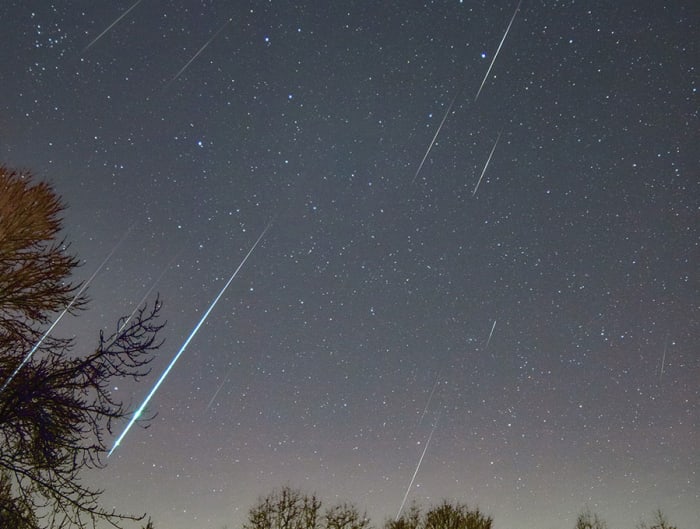
The Geminid meteor shower reaches its peak this weekend, from late Saturday night into early Sunday morning (Dec. 13–14). Under dark, clear, rural skies, you could see more than 100 meteors an hour.
The best viewing window is around 2 a.m. Central, but the good news is the Geminids stay near peak for 10–12 hours. That gives you plenty of flexibility to pick a time that works for you.
The moon won’t cause much trouble, either. It rises after midnight as a slim 26% crescent, nearly ideal conditions for meteor watching.
Here in southeast Texas, the only problem, and it will be a big one, will be cloud cover.
The radiant is from the constellation Gemini
How the Geminids got their name:
The Geminids are named after the constellation Gemini. If you trace the paths of the “shooting stars,” they all seem to originate from that part of the sky. That point is called the radiant.
What makes this year especially good for viewing is the timing: Gemini rises around 7 p.m., which means you could start spotting meteors as early as 9 p.m. Saturday. And because the Geminids have a broad maximum, many of the meteors tend to be bright and vividly colored.
What makes the Geminids unique:
Unlike most meteor showers, the Geminids don’t come from a comet. Their source is an asteroid, ‘3200 Phaethon.’ Instead of shedding dust, Phaethon releases tiny bits of rock. Rock survives the plunge through Earth’s atmosphere longer than dust does, which is why Geminid meteors often produce long, dramatic streaks.
Phaethon itself is about three miles wide and zips around the Sun every 1.4 years, traveling closer to our star than any other named asteroid. Each time it swings by the Sun, its surface heats up to about 1,300°F, causing fragments of rock to break loose. Earth plows through that “river of rubble” every December, giving us one of the best meteor displays of the year.
The proximity to the sun is what creates the showers we see (Sky & Telescope)
These rock particles travel 22 miles per second (79,000 mph). Every time one of them slams into our planet’s upper atmosphere, 60 miles high, air friction vaporizes it in a quick, white-hot streak!
Photo by Sergio Garcia Rill in Sedona Arizona
sgarciarill.com (Sergio Garcia Rill)
It’s actually not accurate to call them “shooting stars.” Geminid meteors are tiny fragments, roughly the size, shape, and color of Grape-Nuts cereal. As they slam into Earth’s atmosphere at incredible speeds, they compress and heat the air in front of them. Just like water piling up in front of a speeding boat, the air forms a white-hot shock wave along the particle’s path.
The flash of light our eyes see is that brief but brilliant shock wave, not the particle itself burning up. And none of these particles ever reach the ground; they vaporize long before they get anywhere close.
They are similar in size, color and texture to Grape Nuts cereal (Anthony Yanez)
How to watch:
You don’t need any special equipment to see the Geminids. Just head outside, find a wide-open view, and look toward the darkest part of the sky, usually straight up. A blanket or reclining lawn chair makes the experience a lot more comfortable, and be sure to give your eyes at least 20 minutes to fully adjust to the darkness.
Keep in mind that any outdoor light, porch lights, streetlights, or even the glow from your phone will make it harder to spot meteors. And that leads to our built-in challenge here in Houston. Even with perfectly clear skies, light pollution inside the Beltway can wash out all but the brightest streaks. If you can get to a darker spot, you’ll see a lot more.
The problem with seeing meteors in the city of Houston. Light pollution (Copyright 2025 by KPRC Click2Houston – All rights reserved.)The forecast:
Unfortunate timing for southeast Texas. A cold front moves through Houston early Sunday morning. Before the cold front arrives, skies will get cloudy and there may even be rain. We are the only part of Texas with clouds forecasted. The Geminids can be seen on Friday and Sunday night, but the peak is Saturday night.
A front brings a chance of rain and lots of clouds (Copyright 2025 by KPRC Click2Houston – All rights reserved.)
If you miss this one. The next major meteor shower is the Quadrantids, peaking Jan 2-3.
If you get any great pictures, we’d love to see them. Go to our Click2Pins App or tag me on Facebook, Instagram or X at: @KPRC2anthony.
Copyright 2025 by KPRC Click2Houston – All rights reserved.