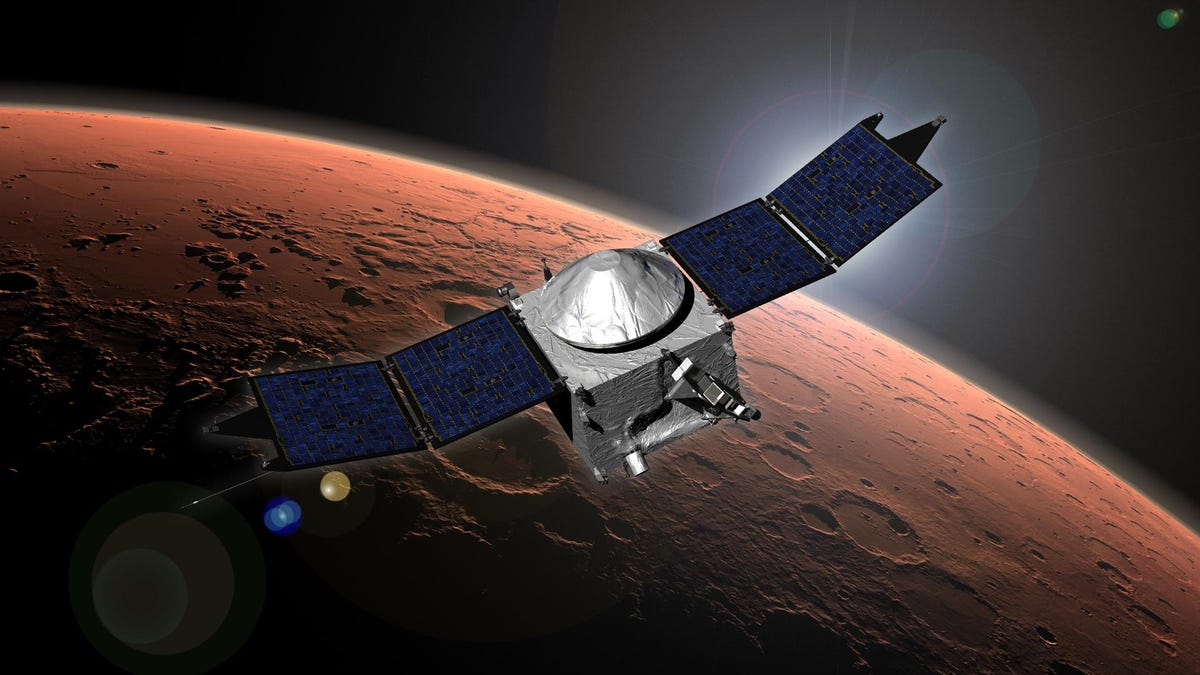
Here’s what to know about MAVEN, and how NASA lost a signal with the Mars orbiter
NASA has lost contact with its MAVEN spacecraft that has been orbiting Mars for more than a decade.
The orbiter, one of three zooming around Mars’ atmosphere, had been working as expected before it suddenly ceased communications with ground stations earlier in December, NASA said. The U.S. space agency added that it is working to determine what caused the issue and restore communications.
While MAVEN has spent years studying Mars’ upper atmosphere, it’s also made other discoveries during its missions and even caught a glimpse of the now-famous 3I/ATLAS interstellar comet.
Here’s what to know about MAVEN, and how NASA lost a signal with the spacecraft.
What is NASA’s MAVEN mission? What does it stand for?
For more than a decade, NASA’s MAVEN spacecraft has been orbiting Mars studying its atmosphere.
The 11-foot-tall orbiter – whose name is an acronym short for the Mars Atmosphere and Volatile EvolutioN – reached Mars’ orbit in September 2014 after launching in November 2013 from Florida. MAVEN’s purpose has been to gather data on the lost gases to space from Mars’ upper atmosphere, which have in turn lent insight into the history of the red planet’s climate, water and potential habitability, according to NASA.
MAVEN is one of three active orbiters around Mars, including the Mars Reconnaissance Orbiter launched in 2005 and the Mars Odyssey launched in 2001.
How long will the MAVEN mission last? NASA loses contact with Mars orbiter
While the mission remains ongoing more than 11 years later, NASA recently lost contact with MAVEN as the spacecraft passed behind Mars from Earth’s vantage.
The anomaly occurred Dec. 6 when ground teams on Earth “experienced a loss of signal” with the spacecraft, NASA said in a Dec. 9 blog post.
Telemetry data had showed all of MAVEN’s subsystems were working normally before the spacecraft orbited behind Mars. But when the orbiter later emerged again, NASA’s array of giant radio network antennas known as the Deep Space Network that communicates with MAVEN did not observe a signal.
“The spacecraft and operations teams are investigating the anomaly to address the situation,” NASA said in the post. “More information will be shared once it becomes available.”
MAVEN among spacecraft to image 3I/ATLAS interstellar comet
MAVEN was among NASA’s fleet of space instruments that have had a chance to glimpse the interstellar 3I/ATLAS comet since the strange object was first spotted in July in Earth’s solar system.
While the Mars Reconnaissance Orbiter captured one of the closest images of 3I/ATLAS, MAVEN obtained ultraviolet images that NASA said should help scientists understand the comet’s make-up. The Perseverance rover on Mars’ surface also snapped a faint photo of the interstellar comet.
The comet, just the third object ever discovered in our cosmic neighborhood originating from another star, is expected to make its closest approach to Earth in December. On Friday, Dec. 19, 3I/ATLAS will pass within about 170 million miles of our planet on Dec. 19 – or about twice the distance between Earth and the sun.
Eric Lagatta is the Space Connect reporter for the USA TODAY Network. Reach him at elagatta@gannett.com