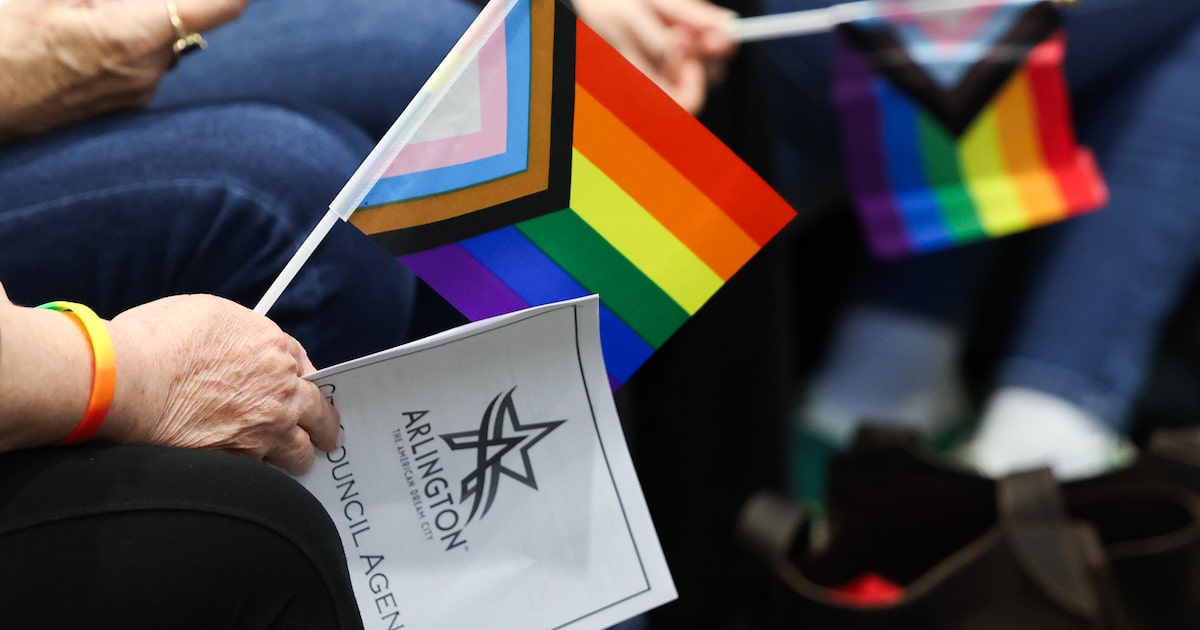
Organizers of Arlington Pride announced Friday they will cancel next year’s event after the City Council rejected a plan to ban discrimination against gay and transgender residents.
The head of the HELP Center for LGBT Health and Wellness said in a statement the organization would not invite visitors to a city that does not offer “the most basic protections.”
“Pride is about safety, celebration, and community,” said DeeJay Johannessen, CEO of the HELP Center, which has offices in Arlington and Fort Worth. “Without local anti-discrimination safeguards, we cannot guarantee those values for our attendees, performers, or partners.”
Arlington Pride began in 2021 and quickly grew to one of the largest celebrations of its kind in North Texas, drawing more than 15,000 people to downtown in June this year. The all-day festival featured performances by RuPaul’s Drag Race queens, live music, an art show and local food vendors.
Breaking News
The decision to suspend the event comes only three days after City Council members scrapped a plan to enshrine protections for LGBTQ residents into a city ordinance. The 5-4 vote followed months of debate, delayed votes and impassioned pleas from the LGBTQ community and allies to restore protections.
Initially passed unanimously in 2021, the ordinance prohibited discrimination based on sexual orientation and gender identity for housing, employment and public services. Discrimination against race, religion, national origin, sex and disability was also banned.
In September, the City Council temporarily suspended the ordinance over fears that Arlington risked losing more than $60 million in federal funding after President Donald Trump pledged to withhold money from cities with diversity, equity and inclusion, or DEI, programs. The president’s order has sown widespread confusion among cities that are unsure what qualifies as DEI.
For now, this means Arlington is no longer investigating complaints from people who say they faced discrimination by a landlord, business owner or employer. The vote makes Arlington one of the first cities in the country, if not the first, to repeal a nondiscrimination ordinance over fears of clashing with the Trump administration.
Some Arlington council members said they did not think the city could enforce its anti-discrimination ordinance. Council member Rebecca Boxall, who voted against restoring the ordinance, called it “bad policy.”
“From the very beginning, it was unenforceable at the city level,” said Boxall, who represents downtown Arlington. “The way I looked at it, and a lot of you mentioned protections, it does not offer protection. So in that respect, it’s just misleading. It’s just plain misleading.”
Federal law protects Americans from being discriminated against in public places based on disability, race, color, religion or national origin, but does not explicitly provide protections based on sexual orientation or gender identity.
More than 20 states and nearly 400 cities across the country have policies banning discrimination based on sexual orientation and gender identity, according to the Movement Advancement Project, a nonprofit research organization that tracks legislation related to LGBTQ issues. Texas has no such policy. Dallas, Fort Worth and Plano include LGBTQ residents in their anti-discrimination ordinances.
Mayor Jim Ross, who voted to restore protections, pledged to continue working on the issue and said the council will revisit the ordinance in coming weeks.
“Arlington is one of the most welcoming places,” Ross said. “We want everyone to know they can feel safe and comfortable here.”
On social media, responses to the cancellation of the 2026 Pride festival were mixed. Some said they did not want to spend time or money in a community that did not protect them, but others said this should drive an even larger event. Pride began in 1970 in a handful of U.S. cities to commemorate the one-year anniversary of the police raids on the Stonewall Inn in New York.
“Don’t you think now more than ever,” one person asked on Instagram, “we should host a louder, more exuberant pride?”