[MUSIC PLAYING] FLORA LICHTMAN: Hey. I’m Flora Lichtman, and you’re listening to Science Friday.
[MUSIC PLAYING]
That sound of a choir performing in a cathedral is iconic for a reason. It’s a beautiful human experience being side by side with other people, feeling the sound vibrate through you, reverberating around the space. But how long has that been a part of human culture? And when we look back at ancient humans during the ice and Stone Age times, what role did sound play in their lives? That’s the focus of a growing field of archeology called archaeoacoustics, where researchers use the scientific tools of today to investigate the role of sound and music in the past.
Joining us now to talk about it are my guests, Dr. Margarita Díaz-Andreu, professor at the University of Barcelona, Spain and principal investigator of the Art Soundscapes Project, and Dr. Rupert Till, professor of music and head of the Department of Humanities at the University of Huddersfield in the UK. I want to welcome you both to Science Friday.
RUPERT TILL: Hi.
MARGARITA DÍAZ-ANDREU: Hello.
FLORA LICHTMAN: Margarita, you’re an archeologist. You study rock art. How does sound come into it?
MARGARITA DÍAZ-ANDREU: Yes, I am an archeologist. And archeologists usually don’t deal with sound. I came to it through an interest in the material. I had been studying color in the landscape and the location of sites. I had also been looking at other issues that usually archeologists don’t pay much attention to.
FLORA LICHTMAN: Like what? Give me an example.
MARGARITA DÍAZ-ANDREU: Like things that are disregarded. Archeologists usually look at typologies, the form of objects, and chronology. And I wanted to go a bit beyond that, so more the human aspect of archeology and the emotional aspect of archeology. There are other archeologists who are dealing with issues with taste and also touch. But in my case, I started with color. And then I moved into sound.
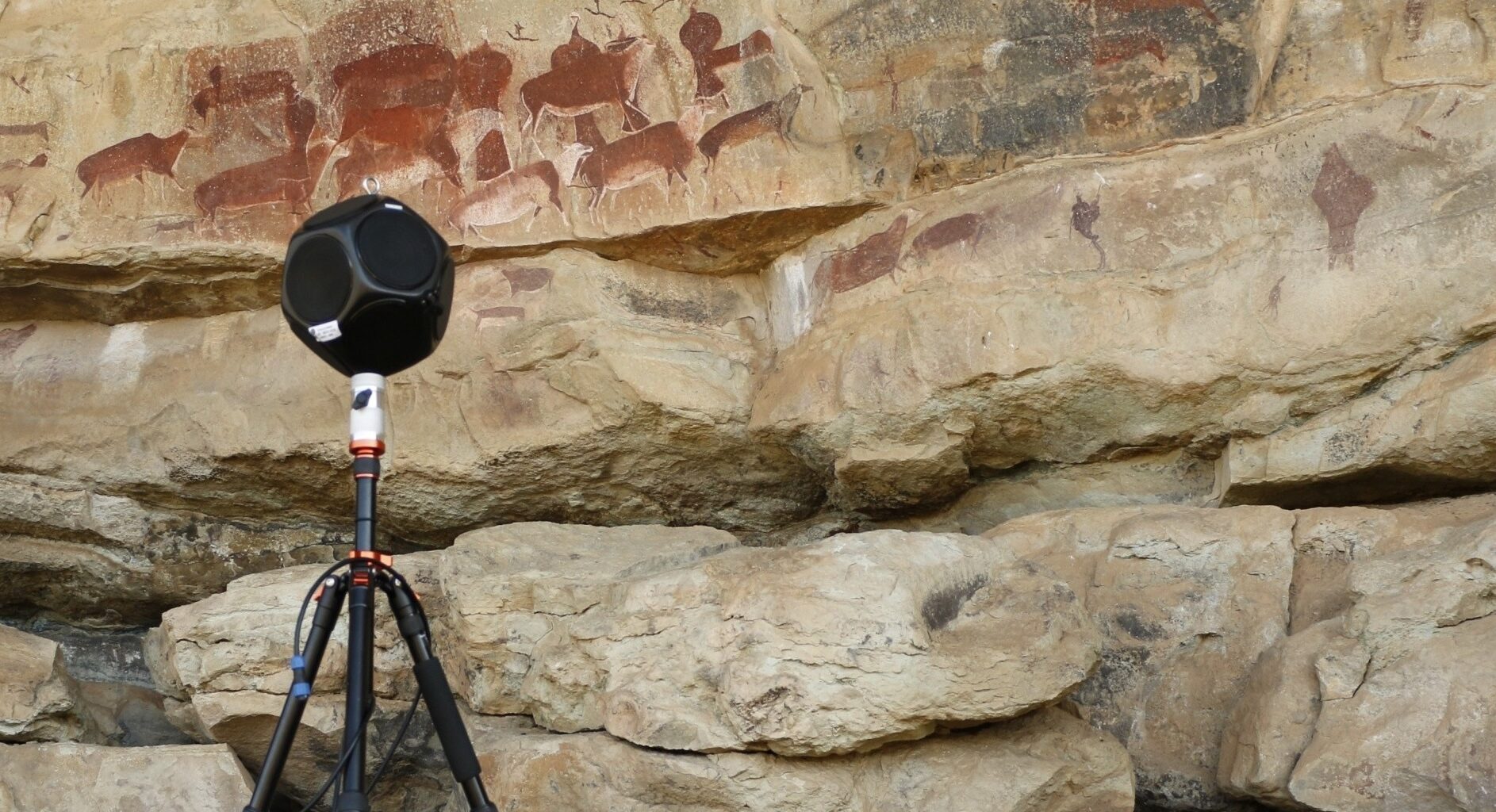
And I just entered this field by chance. I heard someone who was giving a talk about this. It was Steve Haller. And I thought, I’m going to try. And I was completely skeptical about the possibility of finding positive results. And I was so surprised when I then looked at how rock art sites in that particular landscape coincided with areas with higher reverberation in the valley in which I was analyzing.
FLORA LICHTMAN: OK, so you were skeptical that acoustics could play any role in this visual art. And then you looked and studied these sites and found that they have special acoustic properties.
MARGARITA DÍAZ-ANDREU: Yes, exactly.
FLORA LICHTMAN: I want to get into that a little bit more deeply. But first, Rupert, you’re a musicologist and a musician. How did you get involved in archeology?
RUPERT TILL: Well, also kind of by accident, I stumbled into it. I had some very close friends who are archeologists. I moved into a house next to archeologists. And they’re a very sociable bunch. One of them ended up as my lodger. And he was working at Stonehenge on this incredible 10-year dig. And I guess, I realized– because I’d studied acoustics at university. I realized that there was more to the story than they realized.
FLORA LICHTMAN: Careful, because Marg is on the line here.
RUPERT TILL: Well, she said the same thing, that it was a field that had some very spurious research in it and that had as many people from the mind, body, spirit, crystal healing kind of world interested in it, that there was lots to be skeptical about. But I realized that sound, and music, and acoustics could offer more to help fill in a little piece of the jigsaw for archeologists.
FLORA LICHTMAN: That it could be tested, that science could be applied to these questions, it sounds like you realized.
RUPERT TILL: Well, I think most of my archeologists friends spent time looking at a ditch, or a wall, or as an individual stone. And they had a very good understanding of the materials of what were there, whereas music, it animates things. It’s a time-based medium, so it helps in giving you an idea of what it might have felt like to be in a space by having a better understanding of what the acoustics are like and what music or sound was like in this space.
FLORA LICHTMAN: Hmm. Margarita, so how do you do this work? How do you test this hypothesis that acoustics were important in the ancient world? And Rupert, I want to hear from you too on this.
MARGARITA DÍAZ-ANDREU: Yeah. So the way is testing rock art sites and testing places without rock art. So what we want to see is a pattern and looking at different acoustic properties. So throughout the years, we started working with sound engineers. So you can look at reverberation. You can also check whether there are echoes or not. And very important also, speech clarity and music clarity and by comparing rock art sites with sites without rock art, places where that have been especially special for people.
So the question was, is this related to a special acoustics of some sort? And the answer has been varied. There are no universal laws in the type of acoustics that people were searching in these fantastic rock art sites. In some cases, we have found that there was a bit of reverberation, and some others, speech clarity in some other echoes. So it depends. Every culture has been used in a different way of relating to acoustics. And in some other places, we haven’t obtained a positive result.
FLORA LICHTMAN: Rupert, let’s get into a specific example. Tell me about this vulture bone flute and who used it and where it was found.
RUPERT TILL: Yes, so the oldest musical instrument that we’re certain about that has been discovered by archeologists is in caves in Spain and France. So there’s a very ancient one in Hollenfels Cave in Germany, which is 43,000 years old.
FLORA LICHTMAN: 43,000 years old.
RUPERT TILL: Yeah. So around that time, there’s a kind of explosion of creative activity, people in Europe burying people for the first time, and art objects being found, little carvings and paintings appearing on walls, and also, flutes, musical instruments. They’re really a pipe. It’s more like a shakuhachi from Japan or a ney from Egypt or turkey. It’s like a tube of bone. And one of the biggest bones in Europe at the time was that of a vulture bone. If you’ve ever seen The Jungle Book and you’ve seen the vultures, they’re like that with a big hooked nose, these huge birds.
FLORA LICHTMAN: We covered them on the show recently because an ancient sandal was found in one of old nests in Spain. Keep going.
RUPERT TILL: They’re very important creatures. I mean, they’re found in the oldest cities, painted on walls. And you go to [INAUDIBLE] in the far East. And they’re used to defleshed bodies and take the bodies off to the mountains. And they’re quite significant figures in human culture over the years. But they’re big enough, that if you get hold of their wing– because they’re birds, their bones are hollow. Their wing bones are hollow, so they can fly.
So if you cut the two ends off, you’re left with a tube of wood. And if you make little holes along it, you’ve got basically a fairly simple pipe that you can play amazing music on. And so these were found about 43,000 years ago in Germany. And then 25,000 to 30,000 years ago, they were also found in France in a beautiful cave called Isturitz. And the same bones are being used to make these amazing instruments.
FLORA LICHTMAN: Before you go on, because there’s more to this story, we have a little clip of just the flute being played. Maybe you can tell us if it’s in a lab or where it is, but let’s hear it.
[MUSIC PLAYING]
RUPERT TILL: The first time I heard these things, it was an archeologist who wasn’t a musician, wasn’t trained as a musician. They were playing it like a 12-year-old recorder player at school quite simply because it’s not easy. They’re quite difficult to play. And it was in a lecture hall or classroom, so it was that acoustic. And that’s the recording. That recording is played by an archeologist who will remain anonymous, who’s a reasonable player.
But I kind of thought, well, I want to hear what this sounds like if it’s played in the cave it was made in and by a brilliant flute player. I mean, the one you’re hearing has been made from an actual vulture bone. You have to get permission, ecological permission, because they’re a protected species. You have to get one from a zoo or something. It’s an archeologically rigorous replica of the original.
But I managed to work with Anna Friedrich Potergosky, who’s used to be in the Berliner Ensemble who’s a German flute player who became fascinated with these instruments. And she just had a different level of facility on the instrument. So we went to France with Isturitz flute and played the flute in the Isturitz Cave, where these things were made for about 10,000 years. And they found 30 of them. I mean, imagine a tradition of making a musical instrument in the same place for 10,000 years. I mean, it’s pretty unique.
FLORA LICHTMAN: Amazing. OK, we have a recording of this flute being played in the cave where it was found. Let’s hear it.
[MUSIC PLAYING]
RUPERT TILL: It’s just a completely different experience when you hear the reverberation. The sound seems to fly away more like a bird.
FLORA LICHTMAN: Were you there for that recording? Did you make that recording?
RUPERT TILL: I made the recording. And we captured– in much the way Margarita describes it, we captured the acoustic. We used a swept sine wave, which stimulates all the frequencies in the cave. And we captured the acoustic as well. But yeah, I was there with five microphones, capturing it in 5.1 surround, so that I could then let people hear this amazing sound because most people don’t get to hear it.
[MUSIC PLAYING]
I think it’s like reaching back in time. A lot of the context is where we look at these instruments, they’re kind of ritual contacts in places of great meaning because we know that caves were associated with otherly experiences.
FLORA LICHTMAN: Rupert, how often would people 20,000 years ago even hear reverberations like this? How common of an experience would that be?
RUPERT TILL: I mean, nowadays, you go to the bathroom, you get some reverberation. You get some echo. You go to a church or a concert hall. We’re just used to it. There were no bathrooms in prehistory. There were no concert halls. There were no buildings. There’s nowhere you can hear reverberation like that, except perhaps, in caves. I mean, in Margarita’s work, you hear the echoes, which is another– echoes of another thing altogether from the top of mountains. And there are also special places. So these caves were pretty special, magical places where people went into and interacted with the acoustic present.
[MUSIC PLAYING]
FLORA LICHTMAN: OK, we have to take a quick break. But don’t go away because we have more ancient soundscapes to explore. We have front row seats to a concert in an ancient tomb in Malta. I promise, you will want to hear it.
[MUSIC PLAYING]
I work in audio, so I care about acoustics. But I think in general, most people don’t think too hard about acoustics. Or at least, I think this every time I’m in a noisy restaurant, where I’m like, just throw something on the ceiling. What draws you both to this particular corner of the sensory world?
MARGARITA DÍAZ-ANDREU: I think that we usually think about the past. And of course, archeologists have been doing this. They think about the past in a silent way. And no, the past was full of sounds, sounds that were nice to hear and sounds that were not. So I think that what we are trying to do here is to make the past more human, to give it more of a human layer that archeologists had not taken into account.
RUPERT TILL: For me, I’m wanting to reach back into the past and try and recreate artistically what it might have sounded like and what the experience of being in some of these spaces may have been like. And now we’re using VR and computer game technology to try and do that. If we can reach back, reconstruct what the sound environments of the past was like and if there is something in that resonates with us that’s similar to our sonic cultures today, then that suggests that’s a cultural element of humanity that’s lasted for tens of thousands of years. And I think that speaks into what it means fundamentally to be human.
FLORA LICHTMAN: Let’s wrap up with this recording you have, Rupert, from a tomb in Malta. Just give us a little bit of the story about where it’s from.
RUPERT TILL: Actually, I think Margarita and I were both in this space. It’s a rock cut tomb, which was carved into the ground by hand with antler picks. But it’s huge. It’s 30 meters across with two levels. And it was full of bones. It was a place people left their ancestors when they died. But it has a 30-second reverberation time. Acoustically, it’s astonishing. And this is Iegor Reznikov, one of the first people to do research in acoustics and archeology playing this tomb as if it’s an instrument, identifying the resonances and then singing into them.
FLORA LICHTMAN: Let’s hear it.
[MUSIC PLAYING]
MARGARITA DÍAZ-ANDREU: Fantastic, isn’t it?
FLORA LICHTMAN: It is fantastic. What would people be doing in that tomb? What sounds might they be making?
MARGARITA DÍAZ-ANDREU: I guess, that in the same way that Iegor was using lower pitches to create this type of reverberation, this a sound that makes us feel calm and make us feel sort in connection with the other world.
RUPERT TILL: Yeah. I mean, as I understand it, this space was full of bones. And they weren’t all kept together in skeletons laid out neatly. They were piled up. So people would have gone there to place their dead relatives there. And they might have been sort of mourning. But I think more, they’d have gone to visit generations, and generations, and generations of ancestors who were there to speak to them, to ask for their wisdom, to consult them. So totally agree with Margarita that they’d have been reaching out for connection to other planes of existence to connect themselves to something else.
FLORA LICHTMAN: Which is exactly what you two are doing.
RUPERT TILL: I think so. I feel we’re trying to reach back into time to understand those who came before us in the same way that they did when they went to that tomb.
FLORA LICHTMAN: Thank you both for joining me today.
MARGARITA DÍAZ-ANDREU: Thank you.
RUPERT TILL: Yeah, thanks. Great to be here.
FLORA LICHTMAN: Dr. Margarita Díaz-Andreu, principal investigator of the Art Soundscapes Project and Professor at the University of Barcelona, Spain, and Dr. Rupert Till, Professor at the University of Huddersfield in England.
[MUSIC PLAYING]
This episode was produced by Dee Peterschmidt. Thank you for tuning in today and every day. And we will see you next week.
[MUSIC PLAYING]
Copyright © 2025 Science Friday Initiative. All rights reserved. Science Friday transcripts are produced on a tight deadline by 3Play Media. Fidelity to the original aired/published audio or video file might vary, and text might be updated or amended in the future. For the authoritative record of Science Friday’s programming, please visit the original aired/published recording. For terms of use and more information, visit our policies pages at http://www.sciencefriday.com/about/policies/