From the Center for Investigative Reporting and PRX, this is Reveal. I’m Al Letson.
I’m standing on a corner on the southwest side of Chicago. It’s around 3:00 PM on a Thursday, and it’s like any other weekday right about this time. School is out. Kids are pouring across the sidewalk, jumping on each other’s backs, pointing to my producer Ashley Cleek’s microphone.
Ashley Cleek:
Oh, it’s just a microphone.
Al Letson:
They’re hamming it up because they think we have a camera.
Speaker 3:
Can I be on the news?
Al Letson:
Sorry, kid. Audio only. There’s a small playground with a gate where parents are holding hands with their kids, matching the slow stride of their steps. It seems totally normal, unless you know where to look.
For the past few months, there have been local volunteers, neighbors really, walking kids down the street, children of immigrant families, because many of their parents have decided it’s too dangerous to leave their homes. On the corner, a huddle of teachers are passing out plastic orange whistles.
Speaker 3:
You need one?
Maybe.
I have one from yesterday.
Who needs one?
I have one.
Okay. You need one, let me know.
Al Letson:
The whistles have become an unofficial alarm system across the city, used to alert neighbors if immigration and customs enforcement agents are nearby. Everyday Chicagoans have been relentless about finding creative ways to keep communities united and safe since the federal government arrived in September.
The Trump administration’s Operation Midway Blitz deployed over 200 border patrol agents to the city. The point, according to the Department of Homeland Security, was to make Chicago safer and arrest the, quote, “Worst of the worst.” That, at least, is the government’s narrative. But certainly not the only one. Members of Congress have said that agents are treating Chicago, quote, “Like a war zone,” and residents are filming everything.
Speaker 3:
There are at least six ICE agents taking someone right now.
Al Letson:
Videos out of Chicago show federal agents tear-gassing protestors on residential streets.
Speaker 3:
Holy shit.
Al Letson:
Even disrupting a children’s Halloween parade.
Speaker 3:
Tear gas in Old Irving Park right now, our own neighborhood. Scaring our children.
Al Letson:
They fired pepper balls at employees who blocked them from entering private property.
Speaker 3:
Get off their property. You don’t have a warrant.
Al Letson:
In a video from a school pickup line in early October-
Speaker 3:
Wait, you guys came to the school to do this?
Al Letson:
Masked federal agents drag a woman out of her own car.
Speaker 3:
They haven’t asked her a warrant. My name is Jocelyn. They forcefully opened the door of the truck. It was locked. It was locked.
Al Letson:
They’ve pepper sprayed Chicago police officers, detained a journalist, a local politician, and a pastor.
Speaker 3:
You’re supposed to be protecting us.
Al Letson:
They’ve also arrested citizens. They shot one woman multiple times and killed one man.
We don’t know how many people have been detained in Operation Midway Blitz. The Department of Homeland Security hasn’t publicly released the numbers of people detained, arrested, or deported, but journalists from the Chicago Tribune took data gathered by academics and lawyers at the Deportation Data Project, and found that in the first weeks of the operation, agents arrested nearly 1900 immigrants, and the vast majority of them had no criminal record whatsoever, like not even a traffic ticket. It’s one of the many data points that disputes the government’s worst of the worst justification for the force they’ve used in Chicago.
ICE and border patrol agents roaming around the streets in unmarked cars, faces covered, armed with military-style semi-automatic weapons. Tactics they say are meant to protect themselves, but have spread fear across the city like a noxious gas. People are scared. Many folks we spoke to said it feels like the federal government is turning its military power inward, going to war with its own city.
Speaker 4:
We are following this breaking news out of the South Shore neighborhood. This is video of an immigration raid.
Well, all is quiet here now. It was about 36 hours ago that dozens of federal agents wearing masks, carrying long guns, wearing helmets, swooped in and took off with about three dozen people they say were in the US illegally.
Al Letson:
In late September, agents stormed a South Side apartment building. They arrested 37 people, most of whom were Venezuelan. Of those arrested, DHS claimed two were affiliated with a Venezuelan gang, but extensive reporting by ProPublica, Frontline, and Block Club Chicago debunked that claim. It’s been months since the raid, and the government has yet to criminally charge anyone. But DHS did use the footage from that night for something else.
For propaganda. Federal agents were flanked by a film crew that later cut together a short promo for DHS’s Instagram. The whole thing is shot like an action movie. A team of heroes here to save the day. In the video, federal agents from a special unit trained to respond to threats of terrorism rappelled down from Black Hawk helicopters onto the roof of a five-story apartment building, guns drawn. Floodlights blindly scanned the building. It’s pitched black outside, middle of the night. Agents lead out bewildered looking men, many in pajamas and oversized T-shirts. Agents zip-tie their hands and force them into the backs of vans.
But there’s a lot the video doesn’t show. Drones, hovering over the building as agents bash inside doors. Mothers with their children. Some without shoes. Some still in diapers, who are also paraded outside by federal agents.
Speaker 5:
Chicago emergency 911.
Speaker 3:
I don’t know if this is an emergency, but there’s this helicopter that keeps flying around the house.
Al Letson:
A local newspaper, South Side Weekly, got 911 recordings from residents who called in that night.
Speaker 3:
We’ve been doing this for a whole hour, and I don’t understand why. There’s like working families around here and we all need to go to work in the morning. And so him hovering around is really driving me absolutely insane.
Speaker 5:
Chicago emergency [inaudible 00:06:38].
Speaker 3:
Yeah, we just had a wrongful break-in by the FBI and the ICE people, and now my friend’s door won’t even lock.
Al Letson:
The head of this operation, US Customs and Border Patrol Commander Gregory Bovino, admitted that some US citizens were detained in the raid, but he told News Nation, “No rights have been violated today.” And he told the New York Times that everything was highly successful.
Speaker 6:
Do you ever worry that you’re going too far? Does that ever come into your mind?
Gregory Bovino:
No, it doesn’t, because especially there’s inner city residents here in Chicago who have been silenced, been silenced by the Governor Pritzkers and the Mayor Johnsons. Those inner city residents come out and say, “Please stay. Please do more.”
Al Letson:
We didn’t hear back from DHS when we reached out for comment.
We’re in the South Shore neighborhood of Chicago.
Reveal producer, Ashley Cleek and I visited the apartment complex a good month after the raid.
It is a beautiful fall day. The leaves are turning. And I think this neighborhood feels alive. There’s a lot of people on the streets.
Right behind the apartment is a group of four guys chatting and hanging out. When we asked them about the raid, one of them, Antwon Baker, says he wasn’t around that night, but he definitely heard about it.
Antwon Baker:
The kids, and zip ties? That was crazy. No clothes on? That was crazy.
Al Letson:
Little kids.
Antwon Baker:
Babies.
Al Letson:
No clothes.
Antwon Baker:
Like I got a brand new child. I’m going to show you.
Al Letson:
Antwon pulls up a picture on his phone.
Antwon Baker:
Eight months.
Al Letson:
Eight months. He’s beautiful.
It’s his new eight-month-old baby. All smiles and chubby cheeks.
Antwon Baker:
You just said it, because every time I talk about day, I see my baby. God damn. But yeah, that’s all I got to say about them. I never had no issues, no problems with them people at all. At all.
Al Letson:
We walk around the building, 7500 South South Shore Drive. And the main thing I notice is it’s big, over 100 units, tall windows, several of which are busted out or boarded up. It’s hard to tell how long they’ve been broken.
And then in contrast, standing on the corner with your back to the building, you can look down the street and see the turquoise blue of Lake Michigan.
Obama’s Presidential Center is like three miles away.
As gentrification steamrolls south, this neighborhood has one of the highest eviction rates in Chicago. You can feel it. This could be prime real estate.
Alma Campos:
Yeah.
Al Letson:
Hello, my friend. How are you?
Alma Campos:
How’s it going? Good, good, good.
Al Letson:
In front of the building, we meet Alma Campos.
Alma Campos:
I’m Alma Campos. I’m a reporter and editor covering immigration for South Side Weekly.
Al Letson:
Alma’s been reporting on immigration and the South Side for five years. And she says it isn’t an accident that this raid happened here. South Shore is a historically Black neighborhood that has been economically and politically ignored for years.
Alma Campos:
They’ve been strained by decades of disinvestment with shuttered schools, limited city services. The community has also seen a lot of gentrification pressures, and it creates these conditions where people are just very vulnerable.
Al Letson:
And in 2022, this neighborhood was also the site of politically orchestrated chaos. That summer, Texas Governor Greg Abbott started busing immigrants from the Southern border to sanctuary cities like New York and Chicago.
Speaker 6:
Migrants from Texas are waking up here in Chicago.
Speaker 4:
Texas Governor Greg Abbott sent them here on a bus and says he’s planning to send more.
Al Letson:
For nearly two years, Abbott bused then flew tens of thousands of migrants to Chicago, and the city was not prepared.
Alma Campos:
And so the city’s trying to figure out where to place people, where to house them.
Al Letson:
One of the solutions the city came up with was police stations.
Speaker 3:
It was intended to be a temporary solution, but many of those men, women, and children have been sleeping on floors or in tents outside police stations for months.
Al Letson:
Over 3,000 migrants lived in police stations across Chicago.
Alma Campos:
I myself saw how they lived, and basically just people on the floor. Slept there with bags, garbage bags full of like clothes and things like that. Families just slept on the lobbies for months.
Al Letson:
The process of finding housing for migrant families was deeply divisive. Officials approached neighborhoods on the South Side saying they would turn a vacant high school into a temporary shelter, but many residents were furious and they let the city council know at a series of public meetings.
Speaker 3:
While this crisis may constitute an emergency for the city of Chicago, it does not constitute an emergency for the South Shore community.
Al Letson:
Where was all this money coming from to help migrants, and why weren’t locals getting the same attention?
Speaker 3:
I think it would be very fair for every homeless immigrant that you bring in that you scoop up one of the homeless individuals in our community. I think that would be fair.
Al Letson:
Politicians did listen to the residents and the school was never turned into a shelter. Instead, the city offered migrants housing assistance for some apartment buildings. And one of the buildings that took that assistance was 7500 South South Shore Drive where the raid happened.
Alma Campos:
But there were just a lot of problems with the building itself.
Al Letson:
A lot of problems for years. Darren Hightower moved into the building back in the summer of 2023.
Darren Hightowe…:
Things just kind of went downhill, I would probably say within like the first six months or so.
Al Letson:
Darren says the first major problem came when the unit above his flooded, leaking into his apartment.
Darren Hightowe…:
It came out the ceilings and everything, water leaking everywhere. So I had to keep calling out and everything because it was debris falling from my ceiling now.
Al Letson:
Darren calls the management for the apartment. He calls the city. He says it takes months for the building to send someone to fix his ceiling.
Darren Hightowe…:
I guess from the moisture of the water in the walls and everything, my door began to become …
Al Letson:
Warped.
Darren Hightowe…:
Yeah. I couldn’t get in or out of my apartment. I was having difficulty. Usually I hear someone in the hallway, “Hey, hey, can you kick my door in so I can get out,” or whatever.
Al Letson:
He calls again. Eventually they do come, but he says they don’t replace his door. They just shave it down so that it’ll close.
Darren Hightowe…:
And they shaved my door down. It was completely … You can walk past my doorway and kind of see partially into my apartment. I’ve called several times, “Hey, there’s trash in the hallways. It’s such and such. Can you get somebody to come out?” “Yeah, we’ll send somebody out.” And I’ll come back home from work and same. It’s still there.
Al Letson:
Darren and other residents say the issues in the building were constant, like sometimes there were no lights in some of the hallways or stairwells. For weeks in 2024, tenants had no gas. The elevator was routinely broken, making it very difficult for elderly and disabled residents to leave their apartments. Darren says he would often wear gloves and a mask when he entered and left his building because he didn’t want to touch anything and the smell was so bad.
Darren Hightowe…:
Most of the week it’s probably a flood on the first floor. I used to have people come over and now I don’t. I’m ashamed if I have people even knowing that I live here, let alone walk through the hallways that I have to walk through, filled with trash and all type of other stuff going on in there. So it’s terrible, man. It’s like …
Al Letson:
So they’re not taking care of the property and then they bring in a large group of people, which obviously means that you need more upkeep. And so they’re not doing the bare minimum.
Darren Hightowe…:
It’s been literally days I did not go home, and I’ve slept in my car once. I’ll say one time, I slept in my car one time. I didn’t have nowhere else to go. So it hurts that it takes that attention of ICE to get this notice. That hurts the most. And then they are making it like it’s just been because of the migration, and it hasn’t.
Al Letson:
When the raid happened, Darren wasn’t home, but he could tell when he came back. Doors were bashed in, trash and people’s belongings were everywhere. Darren’s apartment was undisturbed, which raised the question, how did the federal agents decide which apartment doors to bash in? After the raid, local journalists found a crumpled map marking apartments in three categories, Vacant, Tenant and Firearms. The Associated Press reported that the building’s landlord had told immigration officials that Venezuelan migrants were not paying rent and threatening other residents. One resident told a reporter with a local magazine, “It costs a lot more money to evict someone than it does to call ICE on them.” We reached out to the companies that have managed the building about all of the things residents told us, but they didn’t respond.
Darren Hightowe…:
I ain’t afraid. I don’t care. Man, I’ve been kicked in my back my whole life. So it’s going to come regardless.
Al Letson:
The building is in foreclosure. In the week of Thanksgiving, everyone still living there got an eviction notice. They had two weeks to move out. Darren and others in the building formed a tenant’s union, and they’ve demanded more time and money to fund the move. The residents even have the mayor on their side. Brandon Johnson wrote a letter in support of their demands. Quote, “The residents didn’t create the conditions that now threaten to displace them.” Even still, the situation hasn’t changed. Residents had until December 12th to move out.
Ashley Cleek:
People have been trying to get out of this building, right? It’s not that people don’t want to leave. It’s not that people are dragging their feet. It’s that it’s hard.
Darren Hightowe…:
I don’t have anywhere to go. I’ll be homeless Friday.
Speaker 3:
Where are we going to go, America? We still trying to figure that out. It’s a few days left-
Al Letson:
Up next, we head to a Chicago neighborhood that’s been a center of this federal operation and where residents are organizing to push back.
That’s ahead. You’re listening to Reveal.
Al Letson:
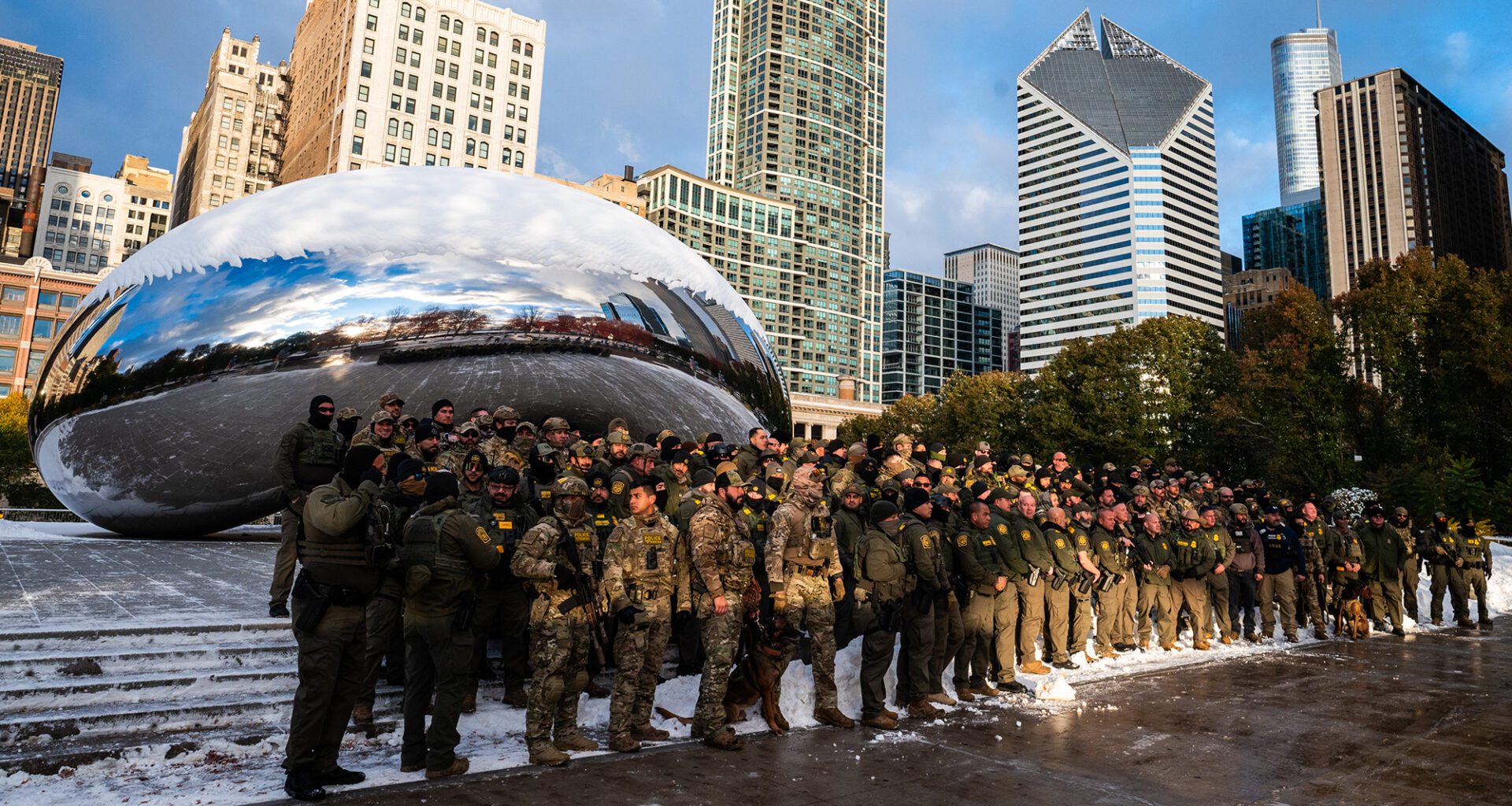
From the Center for Investigative Reporting and PRX, this is Reveal. I’m Al Letson. So there’s an image out of Chicago that I can’t stop thinking about. When visitors come to town, one of the obligatory things to do is visit the touristy heart of downtown and pose for a picture in front of the bean, that famous stainless steel reflective sculpture that looks like a big kidney bean. Even border patrol agents who have been deployed here have done it.
On a Monday in early November, dozens of agents in their military fatigues, faces covered, many carrying assault rifles huddled together for a picture in front of the bean. Their boss, US Border Patrol Commander Gregory Bovino, squeezed in tight with his men. We only know this because a local journalist was there, Colin Boyle, from Block Club Chicago. He reported that as they snap pictures, one agent called out, “Everyone say Little Village,” and a crowd of agents yelled back, “Little Village.”
Little Village is a Mexican-American neighborhood on Chicago’s southwest side, one of the largest Mexican American communities in the Midwest. And since the start of Operation Midway Blitz, Little Village has been one of the main targets.
Baltazar Enriqu…:
If they really want to work with the community, give us the list of the criminals and we will help you get them.
Al Letson:
Baltazar Enriquez is the president of Little Village Community Council, and it’s true. He probably could find anyone in Little Village. While me and Reveal Producer Ashley Cleek meet with him, Baltazar is constantly on the phone, coordinating something, a ride, a meal, a meeting with a lawyer. And he’s been the first call for a lot of residents as federal agents have stormed the neighborhood.
Baltazar Enriqu…:
But don’t go after the lady selling tamales, the man that is taking his kids to school, the person that’s waiting for the bus, people going to the laundry, because that’s who they’re going after. They’re not going after the criminals because if they really were, there’s a big criminal in the White House. They could go after him.
Al Letson:
Even before President Donald Trump won reelection, Balthazar and his fellow organizers knew Little Village could be a target.
Baltazar Enriqu…:
January 20th, when he was inaugurated, we were already out there. We’re a caravan of people, going to the temp agencies, to the day laborers, letting them know in case there’s a raid at your job, this is what you have to do. This is your rights.
Al Letson:
By the summer, Baltazar and his organization started bracing for raids. They watched how Bovino and border patrol agents behaved in LA, and so they called people they knew there.
Baltazar Enriqu…:
Once we talked to our brothers and sisters over in Los Angeles, and they told us Baltazar, when they came here, they came here like savages. They came here to the parks, to the schools, to the hospitals.
Al Letson:
Baltazar wanted his neighborhood to be prepared to protect themselves and each other. And part of the answer was whistles. Now they’re all over the city. But in the early summer when Little Village community councils started passing them out…
Baltazar Enriqu…:
People were like, “What the … What is a whistle going to do?”
Al Letson:
A lot, actually. Some neighborhoods have different systems, but in Little Village, a short series of tweets mean agents are nearby. A long whistle sound means someone is being detained.
Baltazar Enriqu…:
You hear the sound is because immigration is around, lock the doors, lock your gates and go to a safe place or go home. And if you do got papers, if you are a citizen, come and say, “Hey, get the hell out of my neighborhood. Show us the warrant. Show us why you’re here.” We have given out just in Little Village about 8,000 whistles.
Al Letson:
And in the hundreds of videos that have come out of Chicago, you can hear them everywhere.
Speaker 3:
You better live. Live. [foreign language 00:04:06].
Al Letson:
Knowing where federal agents are hasn’t been able to totally interrupt their goal to arrest 3,000 immigrants a day. For weeks, brigades of unmarked SUVs patrolled Little Village’s streets, and Baltazar and teams of volunteers have tried to keep up and keep track by filming everything. In one video from October, Bovino himself casually throws a canister of tear gas into a crowd of protestors near Little Village’s Main Street.
This community has been on high alert for months. When Ashley and I visit the Little Village Community Council office, we can feel it. Everyone’s exhausted and a little on edge.
Speaker 4:
I was in back of Bovino.
Al Letson:
Earlier that day, agents arrested one of their organizers, a US citizen. Volunteers figured they would take her to the federal jail downtown, but no one could confirm where she was. Until finally, one of the volunteers gets a call.
Speaker 4:
Harley’s on her way. They came here. She’s out. We got to go get her.
Speaker 5:
I’ll see right now.
Al Letson:
She was taken to the Broadview Migrant Processing Center in the suburbs. A location that has been the site of many protests where federal agents have been accused of excessive force and where a federal lawsuit alleges detainees are kept in inhumane conditions. A few volunteers jump in a car to go pick her up. The office is also a buzz with reports that earlier in the day, federal agents were driving down residential streets, pointing weapons and antagonizing residents.
Speaker 6:
[foreign language 00:05:56].
Al Letson:
A man and a woman come into the office to report being harassed by ICE agents over a week before.
Speaker 7:
[foreign language 00:06:07].
Al Letson:
The man was outside selling flowers and figurines for Day of the Dead. They say a bunch of cars pulled up and agents got out and demanded to see the man’s documents.
Speaker 6:
[foreign language 00:06:30].
Al Letson:
He pulled out his work permit and says after holding him in one of their vehicles, the agents eventually let him go and left, but he’s really shook up and he wants advice for what to do in the future for next time.
Speaker 7:
[foreign language 00:06:49].
Speaker 6:
[foreign language 00:06:52].
Al Letson:
Like most sanctuary cities, Chicago has multiple ordinances prohibiting the police department from assisting federal agents with immigration enforcement. Mayor Brandon Johnson signed an order saying that no city property should be used for federal immigration raids. So I asked Baltazar about it. Does he feel like the city is protecting immigrants? Yes and no. Balthazar says, sure, Chicago is a sanctuary city. But what good does that do when he’s seen Chicago police officers support and protect federal agents? When he’s seen agents using city property to prepare for immigration arrests.
Baltazar Enriqu…:
When they stage right down the street at [inaudible 00:07:34] School in their parking lot, we’re the ones that called out the mayor and said, “Okay, it’s great that you’re enacting an executive order, but what’s the point of it if it’s not being enforced?” So that’s why we’re saying talk is cheap.
Al Letson:
Baltazar prefers action. From morning to evening, teams of volunteers pick up kids from school, drop off groceries to families who are too scared to leave their homes, and they patrol their neighborhood, walking on bikes, in cars, blowing their whistles when they see federal agents and filming what agents are doing to their community.
Baltazar Enriqu…:
Trust me, I have burned out a couple of my volunteers where they said no, Baltazar, I’m done.
Al Letson:
It’s early evening. The sun is setting. We head outside to the neighborhood’s main drag.
Ashley Cleek:
Huh?
Al Letson:
They’re handing out whistles.
Ashley Cleek:
Yep. Those guys on the corner?
Al Letson:
Yeah. So there’s a report that ICE is in the area and we are on the corner of 26 in Central Park, Little Village. And Baltazar’s organization is out giving out whistles to anybody will take them. We run into one of Balthazar’s organizers, Chela Garcia. She was the one who went to pick up that other volunteer from the Broadview Ice Facility.
Chela Garcia:
It’s hard to do these things because those that are out there are definitely at risk for arrest.
Al Letson:
Chela does a regular patrol. She says that earlier in the day, she saw Gregory Bovino and a caravan of agents.
Chela Garcia:
And Bovino was driving through small streets, okay? And he was even going down one way, jumping out of the vehicle like monsters like. That’s what they were doing. And then once people began running, they were jumping out of the vehicles, almost having joy of scaring people that were in the streets. They did not take custody of anyone.
Al Letson:
So you think that was just fear and intimidation was their goal? And not necessarily apprehending people, but just to make everybody in the neighborhood feel on edge.
Chela Garcia:
Most definitely. To traumatize people, to give a show to Trump, to say, “Look at my guys. They’re out there working diligently.”
Al Letson:
Do you feel like the community itself is feeling the effects of those type of spectacle raids basically?
Chela Garcia:
Yes, because today what I noticed is it wasn’t just the community, it was media. There was a lot of media that was in back. So I think because they seen that media was in back of them, that they were going to ramp up their efforts.
Al Letson:
Yeah. So it’s kind of like if the media is not careful, you’re kind of helping spread their message of fear and intimidation.
Chela Garcia:
Yes.
Al Letson:
I’ve been thinking about this a lot and it brings to mind something that Journalist Adam Serwer wrote. “Cruelty is the point.” Federal agents aren’t just here to detain people. One glance through DHS’s Instagram post makes it clear they’re editing together footage of their enforcement to put on a show. Whether it’s the way they run up on protestors, how they’ve roughed people up who are not resisting during arrests or how officials have lied about agents being attacked by civilians. Journalists, myself included, want to document what’s happening, but if we’re not careful, our coverage can help add to the government’s narrative and I don’t want to make the government’s propaganda for them.
What the numbers tell us. The majority of people federal agents are detaining have zero criminal record, zero. Instead of the worst of the worst, they seem to be blindly grabbing up anyone in their path. People who sell food on street corners, folks walking home from their errands, childcare workers, day laborers. People will say, “This isn’t America,” but a cursory glance at history tells us this has always been who we are.
Speaker 10:
[foreign language 00:12:03].
Speaker 11:
[foreign language 00:12:05].
Chela Garcia:
Mr. [inaudible 00:12:05], what happened?
Speaker 12:
They got to hit.
Al Letson:
Back at the office, Chela gets a call, another ICE sighting, and we head out.
Chela Garcia:
They’re picking up people. ICE is on 26th and Western. We’re going to drive in that area, going to see where they’re at and then pretty much get behind them and just warn people.
Al Letson:
Chela says we can join her and we all get in our rental car and head towards the intersection. It’s about 5:00 PM, starting to get dark.
Chela Garcia:
And lower your windows because we could hear them.
Al Letson:
If we hear any honking, it might tell us where ICE is. Chela’s on the phone talking to other people who are patrolling.
Chela Garcia:
Where are you at?
Speaker 13:
[inaudible 00:12:52].
Chela Garcia:
Okay. I’m over here on 26 and Western. What do you want me to do?
Speaker 13:
26.
Chela Garcia:
26? Okay. I’ll whip around right now because I’m on Western.
Al Letson:
We’re U-turning and looping through one ways, looking out for cars with out-of-state plates, big SUVs. There were reports that federal agents regularly swap out their cars and license plates. It feels like doing this work would make you see your community through a menacing new lens. Every car potential threat. Every driver a potential agent. Chela gets another call. Ice agents by the flower shop.
Chela Garcia:
And how long ago was that? 11 minutes ago. Okay. Okay. I’m going to go just take a little pass by there, okay? Two black SUVs, plates. What’s the make of the SUVs?
Al Letson:
We circle through the parking lot of a flower shop. There’s no one here. Chela says about half the calls are real ice sightings. The other half are nothing.
Chela Garcia:
Well, here’s the last sighting that they said that it was right across the street, so we would just watch and see if there’s anything here.
Al Letson:
We cruise through the parking lot and Chela gets on the phone with Baltazar.
Chela Garcia:
Where are you at? All right. I’m heading back right now. And I need to go home. I’m exhausted. I’m an old lady. I don’t think they’re going to be out tonight. I think they’re done. I think they’re done. I think they did their show. I think these calls are people being nervous. All right. I’m heading back now. So I’m not staying at home right now because I keep thinking that ICE is going to definitely break down the door and yank me out of bed and just take me into custody in the middle of the night.
Al Letson:
Chela’s a citizen, Chicago born and raised, but she’s scared because of the work she does. She doesn’t have any proof, but she feels certain that agents know who she is. Other volunteers we spoke to share the same fear.
Chela Garcia:
I don’t trust them. I really do think that I’m staying far away from my house right now. I literally have to take two buses and a train to get there, but I have to and trek back here tomorrow to do this all over again.
Al Letson:
A week or so after we left Chicago, the federal government started withdrawing many of its agents from the city. Little Village’s main streets are coming back to life. Some of the businesses have stopped preemptively locking their doors, but some of the tactics and tools that agents deployed in Chicago, well, it seems like those could be here to stay.
Speaker 14:
I think there’s been a fundamental shift in the United States where tools that were traditionally used and reserved for protecting the border have now been flipped inwards.
Al Letson:
The surveillance technology that powers immigration raids, that’s next on Reveal.
Al Letson:
From The Center for Investigative Reporting and PRX, this is Reveal. I’m Al Letson.
Ashley Cleek:
All right, Al.
Al Letson:
Okay.
Ashley Cleek:
Where are we at?
Al Letson:
We are freezing in Chicago. We are on the north side of Chicago and it’s a little chilly. The Florida boy is cold, but it’s not that bad. Me and Reveal producer, Ashley Cleek, we’re freezing for a reason. We’re waiting outside a coffee shop to meet Evelyn Vargas. How are you? Good to meet you.
Evelyn Vargas:
Good to meet you.
Al Letson:
Evelyn is an organizer with a group called OCAD, Organized Communities Against Deportations. For the past few months, she’s been working to support families being targeted by the Trump administration’s immigration rates. This has meant connecting families to city services, legal support, and also manning a hotline where people report sightings of federal agents and document detentions. Pretty soon after Immigration and Customs Enforcement agents arrived in Chicago, Evelyn started hearing about an app that they were using.
Evelyn Vargas:
I didn’t believe it. That sounded ridiculous. It sounded inane.
Al Letson:
People who had seen the agents patrolling the streets said the app could use a picture of someone’s face to figure out their immigration status.
Evelyn Vargas:
How could a photo of you pull up all the information that’s on file? I didn’t think we were there technologically. I didn’t think it was possible.
Al Letson:
But she was hearing it over and over again, people being stopped by agents and having a camera phone shoved in their faces.
Evelyn Vargas:
They can come up to you, take a picture, not say anything to you. And if the databases say that you’re a citizen, they walk away and you don’t know what just happened.
Al Letson:
So Ashley started calling around.
Ashley Cleek:
Can you just introduce yourself, like your name and what you do?
Alex:
Oh, yeah, yeah. My bad.
Ashley Cleek:
Yeah, yeah, no worries.
Alex:
My name is Alexander Carduno.
Al Letson:
Alex is 19. He’s from Chicago, lives in Little Village and volunteers with the Little Village Community Council. For months, he’s been doing a bike patrol around his neighborhood in the morning, watching out for ICE agents.
Alex:
Well, my experience has been kind of wild while I was patrolling. I’ve been tear-gassed. They were telling me they were going to chase me, shoot at me. A lot of stuff. It’s been crazy for me.
Al Letson:
One morning, when Alex had just really started patrolling, he and his friend saw an SUV. It looked new, with out-of-state plates. They’re like, “Oh, this has to be ICE.”
Alex:
Well, I started blowing the whistle and letting people know that it was ICE. And that’s when the cars started panicking. The ICE agents started panicking. They were driving the wrong way. And they almost got into a car crash.
Al Letson:
Alex says the car started driving away and he and his friend kept following on their bikes.
Alex:
And we got close enough to the side of them, and that’s when we noticed they grabbed their phone and started taking pictures of us.
Al Letson:
Alex’s friend is a minor. The agents were close enough to get clear photos of their faces.
Ashley Cleek:
What did you think when they did that?
Alex:
It was suspicious for me. I’m like, why do they need our photos? Well, my other friend, he got mad. I got just curious. I wanted to know why they took pictures of us. Are they going to get our informations or what are they going to know about us just because of the pictures they took?
Al Letson:
We heard similar stories regularly while we were in Chicago. Jesus Gutierrez told us he was walking home from the gym one morning when a gray truck pulled up alongside him. Federal agents who did not identify themselves jumped out and asked for his ID.
Jesus Gutierrez:
They got down and they stopped me. And they were like, “Don’t run.” I’m like, “Ain’t nobody running, bro.”
Al Letson:
Jesus explained he didn’t have it on him, but he said he had a picture on his phone. When he couldn’t find it fast enough, he says the agents pulled him into the car, handcuffed him, put his phone on airplane mode, and drove off. Jesus says they drove him around for about an hour before scanning his face with a phone saying, “Oh yeah, he’s a citizen.”
Jesus Gutierrez:
And they were like, “Oh yeah, you’re right, bro.” I ain’t lying. Why would I be lying? And they were like, “Oh, we just doing the jobs.” I’m like, “Okay, I understand, dude, but you’re just grabbing random people, dude.”
Al Letson:
After they released him, Jesus says he didn’t sleep that night and didn’t leave his house for days. Incidents like this have been well documented in news reports, social media, and even a letter from a senator. Now, we don’t know what the Department of Homeland Security plans to do with the photos and videos they’ve captured of people in Chicago, but we do know that the government is going to keep those photos on file for the next 15 years. And the way we know that is through a journalist named Joseph Cox.
Joseph Cox:
I’m Joseph Cox, a co-founder of 404 Media and host of The 404 Media Podcast.
Al Letson:
Joseph and 404 Media were the first to reveal this technology even existed.
Joseph Cox:
ICE has a facial recognition app called Mobile Fortify, and this is on the ICE officer’s phones, their iPhone or their Android device given to them by the agency. They go out and they scan people’s faces, wait a short moment, and then they get their name. They get their date of birth. They get whether this person has been issued a deportation order or not. Now, we’ve had facial recognition for years.
That’s not a new technology in itself. But according to the leaked ICE material I obtained, it was using the Customs and Border Protection system that’s usually reserved for when you enter the United States. When you go to the border and they take your photo and they verify who you are, they had taken that and turned it inwards into the country, which it was never designed to do.
So that was a real crystallizing moment for me that, oh, all bets are off now. They’re taking technology that was never designed for this and using it for an entirely different surveillance purpose.
Al Letson:
Joseph explains ICE agents have more than just this face scanning app at their disposal. There’s another app made by Motorola that they can use to scan license plates.
Joseph Cox:
And what ICE can do is scan a license plate. It will then add it to this massive database of all of these other cameras all over the country, and that can see where else that car has been in the recent past, in the distant past. It can also predict where the vehicle’s going to be in the future.
Al Letson:
The app can even cross reference all of these other points of data connected to the car’s owner.
Joseph Cox:
Thomson Reuters then enriches that data with vehicle ownership details, so obviously you can see who owns the car, marriage licenses as well so you can figure out their associates, credit header data, which is sort of the personal data at the top of your credit report, like your name, address, and phone number, and that sort of thing. And it can basically create an entire picture of somebody’s life when you combine these different data sets. That really is the key is gluing all of this stuff together.
Al Letson:
So if you’re counting, that’s two phone apps and countless data touchpoints. And of course, there’s a lot more than that. Here’s the rest of my conversation with Joseph. Do we know exactly what data DHS and ICE have access to?
Joseph Cox:
How long have we got? It’s a long list, but I would bring up a couple of examples, which to me the most pressing. The IRS, for example, was not allowed to share data with ICE. Taxpayer data has legally been protected for years and years and years to encourage undocumented people to pay their taxes. That’s now been thrown out of the window with Trump’s executive orders and other changes as well, IRS sharing data with ICE, names, addresses, that sort of thing. There’s also Medicaid patients data being shared with ICE as well so they can track those people down.
And what I keep seeing is that every time I see ICE buying data or accessing data, they want to get the addresses because they want to figure out, “Well, can we send agents here?” And ICE will go to all of these very novel sources of information. So there’s this database that I don’t think anybody in the country has really heard of. I hadn’t heard of it until recently. It’s called ISO ClaimSearch. And it’s this massive database that basically includes 90 something percent of medical insurance claims, and that includes your personal data like your address. So ICE has gained access to that as well.
Al Letson:
You spoke about the face scanning app, the Mobile Fortify. We heard from a number of Chicagoans that ICE agents approach them, no warrant, no reason, scan their faces on the street. Can you tell me about how this app is used?
Joseph Cox:
So I’ve seen videos of border patrol and ICE officials scanning people’s faces. In one case, it is somebody who looks like they’re in the driver’s seat of their vehicle and they don’t want to be identified. They say they’re an American and they’re on their way to work. The official then points the camera in their face and says, “Hey, this will be quicker if you could take your hat off.” They’re clearly performing a facial recognition scan on this person. In another case, there are two young men on BMXs or bikes.
They’re stopped by some federal officials. And when one of the boys says, “Oh, I don’t have my ID on me,” one of the officials says, “Well, can we do facial?” An obvious reference again to using facial recognition technology. And behind the scenes, if they’re using the Mobile Fortify app, it is then querying this massive database of something like 200 million images from Customs and Border Protection to near instantly figure out who this person is, their date of birth, other personal data, and whether they should be removed from the country.
And I think one of the most noteworthy things I’ve been told, and this was given to lawmakers, then told to me, is that ICE believes that a result from this app is the definitive piece of proof about someone’s status and overrides a birth certificate. So they will trust the results of this app. Again, a facial recognition app, and we all know that facial recognition has racial bias. It can be inaccurate. They will trust that over a birth certificate.
Al Letson:
So can you refuse to let them scan you? In the airport, you don’t have to have your picture taken by DHS. Can you say no to this face scanning app?
Joseph Cox:
According to an internal DHS document I got, it says, “ICE does not provide the opportunity for individuals to decline or consent to the collection and use of biometric data or photograph collection.” In other words, ICE believes, no, you can’t opt out. No, you can’t refuse consent to have your face scanned like this. And that’s not a law, that’s not an executive order.
Al Letson:
That’s ICE saying that. It doesn’t actually mean that you have to abide by it. It’s just ICE saying like, “Yeah, no, you can’t do it.”
Joseph Cox:
True. It’s ICE saying it. I also don’t know what would happen if you said, “No, I’m not going to have my face scanned off.” Obviously, what’s on a piece of paper is very different to what happens on the streets of Chicago or really anywhere else in the country.
Al Letson:
Based on your reporting, what do you make of these apps together? Is this just a tool with a little more high-end technology that what law enforcement officials have always had access to? Or is this a sign of something changing in how the US government approaches immigration enforcement?
Joseph Cox:
I think there’s been a fundamental shift in the United States where tools that were traditionally used and reserved for protecting the border have now been flipped inwards. And that same technology is being used dozens, hundreds of miles away from the border inside American cities. And that change happened so, so quickly.
It’s clear they were kicked into hyperdrive to build this app and get it out there on the streets. And I think that’s clear by the timeline and I think it’s clear just by the documents themselves I’ve seen where they’re telling ICE officials, “Hey, here’s this app. Please go out on the streets and use it.”
Al Letson:
When I think about this, once the government steps over that line, it doesn’t really go back. These tools that are in place will most likely remain in place.
Joseph Cox:
I don’t think I’ve ever seen surveillance technology trickle back. I’ve only ever seen it trickle down. I mean, it even goes to when we’re flying MQ-9 Predator drones across Afghanistan, Yemen, and Iraq, obviously as a part of President Obama’s drone warfare program. DHS now flies those same drones over American cities.
We saw that recently with the anti-ICE protests in Los Angeles. They don’t build this technology, let it trickle down, and then pull it back in its box. The technology is absolutely here to stay in some form. Maybe it changes ever so slightly, but it doesn’t just disappear. No way.
Al Letson:
That was Joseph Cox, a reporter and co-founder of 404 Media. We reached out to a lot of folks for this story who did not get back to us, including the Department of Homeland Security, Motorola, and Thomson Reuters. We did get a response from the company that runs ISO ClaimSearch, that big database of insurance claims that Joseph mentioned. They told us they don’t have contracts with DHS or ICE, but they acknowledge that law enforcement does have access to their databases.
A few weeks after my conversation with Joseph, a federal court blocked ICE’s sharing agreement with the IRS. And in August, another court blocked the Department of Health and Human Services from sharing information with ICE, but that was after the agency had already given over information for 79 million Medicaid enrollees. It’s been a few months since Operation Midway Blitz began.
Border Patrol Chief Gregory Bovino is gone now, but there are still federal agents in the Chicagoland Area and they are still detaining people. Bovino is off to the next stops on the government’s deportation tour, New Orleans, Minneapolis, Charlotte. And the data from all the raids across the country say the same thing. Overwhelmingly, they are detaining immigrants with no criminal record, which isn’t surprising, because historically, immigrants are less likely to commit crime, but that fact doesn’t fit into President Trump’s narrative of America.
At some point, this push will end, and we, the American people, will have to deal with the costs. The loss of over a million people and counting, the construction of a huge surveillance apparatus, and the militarization of our neighborhoods. Reporting for this week’s show came from me, Ashley Cleek, South Side Weekly’s Alma Campos, and Jim Daley. We also had editorial support from Adam Chaboo from South Side Weekly and Morgan Elise Johnson from The Tribe.
Our lead producer for this week’s show is Ashley Cleek. Jenny Casas edited the show. Artis Curiskis is our fact-checker. He had help from Sarah Salaji. Victoria Baranetsky is our general counsel. Our production manager is the great Zulema Cobb. Score and sound designed by the dynamic duo, Jay Breezy Mr. Jim Briggs, and Fernando, my man, yo, Arruda. They also had help from Claire C. Note Mullen.
Taki Telonidis is our deputy executive producer. Our executive producer is Brett Myers. Our theme music is by Camerado, Lightning. Support for reveals provided by The Reva and David Logan Foundation, The John D. and Catherine T. MacArthur Foundation, the Jonathan Logan Family Foundation, the Robert Wood Johnson Foundation, the Park Foundation, The Schmidt Family Foundation, and the Hellman Foundation.
Support for Reveal is also provided by you, our listeners. We are a co-production of The Center for Investigative Reporting and PRX. I’m Al Letson. And remember, there is always more to the story.