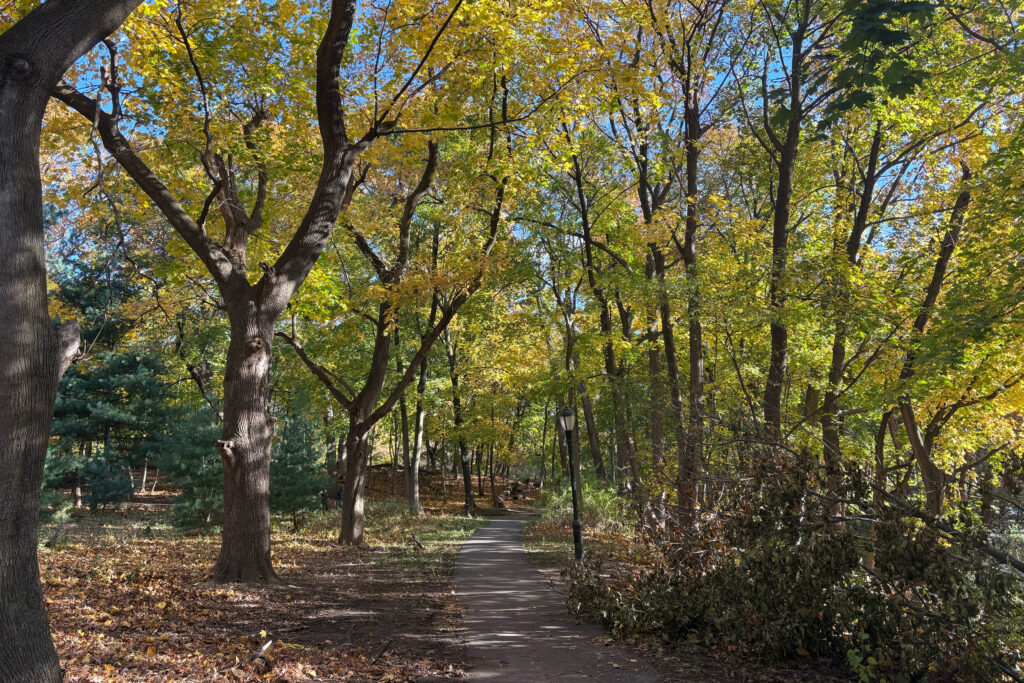
The sound of cars zipping along a nearby highway faded to a low hum as Christian Murphy made his way through a narrow trail in a long-neglected section of Bronx Park.
Murphy, the ecology and education manager at the Bronx River Alliance, said the city Parks Department does not have the capacity to address all the problems, which include invasive species and erosion along the banks of the Bronx River, which runs through the park.
“What we’re looking at here is the undoing of many decades of work to get this space to be as functional as it is now,” said Murphy. “It’s a little bit of a race against time.”
With funding from the state’s new Community Reforestation grants, some of the park’s northern portion will soon receive a complete makeover.
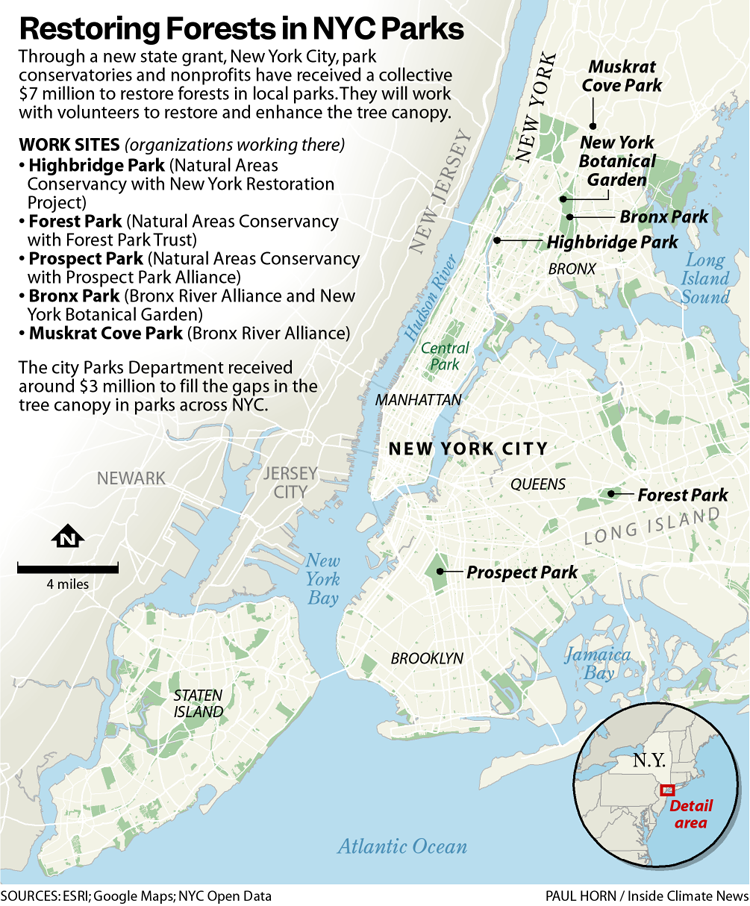
The money will also fund the restoration and expansion of forested areas in urban centers across the state. Around $7 million of the $15 million available went to organizations in New York City, the country’s most densely populated city.
The Bronx River Alliance, along with some city employees, will clear a section of Bronx Park of invasive species, such as knotweed, and replant it with native, resilient trees, including sycamore and silver maple. The group will also restore forests in Muskrat Cove Park in the Bronx.
The grants are part of a state initiative to plant 25 million trees by 2033 to improve community health and climate resilience; trees can provide shade and help cool urban areas during heat waves, suck up water during floods and improve air quality.
The New York Restoration Project, with another nonprofit, the Natural Areas Conservancy, will develop a new forested area along the Harlem River Drive in northern Manhattan.
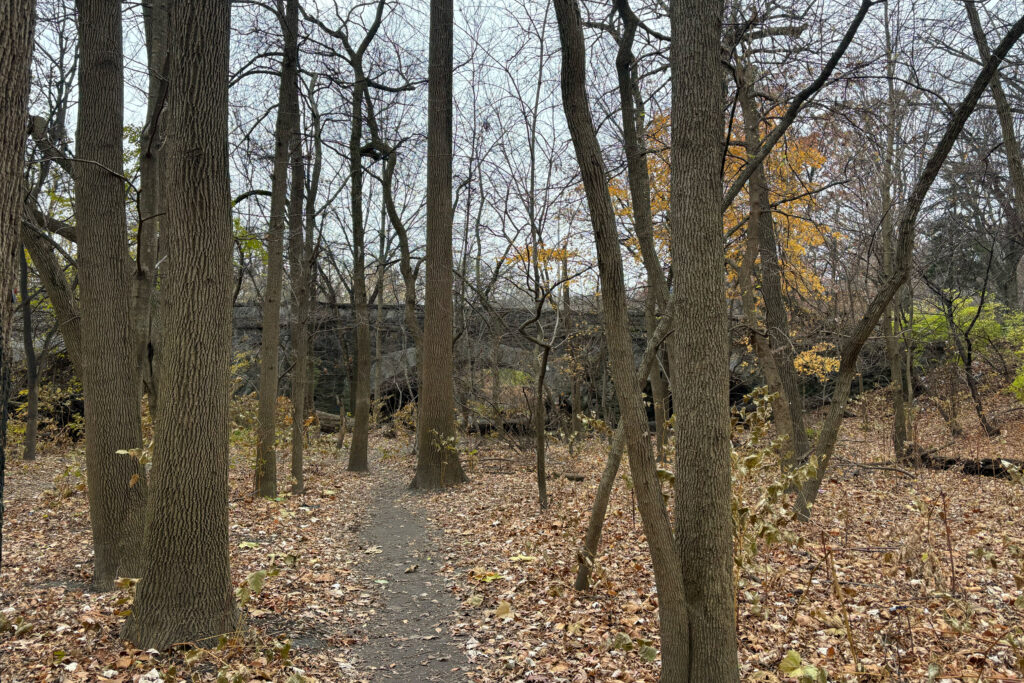 The area of Bronx Park that will be restored by the Bronx River Alliance. Credit: Lauren Dalban/Inside Climate News
The city of New York will receive grant funds to fill gaps in the city’s tree canopy, and the New York Botanical Garden, which is located in Bronx Park, will work in both the garden and farther north in Westchester to restore forested areas. The Natural Areas Conservancy will also partner with the Brooklyn’s Prospect Park Alliance and the Forest Park Trust in Queens to enhance and expand the forest in those parks.
“This funding is really filling a gap in New York City around urban forest and natural areas care,” said Clara Pregitzer, the deputy director of conservation science at Natural Areas Conservancy. Her organization developed a framework for caring for the city’s forested areas in 2018.
The city government has also advocated for the care and planting of local trees. A 2023 law mandated the creation of an urban forest plan to reach 30 percent tree canopy cover across the city. The city is still working on its first plan.
The city’s forested areas have struggled for decades under pressure from overuse, invasive species and inadequate maintenance. This is especially true for parks in lower-income communities, which are often transected by large highways and do not benefit from financial support from large-scale nonprofits like the Central Park Conservancy to fill funding gaps.
City council members and park advocates have accused the city’s government of underfunding its Parks Department, which cares for most of the city’s forests, for years. Despite small increases under the administration of outgoing Mayor Eric Adams, the department’s operational budget has remained at around 0.6 percent of the total city budget, even though it manages over 30,000 acres of land—roughly 14 percent of the entire city.
In response to questions from Inside Climate News, a spokesman for the Parks Department wrote in an email that “we have been fortunate to supplement our City funding with State and Federal grant money to take on specific projects and maintain a robust team.”
“As with any organization with large areas and many properties to manage, more resources will allow us to manage and maintain more areas,” he wrote.
“Declines in Forest Health”
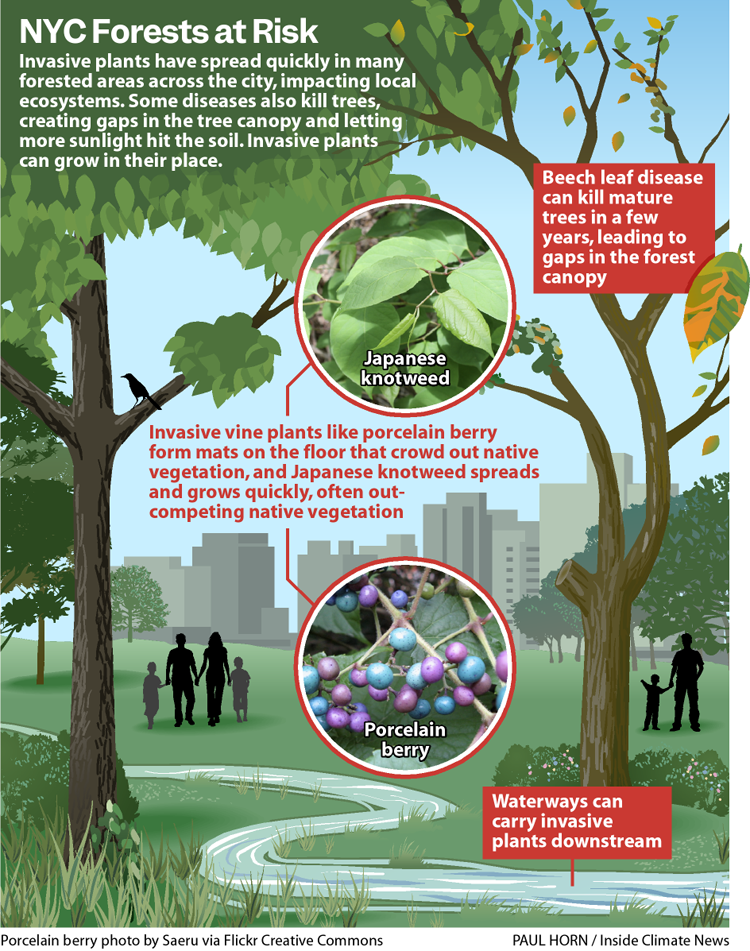
As Inside Climate News reported last summer, the city’s parks face significant challenges. At Bronx Park, it’s a “race against time,” said Murphy, as the invasive species spread, undoing decades of work to expel them. Invasive plants like knotweed and porcelain berry, which spread quickly, make it more difficult for native vegetation to survive.
Knotweed has bamboo-like stems and grows as a shrub or thicket on the forest floor. Porcelain berry is a vine plant that creates large mats on soil. Both plants shade and crowd out other vegetation, adversely impacting the local ecosystem.
This story is funded by readers like you.
Our nonprofit newsroom provides award-winning climate coverage free of charge and advertising. We rely on donations from readers like you to keep going. Please donate now to support our work.
Murphy and his organization are fighting battles on multiple fronts in north Bronx Park. According to Murphy, Beech leaf disease is spreading across the park, impacting a common tree in the area. According to a spokesman for the city’s Parks Department, the disease was first confirmed in New York City in 2021 and has since been detected in all five boroughs.
The state’s Department of Environmental Conservation is studying the disease to understand its cause and how it spreads. Young beech trees are particularly susceptible, though it can kill those of any age. Murphy said that the emerald ash borer, a beetle originally from Asia which was first confirmed in the city in 2017, is also a threat. The beetles eat and kill ash trees, which are common in the park.
“In the summer, when everything is fully foliated, you’ll notice big bald patches in the canopy,” said Murphy. “When those trees come down, they open up these big chunks of sunlight that suddenly hit the floor, and then invasive species utilize that and get new populations that then grow out of control.”
John Zeiger, manager of the Thain Family Forest, located in Bronx Park and in the New York Botanical Garden, says the forest he cares for also faces problems with the emerald ash borer.
Through the state reforestation grants, his organization will focus on restoring forests in the garden and in nearby Westchester, where deer pose a threat because they eat the branches of younger trees, often killing them.
Deer also often avoid eating invasive species, said Zeiger, giving them a competitive advantage over native plants.
“We’re seeing some pretty severe, large-scale declines in forest health across the region,” said Zeiger. “It’s something that worries me a lot.”
The New York Botanical Garden is partnering with several organizations to restore forested areas in the Bronx and Westchester.
Through the reforestation grant, the Bronx River Alliance hopes to restore a portion of the forest’s native ecosystem along the river, and stem the tide of invasive species. The funding will cover three years of work. Volunteers, along with the Bronx River Alliance, will clear weeds and plant trees.
In a city as densely populated as New York, there are not many places to plant new forested areas. The New York Restoration Project will try in an overgrown section of Highbridge Park in Harlem, which is near a major roadway.
 The New York Restoration Project will restore a section of Highbridge Park that borders Harlem Drive. Credit: Lauren Dalban/Inside Climate News
“We can’t be too picky,” said Jason Sheets, the director of community garden operations and citywide greening projects at the New York Restoration Project. To get to the site from the closest park entrance, he walked down multiple flights of stairs. Some were buttressed by fenced-off sections of the park full of invasive vines called bittersweet, visible as he walked underneath an isolated overpass to reach the site.
“There is a history of unsafe and poorly managed green space,” he said.
The section of the park that Sheets’ organization chose is on an incline, leading directly to Harlem River Drive. He says the area is covered in invasive shrubs and trees like sycamore maple. The latter can grow quickly and outcompete other young trees in what is called the “understory,” the area beneath large, fully grown trees where saplings usually grow.
This section will need a year of maintenance before they can plant, Sheets said. Eventually, Sheets’ organization will plant hickory and maple trees, which are native to the area. He hopes that the addition of a forested area and pedestrian path nearby—which his organization has already somewhat restored—will signal to locals that the park is well-managed.
Both Murphy and Sheets said they were excited about the grant money, and how it could help them revitalize the urban forested areas that their organizations care for.
“We’re all hopeful that it’s not just about planting trees, but about growing a forest and … making sure that it’s sustained for future generations, but there’s no guarantees,” Pregitzer said. “I would hope that the leadership that we’re seeing from the state could be translated and imprinted on the local city government to step up and protect the investment that we’ve made.”
About This Story
Perhaps you noticed: This story, like all the news we publish, is free to read. That’s because Inside Climate News is a 501c3 nonprofit organization. We do not charge a subscription fee, lock our news behind a paywall, or clutter our website with ads. We make our news on climate and the environment freely available to you and anyone who wants it.
That’s not all. We also share our news for free with scores of other media organizations around the country. Many of them can’t afford to do environmental journalism of their own. We’ve built bureaus from coast to coast to report local stories, collaborate with local newsrooms and co-publish articles so that this vital work is shared as widely as possible.
Two of us launched ICN in 2007. Six years later we earned a Pulitzer Prize for National Reporting, and now we run the oldest and largest dedicated climate newsroom in the nation. We tell the story in all its complexity. We hold polluters accountable. We expose environmental injustice. We debunk misinformation. We scrutinize solutions and inspire action.
Donations from readers like you fund every aspect of what we do. If you don’t already, will you support our ongoing work, our reporting on the biggest crisis facing our planet, and help us reach even more readers in more places?
Please take a moment to make a tax-deductible donation. Every one of them makes a difference.
Thank you,

Reporter, New York City
Lauren Dalban is a New York City-based reporter with a background in local journalism. A former ICN fellow, she now covers environmental issues in all five boroughs. Originally from London, she earned a B.A. in History and English from the University of Virginia, and an M.S. from Columbia Graduate School of Journalism.