“The transfer from Taleqan only resolves part of Tehran’s shortage and is not meant to eliminate it altogether,” said Mohammad Javad Zareian, head of the Research Center for Water Resources Studies at the Energy Ministry’s Water Research Institute. “If rainfall deficits continue, Taleqan’s water will not be sufficient.”
The Taleqan Dam, located in Alborz Province, is a hydroelectric facility with an installed capacity of 18 megawatts and serves as one of the five primary water sources supplying the Tehran metropolitan area.
Iran is in its sixth consecutive year of drought, with reservoirs at historic lows. Tehran’s Latyan Dam is at its lowest in six decades, Karaj (Amir Kabir) holds under 10% capacity, and Mashhad’s dams are below 3%.
Reserves depleted after years of overuse
Iran has faced droughts before, Zareian said, but the past two years have been more severe because buffers that once absorbed shocks have largely vanished. “Previously we had groundwater and storage behind dams, but those have been lost because consumption has exceeded available resources,” he said, adding that errors in water policy and population growth planning compounded the strain.
Long-term trends are moving in the wrong direction, Zareian warned, with declining resources and rising population. Climate change is also intensifying pressure by raising temperatures and reducing precipitation, a pattern seen beyond Iran.
The prolonged dry period has pushed reservoir levels across Iran to historic lows. The crisis is mainly due to decades of mismanagement. Agriculture uses 80 to 90 percent of the country’s water but with less than 40 percent efficiency.
Too many dams have been built, leaky pipes waste 15 to 30 percent of supply, wastewater recycling stands at only about 20 percent compared to 85 to 98 percent in neighboring countries, and conservation efforts remain weak.
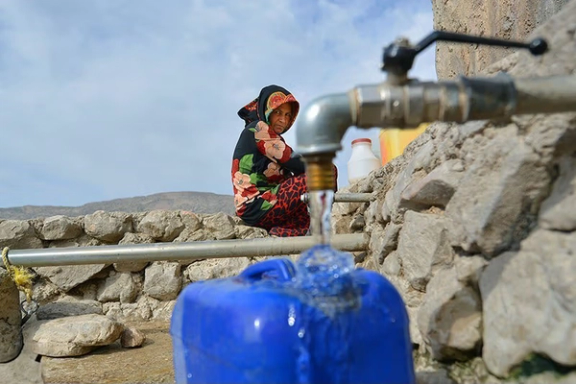 A young girl carries containers to collect water from a tanker truck amid ongoing shortages in Iran.
Separate livelihoods from drinking water
Zareian argued that Tehran and other large cities must separate livelihoods and economic activity from drinking water needs. Household drinking water accounts for only part of total use, he said, while many industries clustered around major cities are water-intensive.
“Except for high-tech sectors, most industries here consume large amounts of water,” Zareian said. He urged factories to cut consumption or rely on recycling within their own systems, a practice common abroad where industrial water is reused multiple times.
Proposals to pipe desalinated seawater to Tehran are economically unsound, Zareian said, citing prohibitive costs that would require massive state subsidies. “With one-tenth of that cost, demand management can stabilize conditions,” he said.
If rainfall fails to recover, authorities will have little choice but to impose consumption limits, he added, noting that drinking water would remain the priority.