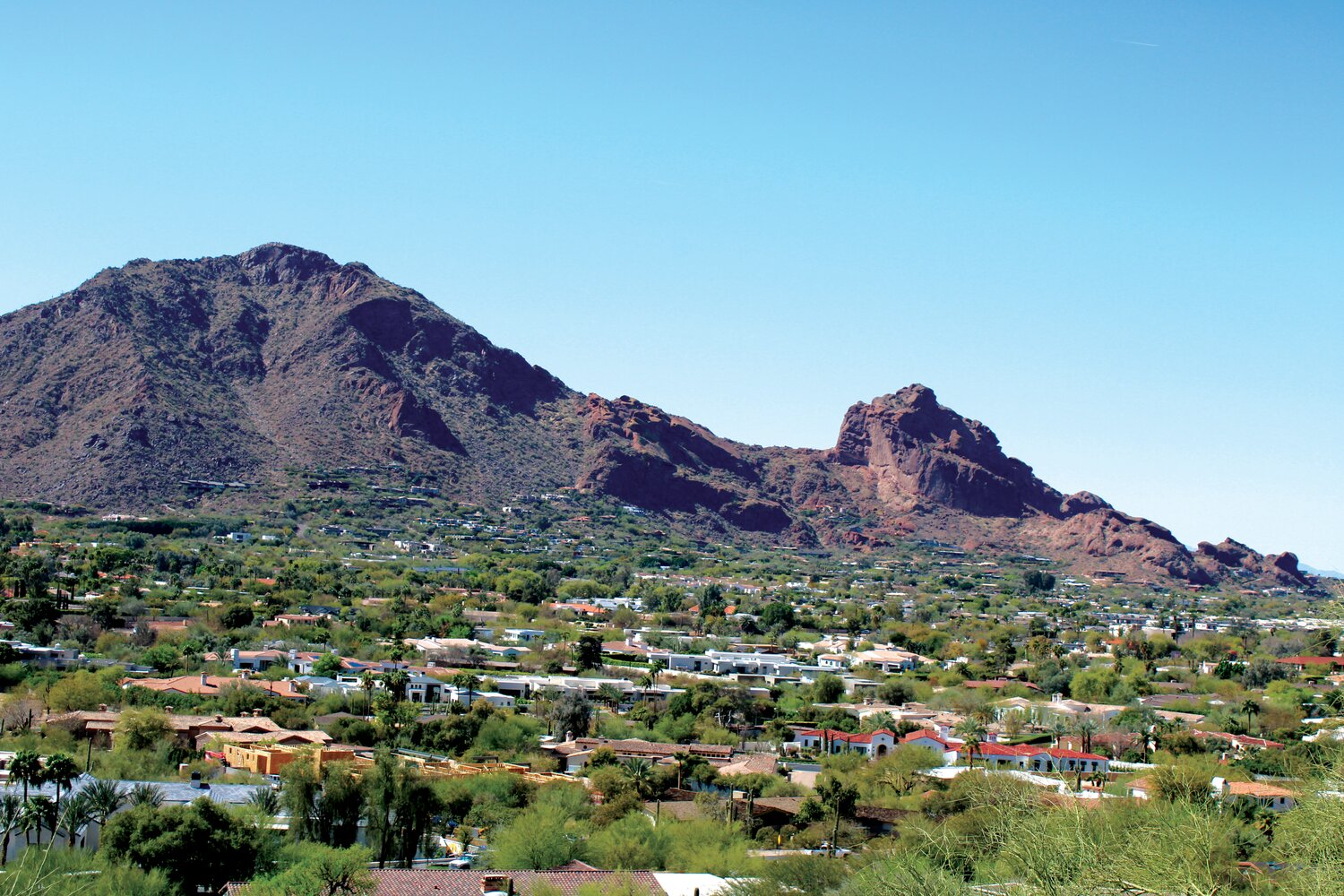
While much of the Valley has seen a bump in population growth, Paradise Valley experienced a miniscule dip.
Of the more than 97,000 people who decided to make Arizona their home in the year ending July 1, nearly one out of every eight landed in Phoenix. That brought the city’s population to more than 1.7 million, according to the Arizona Commerce Authority.
It represented a year-over-year growth rate for Phoenix of less than 0.7% — much slower than the 1.3% average for the entire state.
Paradise Valley, on the other hand, has barely budged. The Arizona Commerce Authority is reporting a population of 12,774, a decrease of less than 0.1%.
Apache Junction is at the top of the mountain for growth, according to the report. It’s estimated that 3,291 people moved into Apache Junction for an 8% annual increase, bringing the total population to 44,934.
That was trailed — but only slightly — by Queen Creek at close to 7.7% growth with a population of 88,050.
Among other southeast Valley cities and town, Gilbert, which a decade ago was among the hottest growth cities, remains the fourth-largest community in the state at 294,689 residents, though its growth rate that has slowed to 0.9%.
Chandler is not far behind at 288,299 residents, with its population increase also lagging the state rate at 0.7%.
It probably comes as no surprise, but once again the fastest-growing communities in Arizona are on the far outskirts of the two major metropolitan areas.
At other extreme of the Phoenix area, Maricopa grew by nearly 6.7%.
Some other Pinal County communities also beat the state’s growth rate, including Coolidge at 5.7%, Casa Grande at 5.3%, Florence up nearly 3.7% and Eloy growing by 2.8%
Also on the top of the growth chart are communities west of Phoenix, with Buckeye checking in at 5.3%, Goodyear at 5%, with a 4.2% annual growth rate in Surprise and 4% in Avondale.
In fact, both areas are growing so fast that state lawmakers have set aside millions of dollars to alleviate existing and potential future traffic jams for daily commuters.
That includes widening stretches of Interstate 10 that serve both those areas, one north of Casa Grande and the other adding more lanes to the freeway going out to Buckeye. And an entirely new freeway — State Route 30 — is being planned parallel to I-10 to serve Buckeye, Goodyear and Avondale.
And what of the rest of the state?
It isn’t until you look at Marana where there’s an indication that there is growth in Southern Arizona, with nearly 4,000 new residents boosting the town by 6.3%. Sahaurita was farther behind at 1.9%, though still besting the statewide average.
So where else has been growing in the past year?
The border community of San Luis added more than 2,000 people, enough to boost its population by 5.1%.
Prescott Valley, which years ago overtook Prescott, continued to grow its lead, boosting its population by another 2.2%, compared to less than 0.7% for Prescott.
Leading on the losing end were places like Bisbee, which saw its population shrink by 1.5%. Also at the top — or bottom, if you will — of the list of communities with negative numbers are Winslow, Springerville, Jerome, St. Johns, Page, Fredonia and Miami.
Beyond Phoenix among large cities, Tucson maintained its slot as the second largest, adding 682 people in the past year to bring its population to 557,901.
But Mesa is moving to catch up, with 4,499 new residents. That puts its population within 29,000 of Tucson.
And Scottsdale’s own growth is down to 0.4%, with the community now at 251,000.
Glendale, however, did better than the state’s 1.3% growth rate, clocking in at 1.8% and boosting its population to more than 265,000. So did Peoria at 1.5%, now with 206,000 residents, and even land-locked Tempe with 196,000 residents after posting a 1.4% year-over-year increase.
Among the other communities outpacing the state’s 1.3% growth rate include Colorado City, Wickenburg, Snowflake, Thatcher, Douglas, Pima and Bullhead City.
Howard Fischer
Mr. Fischer, a longtime award-winning Arizona journalist, is founder and operator of Capitol Media Services.