
STATEN ISLAND, N.Y. — After immigrating from South Africa 20 years ago, Jocelyne, 50, moved to Staten Island where she rented an apartment and started a new life.
However, that life was upended in 2022, when Jocelyne’s sister fell ill, and she had to move to Florida to care for her. After her sister’s passing, Jocelyne was eager to resume her life on Staten Island. But when she returned, she needed to find a new job.
“My sister passed away more quickly than I was expecting,” she said, noting she had left a job and needed to find work. “And I no longer had a place to live.”
While her son was able to stay with his godmother during this time, Jocelyne found herself “living in the streets,” or crashing on friends’ couches to get a good night’s sleep.
“I couldn’t stay where my son was staying because there was just too many people living there,” she said, noting her son is now 17 years old.
“Eventually, there wasn’t room at the godmother’s home for her son either, so she applied to live in the city’s homeless shelter system. She was placed in The Audre Lorde Family Residence in Tompkinsville, run by Win (formerly Women In Need), which touts itself as the nation’s largest provider of family shelter and supportive housing. The Advance/SILive.com previously reported the residence, which opened in November 2023, serves about 165 families.
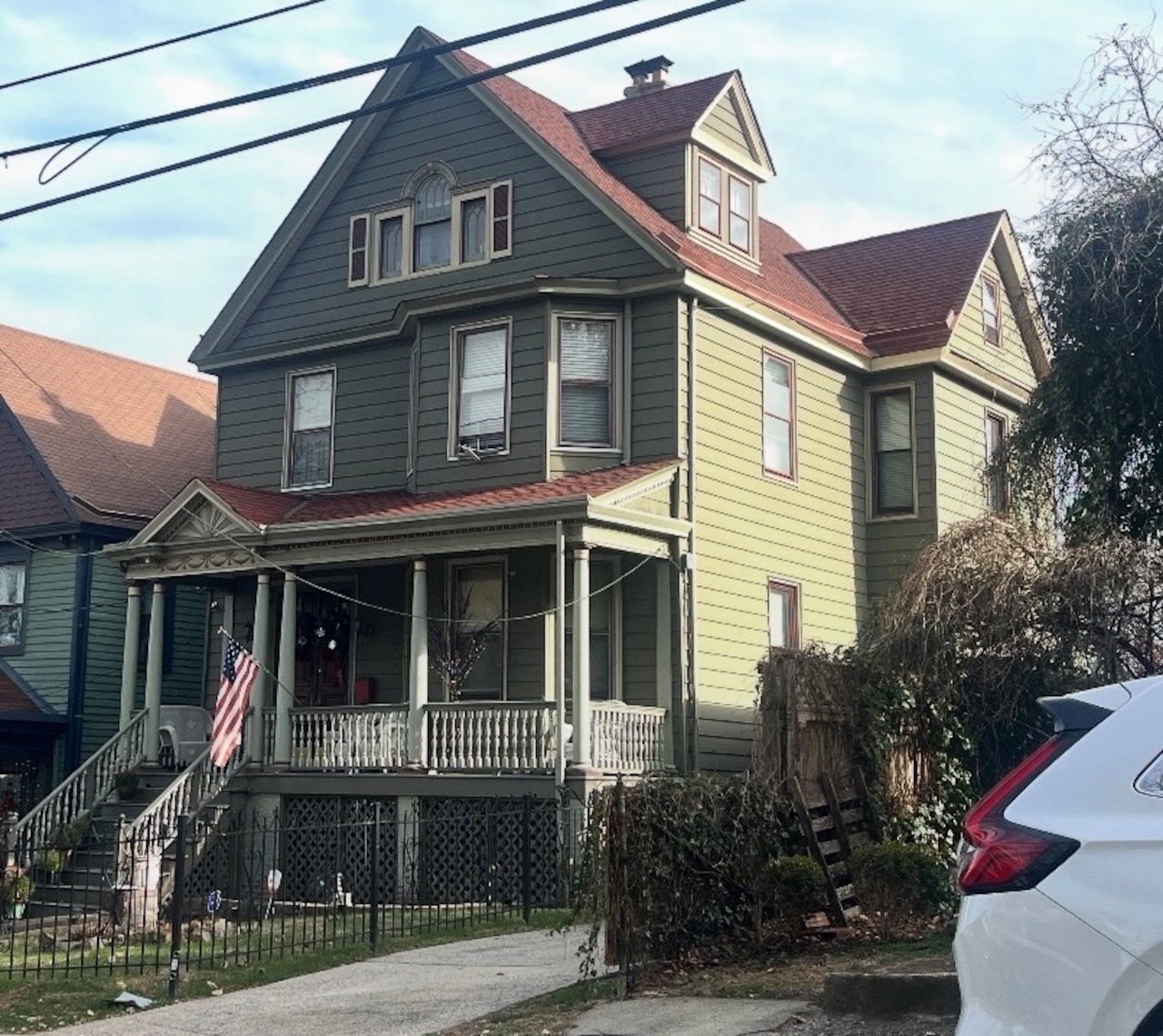 Pictured is the Audre Lorde Family Residence run by Win (formerly Women In Need), which touts itself as the nation’s largest provider of family shelter and supportive housing. The Advance/SILive.com previously reported the residence, which opened in November 2023, serves about 165 families.SILive.com | Jan Somma-Hammel
Jocelyne obtained a job working for EZpass, but getting back on her feet would take some time. High rents and skyrocketing costs of everything from food to electricity have prevented her from obtaining permanent housing. And despite having a CityFHEPS (Family Homelessness & Eviction Prevention Supplement) Housing Voucher, she still can’t find an affordable place for her and her son to live.
“I’ve viewed apartments. They ask me how much is my share, and I tell them around what it is, and they say I cannot afford it [the apartment for rent],” she said, noting her housing voucher covers part of the rent and her share is about $900.
Jocelyne said the rents of apartments she is viewing are at least $2,000 and up, without utilities included. She said landlords often reject her because her required rent share is considered too high, even though she is employed. Landlords tend to prefer tenants receiving more public assistance, which guarantees steady rental payments, she said.
“So far, since I got this voucher, I saw five [apartments]… Two were basements, so small, so rough… Another one was okay, but it wasn’t finished yet. I liked it, and I told the person I would love to take that apartment. That person said, ‘No, you cannot have it… your share is too big,’”she said.
And her voucher has a looming expiration date, adding urgency and stress to the process.
Housing voucher proposed reforms
Jocelyne’s story is a familiar one, according to Win, which recently partnered with former New York City Chief Housing Officer Jessica Katz, Manhattan Councilmember Gale A. Brewer, and the Real Estate Board of New York to highlight issues with the housing voucher process.
Calling the process “inefficient and deeply flawed,” Win presented a newly developed board game as a visual representation of the setbacks that families often face while navigating the lengthy housing process. Win says the process includes “redundant paperwork and constantly being forced by the city to prove they are poor and homeless.”
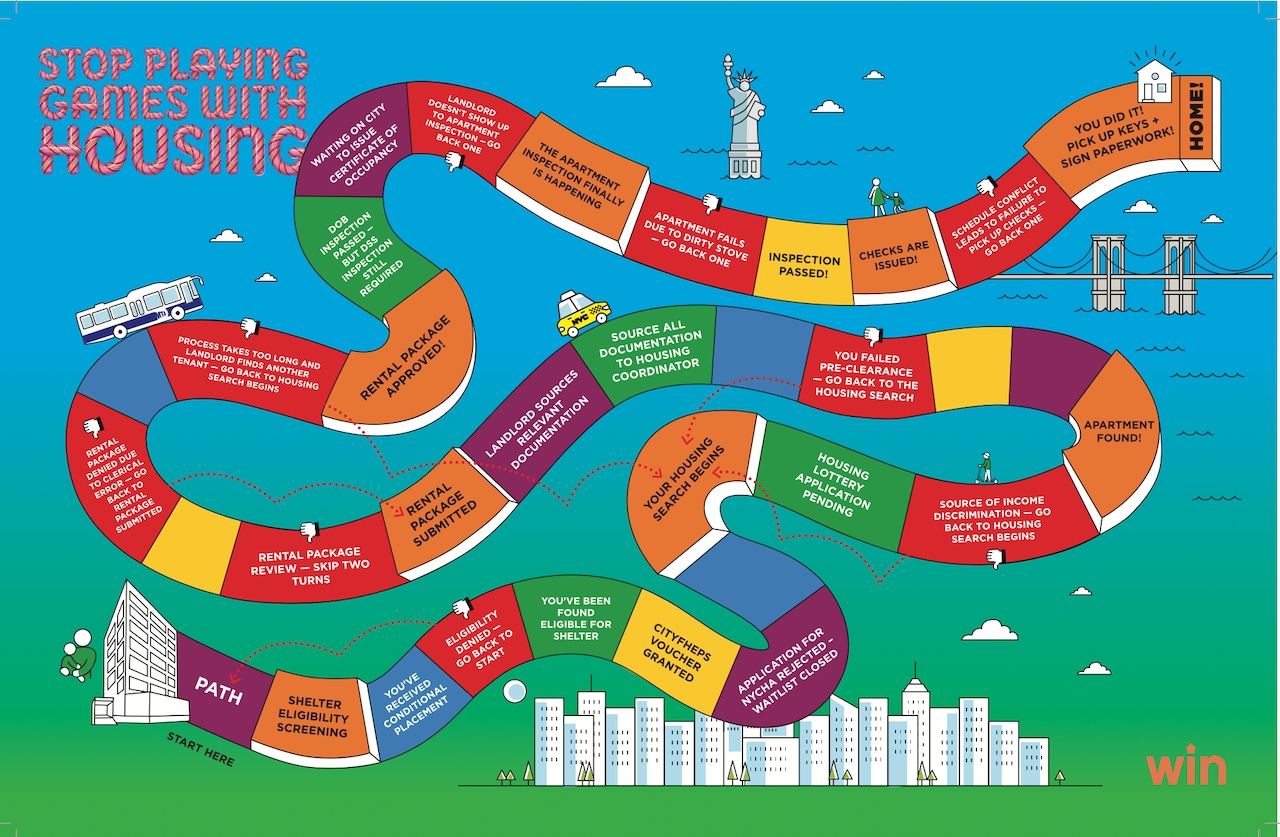 Calling the process “inefficient and deeply flawed,” Win presented a newly developed board game as a visual representation of the setbacks that families often face while navigating the lengthy housing process. Win says the process includes “redundant paperwork and constantly being forced by the city to prove they are poor and homeless.”Courtesy of Win
Henry Love, Win’s vice president of public policy and strategy, calls the 25-step process to secure a CityFHEPS Housing Voucher “a game of chance.”
“You have to prove that you’re actually homeless, right? And that takes weeks, if not months [the process]. You have to go back and forth, and back and forth so many times,” he said.
“After you finally get a voucher, you can finally begin your housing search, but this could take months…Once you start that housing search, you have to go through the housing lottery… You might find an apartment, but maybe you failed the pre-clearance for the apartment, so then you have to go back to find a new apartment. It’s a cyclical thing,” added Love.
CityFHEPS is one of several housing voucher programs available in New York City,
Win shelter residents, elected officials, and advocates gathered on the steps of City Hall last week just before a City Council hearing to call for the passage of three bills introduced into the City Council by Brewer and another introduced by Brooklyn Councilmember Lincoln Restler.
What the bills aim to do
Win says the bills would improve and expand the CityFHEPS voucher program.
“The current housing voucher process is set up for people to fail,” said Christine C. Quinn, president and CEO of Win. “It is far too difficult for families to secure permanent housing, and often feels like playing a game that depends on the roll of the dice.”
The proposed bills are as follows:
- Speeding Up Inspection Times: Introduced by Brewer, this bill, Intro 1458, would establish a hierarchy of issues in inspections to establish a process for resolving minor issues without requiring reinspection, such as fixing minor issues on the spot, including missing window guards, light bulbs, outlet plates and other low-cost fixes.
- Require CityFHEPS Applications to be Processed Within 15 Days: Introduced by Brewer, this bill, Intro 1477, requires that upon submission of a complete tenant-based rental assistance application, the department must inform the applicant of its approval decision no more than 15 days after submission.
- Increasing Transparency Around CityFHEPS Processing: Introduced by Brewer, this bill, Intro 1459, would require the Department of Social Services to submit to the mayor and the speaker of the Council, and to include in the Mayor’s Management Report the average time it takes for an individual to secure housing after receiving a housing voucher.
- Requiring CityFHEPS Payments be Made Within Seven Days: Introduced by Restler, this bill, Intro 1472, would require the Department of Social Services to provide landlords with rental assistance payments within seven days of the scheduled payment date.
“No one should spend years in shelter or lose an apartment because of unnecessary inspections or stalled paperwork,” said Brewer. “These delays are unconscionable and entirely fixable. My bills are designed to cut unnecessary red tape, speed up inspections, and bring transparency and accountability to a process that has been opaque for too long. Families deserve a clear path to permanent housing.”