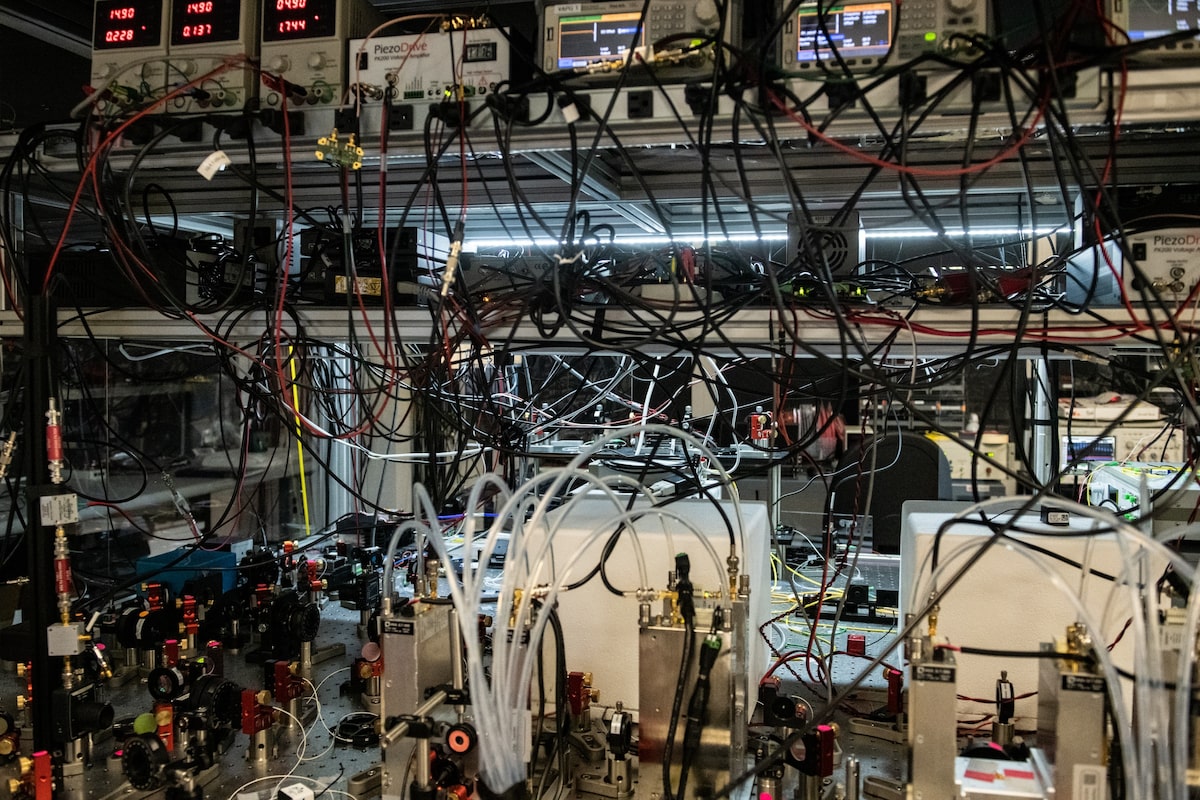
A section of the ‘Borealis’ quantum computer developed by Toronto-based tech company Xanadu Quantum Technologies Inc., in May, 2022.Galit Rodan/The Globe and Mail
After watching Canada squander its early advantage in artificial intelligence, the federal government on Monday will unveil a program aimed at supporting key homegrown players in the emerging quantum computing space to ensure they stay here and become industry leaders.
Through the initial phase of its Canadian Quantum Champions Program, the government will commit up to $23-million apiece to four companies that have shown early promise in the field: Xanadu Quantum Technologies Inc. of Toronto, Montreal-based Anyon Systems Inc., Photonic Inc., based in Coquitlam B.C., and Sherbrooke’s Nord Quantique.
The program is the first pillar of a $334.3-million commitment in November’s budget to support Canada’s quantum sector, and could provide hundreds of millions of dollars in further funding if the companies continue to advance toward building industrial-scale systems.
“We’re very happy that they’re taking this step and recognizing we have a part to play in the future of computing,” said Photonic founder and chief quantum officer Stephanie Simmons, co-chair of the federal Quantum Advisory Council.
The program, which is being overseen by the federal industry minister with technical help from the National Research Council, will involve “a lot of diligence to ensure these companies have the potential to do what they say they can do,” said Artificial Intelligence and Digital Innovation Minister Evan Solomon in an interview. “We have to make sure our money is going into the right place.”
After years of sluggish growth in Canada and the launch of a trade war by U.S. President Donald Trump, the government of Prime Minister Mark Carney has moved to put more muscle behind economy-building projects that capitalize on Canadian strengths.
To support that effort, Mr. Solomon’s ministry is developing strategies aimed at capitalizing on Canadian AI and quantum know-how. By investing in quantum – an area where Canada built early research and development leadership a generation ago – the government can also claim to be honouring NATO military-spending commitments, as the sector is developing tools with both commercial and defence applications.
Industry proponents have long promised that quantum computers will some day solve tasks that remain out of reach of existing computers, opening up new applications in financial forecasting, drug and material discovery and machine learning.
Unlike conventional computers, quantum systems don’t derive power from manipulating bits of information compromising a combination of 0s and 1s, but by tapping into the peculiar properties of matter and light at microscopic scales. There are several ways to leverage these effects in a quantum computer; no clear winner has emerged despite a string of scientific breakthroughs.
Quantum technology also has applications in sensing, communications and cybersecurity. Yet, advances the technology could bring are twinned with dread. That’s because quantum computers could enable bad actors to pick the locks on cryptography algorithms that secure the world’s digital economy. Canada’s intelligence and defence establishment have recognized the threat for years and governments and financial-sector players have been put on notice to quantum-proof their critical infrastructure.
The support for the four Canadian companies comes at the end of a pivotal year for the quantum sector. Interest in quantum technologies has soared owing to several factors, including a competition by the U.S. Defense Advanced Research Projects Agency (DARPA) challenging developers to show they can build a commercial-grade quantum computer by 2033.
Three Canadian companies advance to next stage in DARPA quantum computer challenge
Xanadu, Photonic and Nord Quantique are among 11 companies to make the first two cuts of DARPA’s Quantum Benchmarking Initiative (QBI) program, qualifying them for US$16-million in U.S. government funding. If they complete the third phase, they could each receive US$300-million more and would be viewed as leaders in a global race featuring startups and giants including IBM and Google.
But other jurisdictions – including Illinois and Maryland – are leaning into their own quantum sectors and wooing companies to move there. That has sparked concerns that if Canada doesn’t step up, our best and brightest could leave. Already, D-Wave Quantum Inc. QBTS-N, a pioneer that has taken a partial version of a quantum computer to market, has moved to Silicon Valley from B.C.
Nipun Vats, the federal public servant overseeing Canada’s quantum secretariat, warned during a panel at the Canadian Science Policy Conference in November that if Canada doesn’t seize the opportunity while the industry is nascent, “it would be a bit of a wasted moment.”
Xanadu founder and chief executive officer Christian Weedbrook said in an interview the government “could have easily said, ‘No, you don’t need any money, you got into QBI, that should be enough.’ But Canada is really making a statement with this.”
Mr. Solomon said his goal since joining cabinet has been “to champion our champions and make sure they stay in Canada, that the intellectual property stays in Canada, that the work force stays in Canada. The goal is sovereign quantum capability. We are unapologetic about it.”
The new Canadian program is expected to largely mirror the DARPA program, with some notable differences. For one, it doesn’t hold companies to the arbitrary 2033 deadline. Funding for the first phase is slightly larger than what DARPA has committed to participants thus far. It also accommodates for Anyon, which didn’t apply to QBI over concerns the U.S. government could assert rights over its intellectual property, said CEO Alireza Najafi-Yazdi. (The other three don’t think that will be an issue).
Mr. Najafi-Yazdi, also doesn’t believe anyone can develop a fully scalable quantum computer within 10 years, unlike the other three. That promise is a centrepiece of Xanadu’s pledge to investors after it struck a deal last month to go public next year by merging with a special purpose acquisition company. If Xanadu’s offering succeeds it would be the first IPO by a Canadian tech company since 2021.
But Anyon has earned consideration as it is not only the eldest of the four but has delivered three of its early systems to customers, including Canada’s Defence Department. “We are honoured, flattered by the recognition,” said Mr. Najafi-Yazdi. “It was time for the government to invest, to make bold bets and support Canadian champions.”