
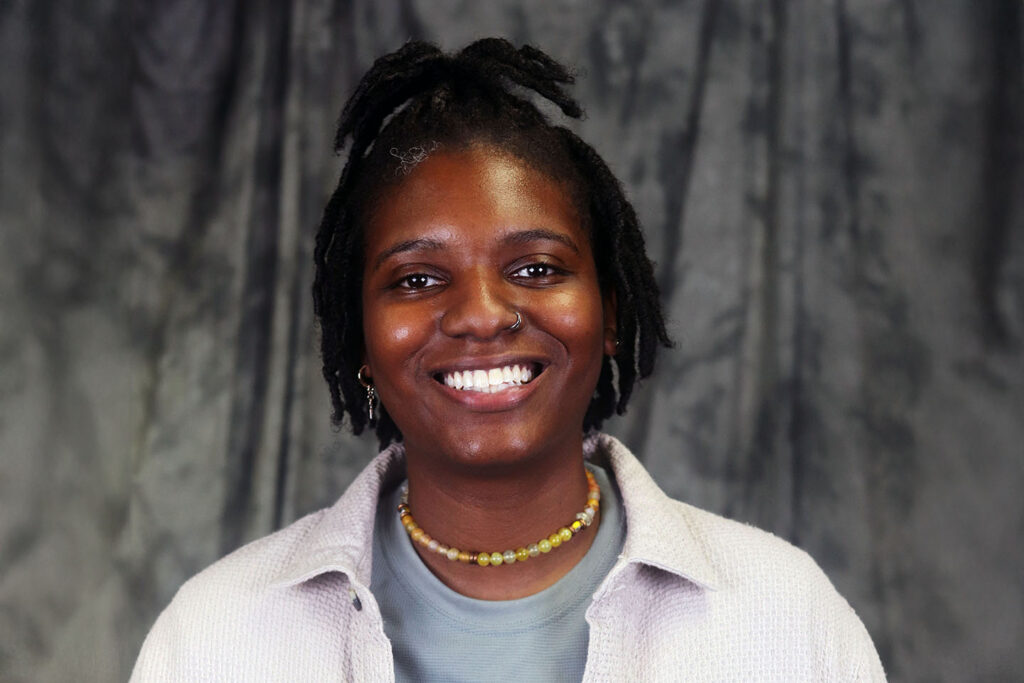
By Chanelle Williams
“You just get it. You know what it’s like to be me.”
Those words from Aaron, a bright and outspoken 9th grader in my African American History class, still resonate deeply with me. As a Black woman teaching in the city where I grew up, I share experiences and understandings with my students that go far beyond textbooks. When we studied the Great Migration and connected historical displacement to modern-day issues like gentrification and housing injustice in Philadelphia, Aaron saw his own family’s struggles reflected in the lesson.
As we discussed redlining maps side by side with today’s eviction rates, Aaron suddenly raised his hand and said, “Ms. Williams, this is like what happened to my cousin’s building last year.” His face lit up with the realization that history wasn’t just something in a textbook; it was part of his family’s story. That moment stuck with me, not because he understood the lesson, but because he felt understood.
With five years of experience under my belt, I can confidently say that teaching is my calling. My rapport with students, engaging lessons, and the tangible growth reflected in student achievement data affirm this truth every day. Yet, the path to becoming an educator especially for people of color is riddled with unnecessary barriers. As a Black educator who fought my way into this profession, I’ve come to see both the systemic obstacles and the opportunities to reshape them.
The problem is not unique to me. Across Pennsylvania, the teacher shortage has reached critical levels, with more than 2,000 vacancies and 6,500 emergency-certified teachers. This dearth disproportionately impacts special education; science, technology, engineering, and mathematics fields; and schools serving historically underserved communities where representation matters most. But the shortage isn’t just a numbers problem; it’s a systemic issue tied to how we prepare, certify, and support educators. Current certification pathways often exclude aspiring teachers of color by emphasizing rigid, one-size-fits-all standards that fail to recognize diverse strengths, which leads to fewer people of color entering the profession. After all, research shows that all students benefit from a diverse teaching workforce.
To truly address this critical issue and build a workforce that reflects our students, Pennsylvania must rethink what it means to be qualified to enter teaching and create accessible, equitable pathways into the profession.
It begins with teacher preparation programs, which should place greater value on overall academic performance, including grade point average (GPA) and relevant coursework, rather than relying solely on a single test score. Academic achievement reflects sustained effort, content mastery, and dedication, all qualities vital to effective teaching but ones that aren’t necessarily captured on teacher entrance exams.
Many certification exams are expensive and often disconnected from the realities of classroom teaching. Investing in performance-based assessments, high-quality coursework, and clinical practice that accurately measures teacher readiness and effectiveness would reduce financial strain on teacher candidates and make certification processes more equitable. I struggled through these tests for three years, even while excelling in my coursework and earning a master’s degree in education. It wasn’t until the Pennsylvania Department of Education allowed me to use my GPA as a qualifier that I finally earned my certification.
Then there’s student teaching, which is often unpaid, placing a heavy financial burden on aspiring educators. Paying student teachers through salaries or stipends like the PA Student Teacher Support Program would remove this financial barrier, especially those from low-income backgrounds. By investing $30 million in student teacher stipends, the 2025–26 state budget makes real bipartisan progress; however, full funding of $50–$55 million is still needed to ensure future student teachers don’t face the stress I did. When I was a student teacher, I had to work summer jobs to cover rent, transportation, and basic living expenses. This juggling act left me overwhelmed and distracted at a time when I needed to focus fully on developing my craft.
If I had let barriers stop me, I would have missed out on a deeply rewarding career, and my students would have missed out on a teacher who understands them beyond the curriculum. I think back to the students who stop by my classroom to talk, who linger after the bell to share stories or ask questions they don’t feel safe asking anyone else. Aaron’s voice echoes in my mind: “You get it.” He wasn’t just making an observation; he was issuing a call to action. Let’s listen. The time to open the door wider and create accessible pathways for teachers of color is now.
Chanelle Williams is a 9th grade African American history teacher and African American history content lead for the Mastery Network. She is a 2024-2025 Teach Plus Pennsylvania Senior Policy Fellow.
Disclaimer:
The views, thoughts, and opinions expressed in the article belong solely to the author, and not necessarily to the author’s employer, The Philadelphia Sunday SUN, the author’s organization, committee or other group or individual.