
In the wake of mass shootings at Brown University in Providence, Rhode Island, and Sydney, Australia, Northeastern Global News spoke to Khushal Safi, head of global security at Northeastern University, about how the institution works to assess risk, responds to threats and ensures safety of its global community.
Safi oversees Northeastern’s Global Safety Operations Center, or GSOC, a 24/7 hub that monitors global risks and security-related events across all the university’s 13 campuses. He also tracks the location and well-being of Northeastern students, faculty and staff abroad, and coordinates real-time emergency support worldwide.
He and his team helped three students evacuate Israel after the Hamas attack on the country on Oct. 7, 2023; assisted co-op students in navigating the aftermath of a disastrous earthquake in Marrakesh, Morocco; and extracted a professor from a military coup in Niger.
Safi has had an extensive career in counterintelligence that has taken him around the globe. Most recently, he worked in Afghanistan from 2009 to 2014 as a U.S. intelligence officer.
His comments have been edited for brevity and clarity.
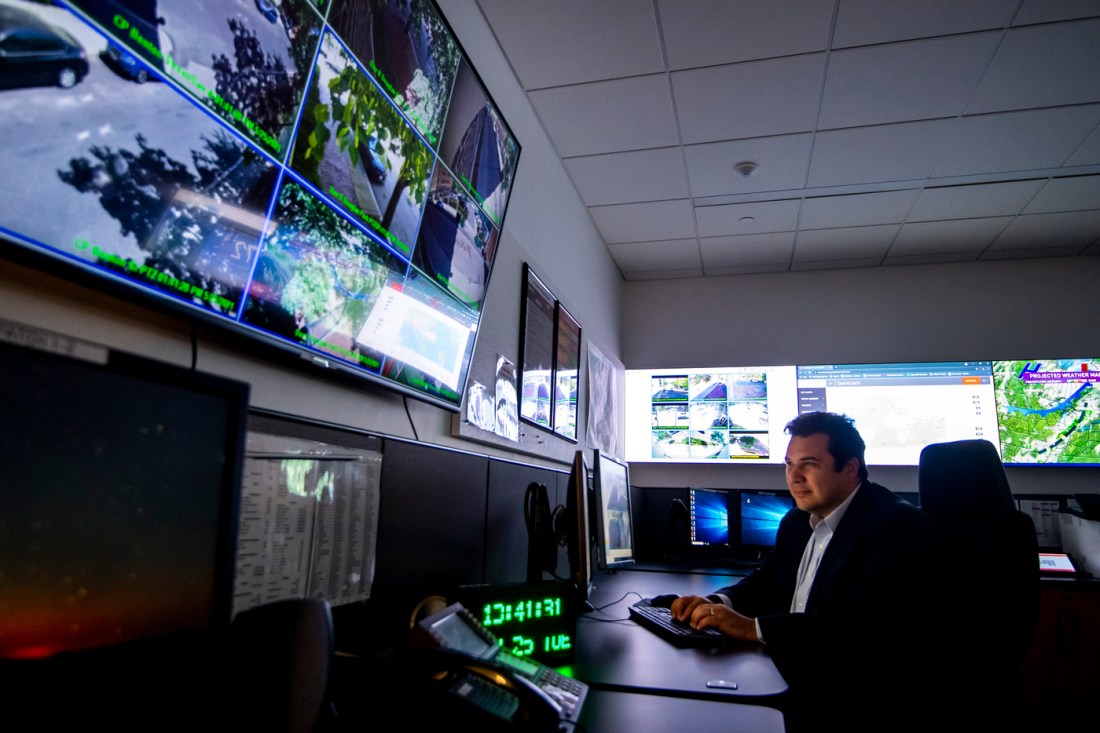 Khusal Safi oversees Northeastern’s Global Safety Operations Center, or GSOC, a 24/7 hub that monitors global risks and security-related events across all of the university’s 13 campuses. Photo by Ruby Wallau/Northeastern University
Northeastern has 13 campuses in three different countries. What are the differences and similarities from campus to campus?
The safety and well-being of our community is our number one priority, wherever they are. Our security infrastructure is tailored to support the unique aspects of each campus location and is tied together by the Global Security Operation Center. The Boston campus is in a dense urban location across 73 acres, with a population of tens of thousands of students, faculty and staff. The technology and resources we have in place are designed to provide us with the ability to monitor our campus, assess threats and respond immediately in support of every member of our community.
Our London campus is also in a major urban city but has fewer buildings and a smaller population. Our Oakland campus is twice the size of the one in Boston and has about a thousand students.
We have thirteen campuses, and they are all different. But what is identical is the robust nature of the security infrastructure in each location, which is complemented by partnerships with local law enforcement and third-party security providers who can assist no matter the issue a student, a professor, or a staff member might be tackling.
Describe the safety measures you have in place on the Boston campus.
The Global Security Operation Center, or GSOC for short, is located on the Boston campus and this is where all the different pieces of threat intelligence and security data converge. In Boston, there’s police dispatch, monitoring the cameras, the doors, and the alarms, and they work with facilities and other teams to enhance building safety.
There are communication nodes throughout campus — blue light or Code Blue phones — so if someone’s phone goes down, they can push a button and speak to our police dispatch. They will receive immediate assistance.
Then there are various alarm systems. For example, in the library, if you push through a turnstile, an alarm goes off. The person at the desk gets alerted, and so does our police dispatch. If someone props open a door with a sensor, pushes through a fire door, opens a rooftop door — we get alarms.
We have cameras providing comprehensive coverage of our campuses. The technology is in addition to the robust staffing.
We have campus police officers and security personnel ready to identify and respond to security risks. We have badge readers that provide access to certain areas of the university, like the residence halls and libraries. We also have proctors in each residence hall as part of our Residential Security Office; they’re the people sitting at the desks making sure that only authorized people are coming into the facility — and you are only permitted to enter the facility if you have access to the building.
Then beyond that, we have community service officers who provide security escorts for anyone requesting it. They work with the police department, and we strategically deploy them to different areas. They do a lot of the checks on our security technology infrastructure.
We have our police officers — armed and with arrest authority — who are patrolling around campus; and many of them are trained as our incident containment team, which is a quick response force. These are the police officers who are trained to stop an active threat.
How quickly can those officers respond?
Almost immediately, because the incident containment team is on campus. Their close familiarity with every inch of our campus, including buildings, classrooms, alleys, tunnels, entrances and exits, provides a significant advantage, and enables rapid deployment across the Boston campus.
Northeastern’s global community extends beyond these 13 campuses. How do you support students on co-op in Asia, or a faculty member in Africa, who might find themselves in a crisis?
Our work is 24/7. There is no time zone or location that is out of our reach. Our community travels for co-op, for research projects, for study abroad, for conferences, you name it. Our students are in 158 countries on all continents. The issues they may encounter can range from a medical emergency to a political coup.
We have built a threat monitoring system that scrapes data and alerts from numerous open source, governmental, and subscription-based sources. These alerts display in our GSOC’s dashboard are automatically correlated with our global campuses map and the data in our travel registry. If anything is developing anywhere in world, that is in close proximity to a campus or a traveler. The GSOC Analyst get an almost immediate reports of our campuses or any member of our community being in the affected area so we can reach out and assist. As an example, when the October 7 terrorist attacks happened in Israel, we were able to evacuate our students within 24 hours.
We also build and maintain partnerships and contacts around the world, including with security firms, healthcare providers, law enforcement, and even local drivers and other individuals who can help navigate the environment in high-risk areas.
Do students and employees have to register before they travel?
Yes. We have a travel registry for all members of our community who are planning to travel for university sponsored programs. In addition, they must carry an operational cell phone with international calling, SMS, and cellular data capabilities. It is important that phones can receive incoming communication and make outgoing phone calls without relying solely on data-calling or a Wi-Fi signal.
We also have a dedicated 24/7 Northeastern Global Health and Safety hotline, the number is +1.857.214.5332 or +44.20.3467.1773, that can assist callers based on their individual needs. For example, the operators can help with health and safety advice through a team of on-call medical or security professional, provide medical/hospital referrals, coordination of care, and help callers with urgent travel or immigration matters. It can also provide emergency evacuation services.
In addition to registering their travel, our team also works with each individual on pre-travel preparations, depending on the potential risks they may encounter at their destinations.
Tanner Stening is an assistant news editor at Northeastern Global News. Email him at t.stening@northeastern.edu. Follow him on X/Twitter @tstening90.