In Philadelphia, officials and residents hope that a new, sweeping housing plan will do more than alleviate the city’s long-standing problem of housing affordability. They think it might also drive down violent crime.
Listen to the audio edition here:
Among them is Sharon Obentsuwaa-Tiga, who testified at a City Council hearing on December 2. Obentsuwaa-Tiga earns less than $20,000 a year. She’s been a single parent of two since a 2022 shooting near a Southwest Philadelphia public housing community killed her children’s father.
“I asked him to move out of that neighborhood, but he wouldn’t,” she says. “It’s not even safe for children to live in that area.”
She came to the hearing to show her support for Mayor Cherelle Parker’s Housing Opportunities Made Easy (H.O.M.E.) plan, which Parker first unveiled in March. It touches on affordability in different ways, like changing mortgage qualification rules and helping residents repair leaking roofs.
The $2 billion, four-year initiative is on track to win final City Council approval this month. The funding comes from $800 million in housing bonds, city land assets valued at $1 billion, and federal and state dollars. That money is supposed to fund the building and refurbishing of 30,000 housing units. The plan also aims to provide financial assistance to homeowners and renters, remove blight, reduce the number of vacant properties, and help beautify neighborhoods.
In recent years, a steady stream of research has connected housing to public safety. In 2023, a University of Pennsylvania study found that fixing up clusters of abandoned homes with new doors and windows, and clearing yard weeds reduces gun crime compared to clusters of houses that received no remediation.
Obentsuwaa-Tiga, a native of Ghana who works as a nursing assistant, lamented that many of the city’s poorest residents are virtually trapped in dilapidated housing in dangerous communities without the means to improve their circumstances. She makes ends meet by living with her parents in Northeast Philly. She hopes that the housing plan will help her get a place of her own.
“We need to really look at some of these buildings and houses. They are not pleasant. You look at them and it’s like, Oh, no!” says Obentsuwaa-Tiga, 43. “This is a developed country. Why aren’t our houses developed the way they’re supposed to? They breed violence.”
400 dead houses
A drive through parts of West and Southwest Philadelphia provides a window into some of the city’s best and worst housing. On the highest end, there are stately Victorian houses and newly built townhouses in Spruce Hill and University City. On the lowest end are more than 400 abandoned homes that are magnets for crime and violence, say concerned residents, including City Councilmember Jamie Gauthier, who represents the area.
There’s the house at the corner of 61st and Walnut Streets, all boarded up on the first floor, with windows missing on the second. The house at 5939 Pine Street also features boarded-up windows, a sofa turned sideways, slouched against the front porch, and a trash dump along the side wall.
“Housing is health care, housing is a way that we keep people out of the criminal legal system.” — City Councilmember Jamie Gauthier
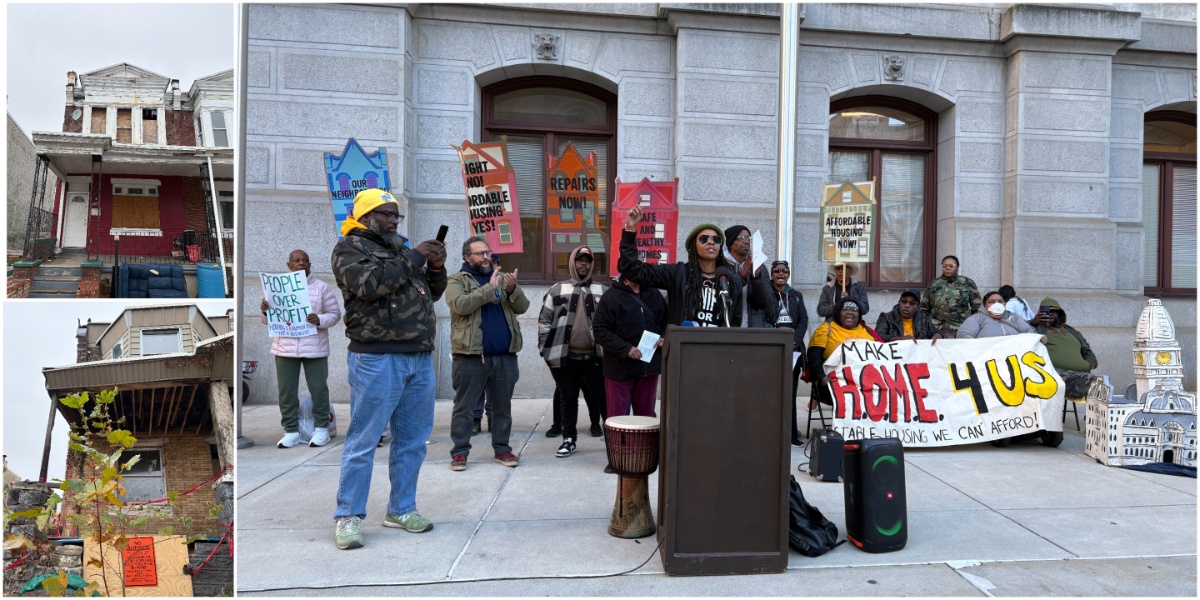
Two side-by-side houses on the 5600 block of Walnut Street stand forlorn on an otherwise intact block, across from the Kingdom Hall of Jehovah’s Witnesses church. Then there is the house on Spruce Street near 60th that looks so haunted that the OnePA West/Southwest Rising organization used it as the backdrop for a spirited news conference to demand that the city’s housing plan address such problem properties.
The organization, which represents low-income Black residents, is calling for the city to enact a law to hold property owners accountable for repairing vacant properties and for the city to repair abandoned buildings and turn them into affordable housing and green spaces.
“We chose this issue because every empty lot and boarded-up house erodes community trust, fuels crime, and undermines our vision of a safe, beautiful neighborhood for all families,” says Rasheeda Price, a OnePA co-chair. She added that in addition to just over 400 unsafe vacant homes in Gauthier’s Third Council District, there are 31 dangerous buildings. Some of those properties are hot spots for crimes, she says.
“Hideouts for illegal activity”
The authors of the 2023 University of Pennsylvania study also found that vacant houses help drive crime, perhaps because they “are excellent hideouts for illegal activity, like open-air drug dealing, that can generate gun violence.” The authors noted that such houses are used to store firearms and contribute to a stressful neighborhood environment, which may lead to the escalation of disputes involving firearms.
Dianna Coleman, a OnePA member and block captain in her Southwest community, called vacant and abandoned properties one of Philadelphia’s most pressing and overlooked crises. “In neighborhoods full of broken houses and empty lots, it’s not just a housing issue, it’s a public health crisis,” says Coleman, who was The Citizen’s 2025 Block Captain of the Year. “And until we treat it like one, we will continue to lose lives, we will continue to lose families.”
Gauthier says the OnePA members’ opinions are supported by the study, which found that one reform helped reduce weapons violations, gun assaults, and, to a lesser extent, shootings: remediating abandoned housing in under-resourced, predominantly Black Philadelphia neighborhoods.
In 2023, a University of Pennsylvania study found that fixing up clusters of abandoned homes with new doors and windows, and clearing yard weeds reduces gun crime compared to clusters of houses that received no remediation.
To study three measures of gun violence — weapons violations, gun assaults, and shootings — researchers randomly sorted a master list of 3,265 abandoned homes in Philadelphia, then formed 63 neighborhood clusters of 258 abandoned houses.
The clusters were randomly allocated to three study groups. Houses in the first group receieved full remediation — working windows and doors were installed, trash was cleared, and yards were weeded around the vacant houses. The second group received yard cleaning only — trash pickup and weeding. The third had no interventions.
The researchers found that, while gun violence went up across all groups in the trial, it went up the least in the full remediation group. “So the impact of the intervention is real — it buffered against upward trends in gun violence,” summarized study co-auther Eugenia South.
“We know, and it’s been proven, that in areas where we’ve done interventions like fixing up homes that are vacant and abandoned, greening lots, you see shootings come down,” Gauthier says.
‘Housing is health care’
Gauthier, along with seven other Council members, OnePA, and other housing advocacy groups, rallied and called for changes to the housing plan, like serving more low-income residents at the expense of higher-earning residents. The entire Council preliminarily approved the amendments at a December 2 hearing, over the objections of the Parker administration. During its December 11 meeting, the Council approved the amendments.
“Cities need affordable, accessible, stable housing for cities to be safe, for neighborhoods to thrive,” says Gauthier, who chairs the Council’s Committee on Housing, Neighborhood Development, and the Homeless. “Housing is health care, housing is a way that we keep people out of the criminal legal system.”
On December 7, Parker took her objections to nine churches across the city, where she told congregants that if the City Council approves the changes, thousands of homeowners will be excluded from the H.O.M.E plan’s Basic Systems Repair Program, which provides free home repair grants for homeowners to fix electrical, plumbing, heating, carpentry and roof emergencies.
“We cannot and will not exclude owners of these homes from accessing free repair grants under H.O.M.E. because they earn a nickel and a quarter more than the income eligibility limits,” Parker says. “Not on my watch.”
Mensah Dean is a staff writer at The Trace. Previously he was a staff writer on the Justice & Injustice team at The Philadelphia Inquirer, where he focused on gun violence, corruption and wrongdoing in the public and private sectors for five years. Mensah also covered criminal courts, public schools and city government for the Philadelphia Daily News, The Inquirer’s sister publication.
 Every Voice, Every Vote funds Philadelphia media and community organizations to expand access to civic news and information. The coalition is led by The Lenfest Institute for Journalism. Lead support for Every Voice, Every Vote in 2024 and 2025 is provided by the William Penn Foundation with additional funding from The Lenfest Institute for Journalism, Comcast NBC Universal, The John S. and James L. Knight Foundation, Henry L. Kimelman Family Foundation, Judy and Peter Leone, Arctos Foundation, Wyncote Foundation, 25th Century Foundation, and Dolfinger-McMahon Foundation.
 MORE FROM THE TRACE
Far left: Two blighted Philadelphia homes, and a protest outside City Hall. Photos by Mensah M. Dean.