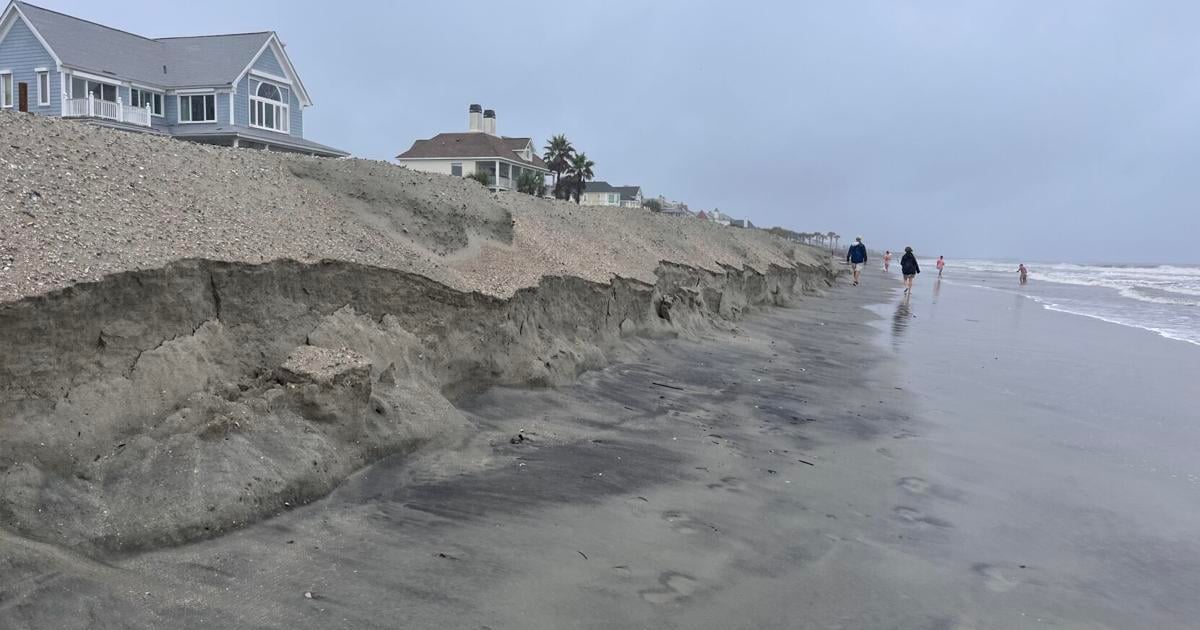
ISLE OF PALMS — As the city works to defend the island against major erosion on both ends, officials are looking to get a handle on long-term solutions for managing the beach, and they want to get the right engineering firm on board to help.
The focus on future planning follows a year in which the city put hundreds of thousands of dollars toward emergency measures following king tide cycles and storms that ate away at the shores. The barrier island saw fleeting sands in hotspots historically prone to erosion and in new areas at the southern end of the island.
Reports from coastal scientists for the Isle of Palms reiterated that the beach is losing sand at an unsustainable rate, leading city leaders to consider new ways to strengthen the island.
Two coastal engineering consultants will craft proposals for the city to help tackle persistent erosion at the north and south ends of the Isle of Palms. City Council selected Coastal Science and Engineering and Foth Olsen Associates, a Florida-based engineering firm, on Dec. 9 to explore and analyze several ideas for strengthening beach conditions.
Coastal Science and Engineering and Foth Olsen were two of four firms to respond to the Isle of Palms’ request for qualifications published in November.
The city has worked with the two engineering consultants in the past. Recently, Foth Olsen offered a second opinion on the Isle of Palms’ beach management strategies. CSE has documented the Isle of Palms’ shoreline and erosion patterns for many years.
Looking for long term solutions for erosion
Much of the city’s efforts in 2025 to strengthen the beach was in response to storm damage or sand loss from extremely high tide cycles. After Hurricane Erin, the city spent over $550,000 on emergency sandbag deployments for highly-eroded sections of the island.
The Army Corps of Engineers pumped 60,000 dump trucks-worth of dredged sand onto Breach Inlet early this year, too, as part of the agency’s work to dredge the Intracoastal Waterway.
And on the north end of the island encompassing Wild Dunes, the city partnered with the resort to harvest sand from an incoming shoal in 2024. Those efforts are finally showing early results: a portion of the sandbar attached to the shore near Beachwood East and Dunecrest Lane. With the shoal joining the existing sands, the beach is significantly wider where high tides sometimes reach the foundations of the homes there.
While it’s a promising development, the shoal will only provide temporary relief to the island’s north end, the city wrote in a Dec. 5 project update shared to Facebook.
“The long-term erosion in this area will continue, and a major beach renourishment project will still be necessary to restore and protect the beach in a lasting way,” the social media post read.
That major beach renourishment, the first one the city has planned since 2018, is on the horizon. Construction on the project is anticipated to start in late 2026.
City leaders want to pair these projects with a number of “back of the napkin” concepts to strengthen beach conditions. City Administrator Douglas Kerr told city council on Dec. 9 that engineers with the two firms will conduct a deeper study on several loose concepts that have been discussed throughout the year.
“This would be an effort to get a deeper study on each of those, identify the pros and cons, cost estimates, and hopefully give council the tools you all need to make some choices about if and how you would like to create a more durable beach,” Kerr said.
These ideas include conducting regular beach renourishments, either alone or in conjunction with erosion control structures. These structures could include adding groins to the beach, building breakwaters, or placing geo-tubes on the shore, which are sand-filled fabric tubes designed to support dune growth. These additions would absorb the blows from waves and high tides and trap shifting sands by physically fortifying the beach.
CSE and Foth Olsen will also turn their attention to the conditions at Breach Inlet and Dewees Inlet to “alleviate erosional currents,” the RFQ states. They’ll explore other methods that could include physically changing the inlets through realigning the channel or creating an offshore sand trap.
These ideas were included in Foth Olsen’s September report. The firm wrote that the methods could “provide more consistent beach conditions and shore protection” as well as “increase the time between required large-scale renourishment.”
Engineers with Foth Olsen and CSE will present their proposals in early 2026. From there, city council will decide which firm they want to move forward with.