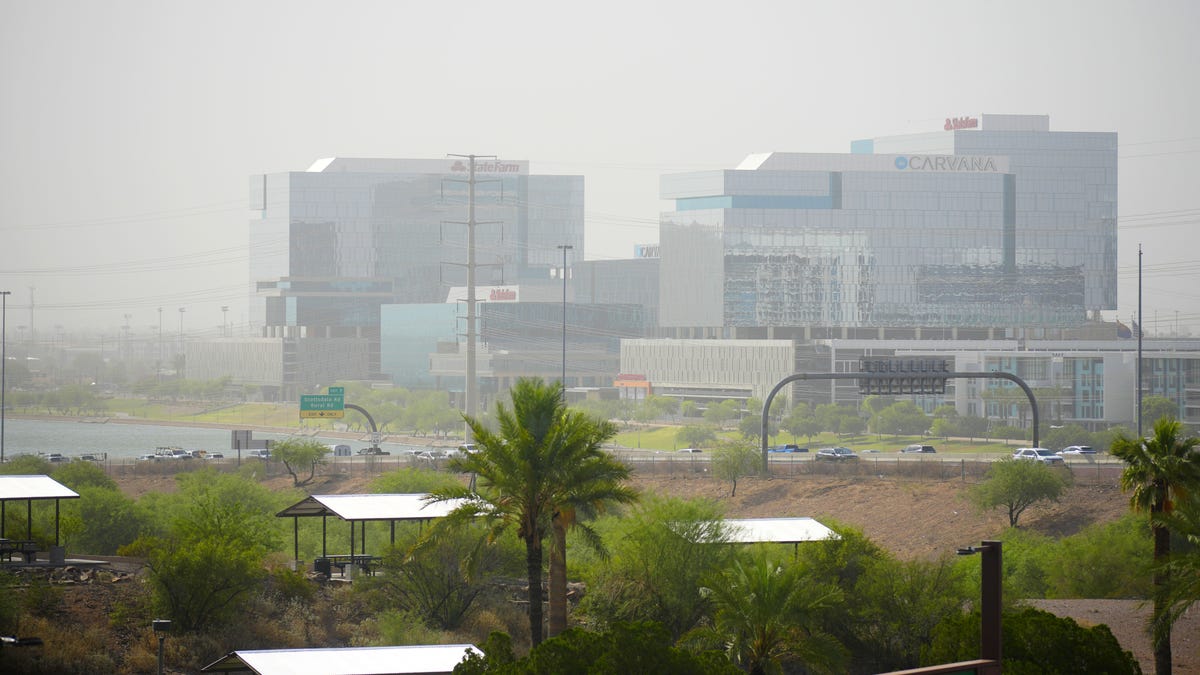
Maricopa County has issued no-burn day advisories through Dec. 17 as hazy skies and dangerous air pollution settle over the region this week due to winter weather patterns and holiday festivities taking hold across the Valley.
The county is under no-burn day advisories at least through Dec. 17, with wood burning prohibited and leaf blowing and off-road vehicle use discouraged. Officials issued yellow air quality flag warnings for Tuesday, Dec. 16 and Wednesday, Dec. 17, signaling moderate pollution levels that could approach unhealthy levels for sensitive groups.
Air quality monitors across the Valley showed elevated PM 2.5 and PM 10 readings, which are two types of fine particulate matter pollution. Pollution peaked during the overnight and early morning hours, a common pattern for the winter holiday season in Phoenix.
Why winter air quality plummets in Phoenix
Winter hazy skies are driven by a seasonal temperature inversion combined with calm winds and increased smoke from fireplaces and fireworks.
“What’s driving these elevated levels is the weather,” said Ari Halpert, a communications officer with the Maricopa County Air Quality Department. “The Valley is shaped like a bowl, and we have an atmospheric condition during the winter season called a temperature inversion. It creates a lid on top of the valley.”
During the winter, surface temperatures cool quickly overnight, while a layer of warmer air settles above it. That warmer air acts like a lid, trapping colder air and pollution close to the ground.
Without wind to clear the pollution, smoke and fine particles can build up near the surface.
“Add to that wood burning and the use of consumer fireworks, all of that contributes to higher concentrations of air pollution during the season,” Halpert said.
As residents celebrate the holidays, they tend to light fireplaces and fireworks, worsening the air quality in Phoenix.
No-burn days and winter restrictions
Winter air quality problems are a recurring issue in Maricopa County because the temperature inversion happens every year and residents burn more wood and fireworks during the colder months.
The Maricopa County Air Quality Department launches its annual Burn Cleaner, Burn Better campaign to raise awareness and discourage polluting activities.
“It would take the weather changing and having some more wind to clear the air, which of course we can’t control,” Halpert said. “But we can control our own actions.”
The county has already issued multiple no-burn days this month: Dec. 7 and Dec. 13 through 17. While levels haven’t increased enough to call a high pollution advisory for the rest of the state, pollution is on the rise.
Halpert said pollution often peaks later in the holiday season, with the worst air quality typically occurring on New Year’s Eve and New Year’s Day as residents celebrate and light fireworks. She encourages residents to attend professional firework shows instead of lighting consumer fireworks.
Professional-grade fireworks explode higher in the atmosphere, allowing smoke to disperse. But personal fireworks are ignited closer to the ground, where pollution can linger.
“We see the worst of it as we approach the holiday season,” Halpert said. “Last Jan. 1, we started out the year having the third-worst air quality in the world and the worst in the nation, where air pollution reached hazardous levels.”
Health concerns
Particle pollution affects everyone, but some residents are more vulnerable during poor air quality days. Older adults, children and people with preexisting respiratory conditions like asthma are most at risk.
Short-term exposure to elevated particulate matter, especially PM 2.5, the fine particles commonly found in wood smoke, can aggravate lung disease, trigger asthma attacks and cause acute bronchitis.
Long-term exposure over months of years has been linked to serious health impacts, like reduced lung function, chronic bronchitis, premature death and increased risks of cancer and harmful developmental and reproductive effects.
For more information on no-burn days, fine particulate pollution and health risks, visit maricopa.gov/aq.
Hayleigh Evans writes about extreme weather and related topics for The Arizona Republic and azcentral.com. Email her with story tips at hayleigh.evans@arizonarepublic.com.