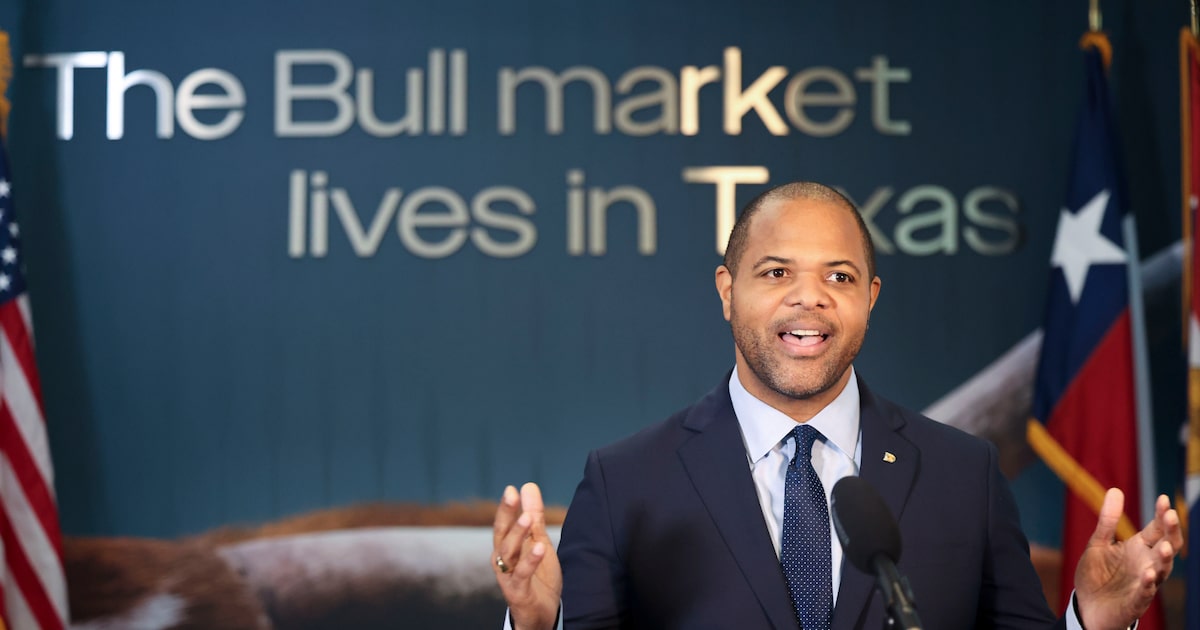
Dallas Mayor Eric Johnson said the Republican Mayors Association, a group he launched after he switched from being a Democrat, could help the GOP make gains in the 2026 midterms by attracting urban voters.
“For a long time, the Republican Party has basically conceded that Democrats are going to be dominant in our major cities and use them more as foils to talk about,” Johnson said in a CNBC interview that aired Monday. “But what we’re realizing now is that there are a lot of votes in these cities, and they actually impact the statewide races, and particularly swing states. It becomes very important in presidential years.”
This comes nearly a week after the city of Miami elected Eileen Higgins, a Democrat, instead of a candidate backed by President Donald Trump in Florida, a red state.
Johnson said he wanted his association and the Republican National Committee to get involved early in scores of mayoral races in the top 300 cities where there may be an overlap in a key congressional race. “In Miami, the Democrats were really early involved in that race, and it paid off for them, and they outspent us 19 to one in that race,” he said.
Political Points
“We can’t let that happen,” he continued.
Mayoral races shaping the 2026 political map
- Miami, Florida: Voters recently elected Democrat Eileen Higgins, defeating a candidate backed by President Donald Trump after Democrats invested heavily in the race. No Democrat had held the position in decades.
- Los Angeles, California: The largest U.S. city with mayoral elections next year. The race is nonpartisan, but Mayor Karen Bass, a progressive Democrat, won in 2022 by nearly 10 points over former Republican Rick Caruso.
- Oklahoma City, Oklahoma: Republican Mayor David Holt is up for reelection in a nonpartisan race.
- Louisville, Kentucky: Currently led by Democrat Craig Greenberg. Next year will mark the city’s first nonpartisan mayoral election, even as the state votes reliably Republican statewide.
- Raleigh, North Carolina: Mayor Janet Cowell, a Democrat, leads the state capital. North Carolina has emerged as a potential swing state in recent presidential cycles.
- New York City, New York: Voters recently elevated a younger, more progressive mayor, signaling fresh challenges for Republicans in one of the nation’s largest Democratic strongholds.
The midterms next year have the potential to shift the levers of power, and Johnson, who has typically cast himself as opposed to policies that call for more government regulation, said affordability would remain relevant to the GOP.
“To a certain degree, people are forgetting that we do live in a free market economy, at least ostensibly, and prices of things are determined by the market,” he said, adding that supply and demand determine prices, and there was a growing feeling that the government can play a greater role in setting prices.
“That, to me, is a little bit concerning,” he said.
Republicans, he said, will have to be careful about how they respond to it. “If we go down that road, I think that we’re sort of playing to the socialist game here, and if we don’t, we appear not to be sensitive to the issue,” he said.
Why cities matter in 2026
- Urban votes could shape statewide races: Johnson said Republicans can no longer afford to treat major cities as political afterthoughts, arguing that urban turnout can influence statewide and presidential contests.
- Overlap with congressional races: He said mayoral contests often coincide with competitive congressional districts, creating opportunities to build turnout and messaging across races.
- Early investment pays off: Johnson pointed to Miami as an example of Democrats getting involved early and outspending Republicans, a strategy he said the GOP must match.
- Nonpartisan races still carry partisan consequences: Even in cities like Dallas and Los Angeles, where mayoral elections are officially nonpartisan, outcomes can signal broader ideological trends.
- Affordability cuts across party lines: Johnson said housing costs and prices remain key issues in cities, forcing Republicans to balance free-market arguments with voter concerns about rising costs.