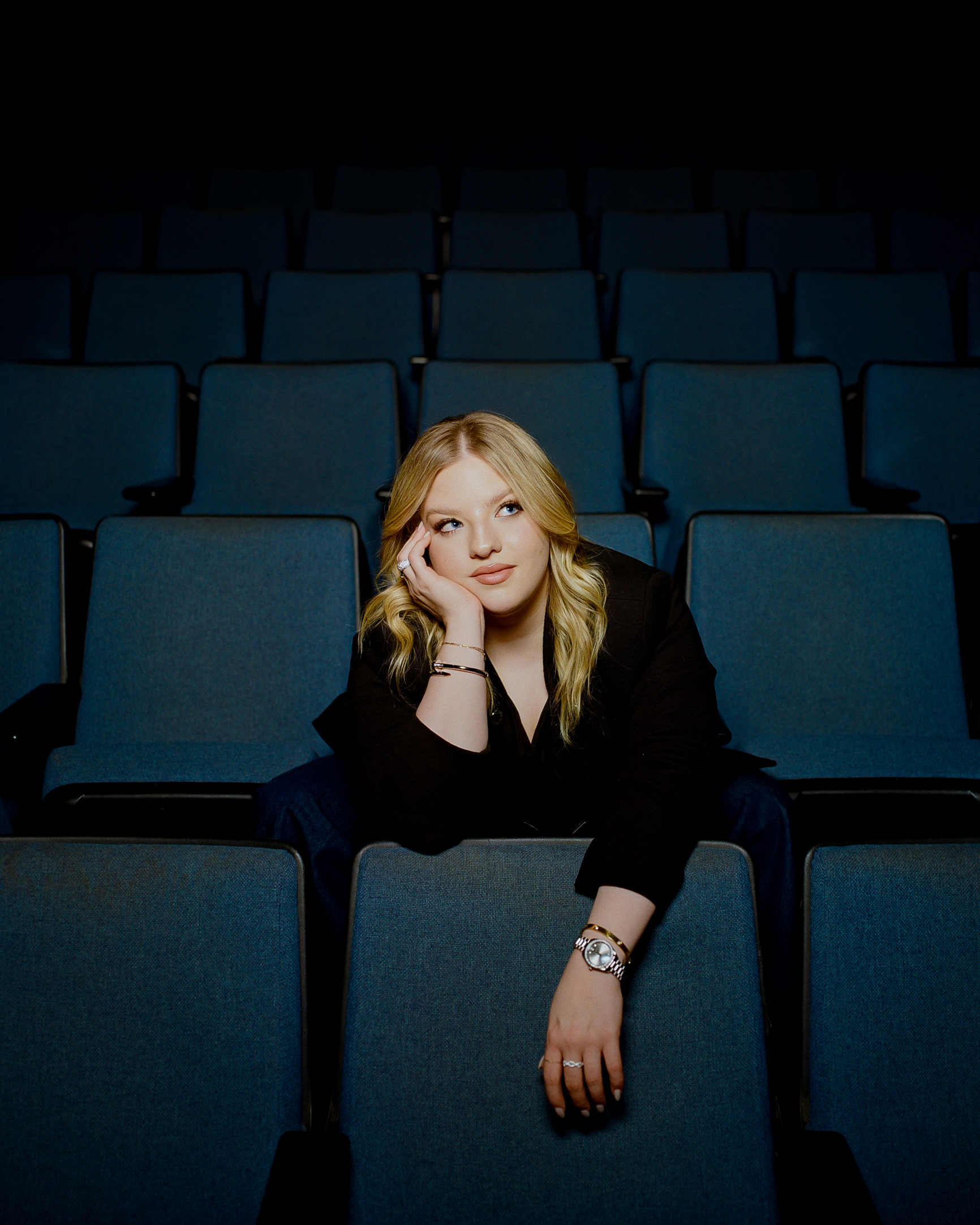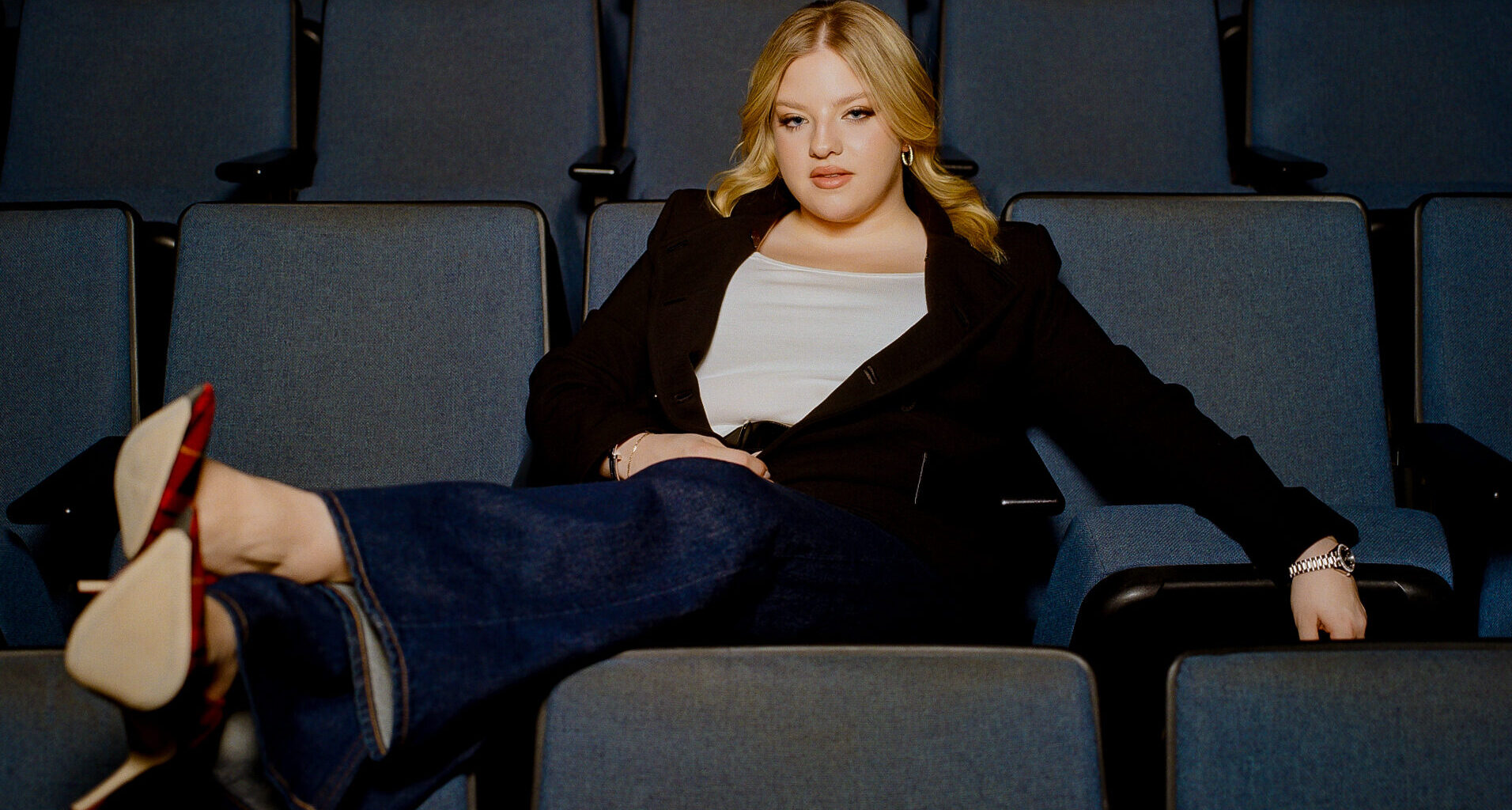
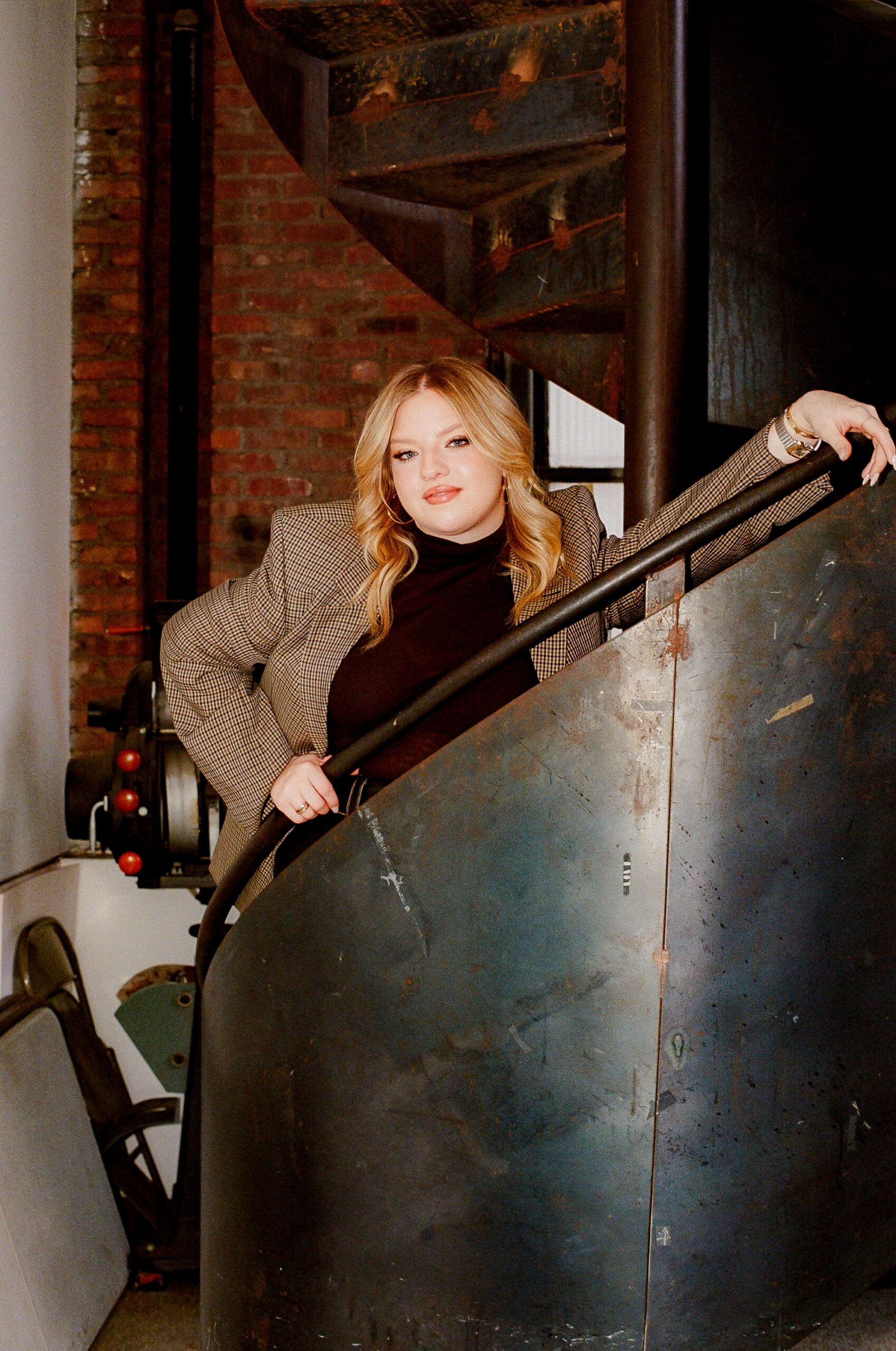
Francesca Scorsese, photographed by Dev Bowman at Anthology Film Archives. Blazer Balenciaga Turtleneck The Frankie Shop.
When I met Francesca Scorsese for coffee earlier this month, the state of theatrical moviegoing had officially entered something of a crisis state. Days earlier, Netflix announced its $72 billion acquisition of Warner Brothers, an inauspicious development for the Hollywood studio system and the survival of movie theaters, for which Francesca’s father, Martin Scorsese, has been one of the industry’s most full-throated advocates. For the 26-year-old, though, the venerable director of several of the greatest American movies ever made is simply “dad.” That means that Francesca, who’s just directed her first episode of television on the Fox Nation series The Saints, has a leg up on most if not all of her peers. But it also means she received the kind of film education most cinephiles could only dream of, having grown up in what she describes as a “dreamland of make-believe and pretend.” More recently, as she prepares to write a book for A24 about her singular cinematic upbringing (which included several cameos in her father’s movies and standing appointments at his private uptown screening room), Scorsese’s had the occasion to revisit the films that shaped her. So, on an arctic afternoon downtown, we took shelter in the lobby of the Bowery Hotel, where Scorsese regaled me with several tales from a charmed life of moviegoing.
———
JAKE NEVINS: So, after many years of being known predominantly as your father’s daughter, you’re striking out on your own. What’s it like to make that pivot?
FRANCESCA SCORSESE: That’s a good question. I feel like it just happened naturally. I was in school, and then as I started to create my own things, that’s where the shift happened, if that makes sense.
NEVINS: Did you ever grapple internally with whether or not you wanted to be in the industry?
SCORSESE: Not at all.
NEVINS: Really?
SCORSESE: Not at all, no. My dad would always bring me on set since I was very, very small and it created like, an altered state of reality for me. I was just in this dreamland of make-believe and pretend, and seeing my dad do what he loves to do was amazing. I don’t think I really processed that there was anything else that you could do. So I was like, “I’m going to go into the industry. This is what I want to do. I’ve known it my whole life. Why not?” I just didn’t find any interest in anything else. And I was always like, “Why am I learning algebra?” [Laughs] I’m just kidding, but you know what I mean?
NEVINS: I do.
SCORSESE: It was just natural. I never really had any pushback. The only pushback was actually from my dad when I said that I wanted to get into acting. That was when I was a teenager, and I was going through it a little bit.
NEVINS: As teenagers do.
SCORSESE: As teenagers do. So I was like, “I’m going to act.” I don’t think it took him by surprise, but he knows how dark and scary it can be, especially for a young woman, and how intense it is. So I think it just came out of a place of protection.
NEVINS: But that had more to do with acting specifically, right?
SCORSESE: Yeah, specifically that. Filmmaking, he was like, “Do it. Go.”
NEVINS: Right. Do you remember the first time you became conscious of being Martin Scorsese’s kid?
SCORSESE: This is ridiculous, but going on the carpet and getting photos taken, paparazzi, that’s not normal. But I just thought it was normal, and then—
NEVINS: Did you really think it was normal?
SCORSESE: I don’t think I even thought about it. And then I think when I was around three or four years old, I was at a Cold Stone Creamery. [Laughs] And I was in line and I don’t know what happened, but I saw this older woman and I tapped her and I was like, “My dad’s Martin Scorsese.” And she was like, “Wow.” And when I saw the reaction I was like, “Oh, okay. This random woman in Cold Stone knows who he is, so he must be a pretty big deal.” But I just thought it was a normal thing for so long. And then seeing so many films—that was just normal. In school there were so many kids watching Harry Potter and Hannah Montana and all these things, and I never really got into them because I was watching more classic films. So that’s also where I was like, “Why is nobody watching what I’m watching?”
NEVINS: Were there rules about which films of his you were allowed to watch at certain ages?
SCORSESE: I mean, none of them are really child-friendly except for Hugo, which came about because of me. And I was in it as well, which was fun. But yeah, there were rules, definitely. I’m writing a book with A24 about my film upbringing and all the films that shaped me into who I am today as an artist, as a woman. And the thing is, my dad kept track of every single film he showed me throughout the years since I was a baby. It has my first film ever that I saw—I was just sleeping in a bassinet. I didn’t actually see it, but I was there in the theater while my parents watched the film. So it’s like, “Francesca sleeps in her bassinet. This is the first time that she watches Cinderella, the original Technicolor.” IIt goes to Rosemary’s Baby. It goes to [Alfred] Hitchcock, all of these incredible films. I completely forgot the question, but that’s what the book is about. But my dad’s films, it’s funny—he’s actually really shy when it comes to showing me his films.
NEVINS: Like, bashful about it?
SCORSESE: Yeah, yeah, yeah. He’ll put it on and then leave. He can’t watch me watch it. I’m still waiting to watch a few of them because he’s like, “I want to show you this one at this time and at this time.”
NEVINS: Like which ones?
SCORSESE: The Color of Money.
NEVINS: Okay.
SCORSESE: Casino.
NEVINS: I just watched Casino for the first time a few weeks ago.
SCORSESE: Really?
NEVINS: Yeah. I was really hungover and I was just like, “I’ve got all day.”
SCORSESE: Was it good?
NEVINS: [Laughs] Very good. But it was partially informed by Mr. Scorsese, Rebecca Miller’s terrific new docuseries about your dad. I’m dying to know if you watched it.
SCORSESE: Yeah, I did.
NEVINS: It colored in a lot for me.
SCORSESE: Yeah, me too.
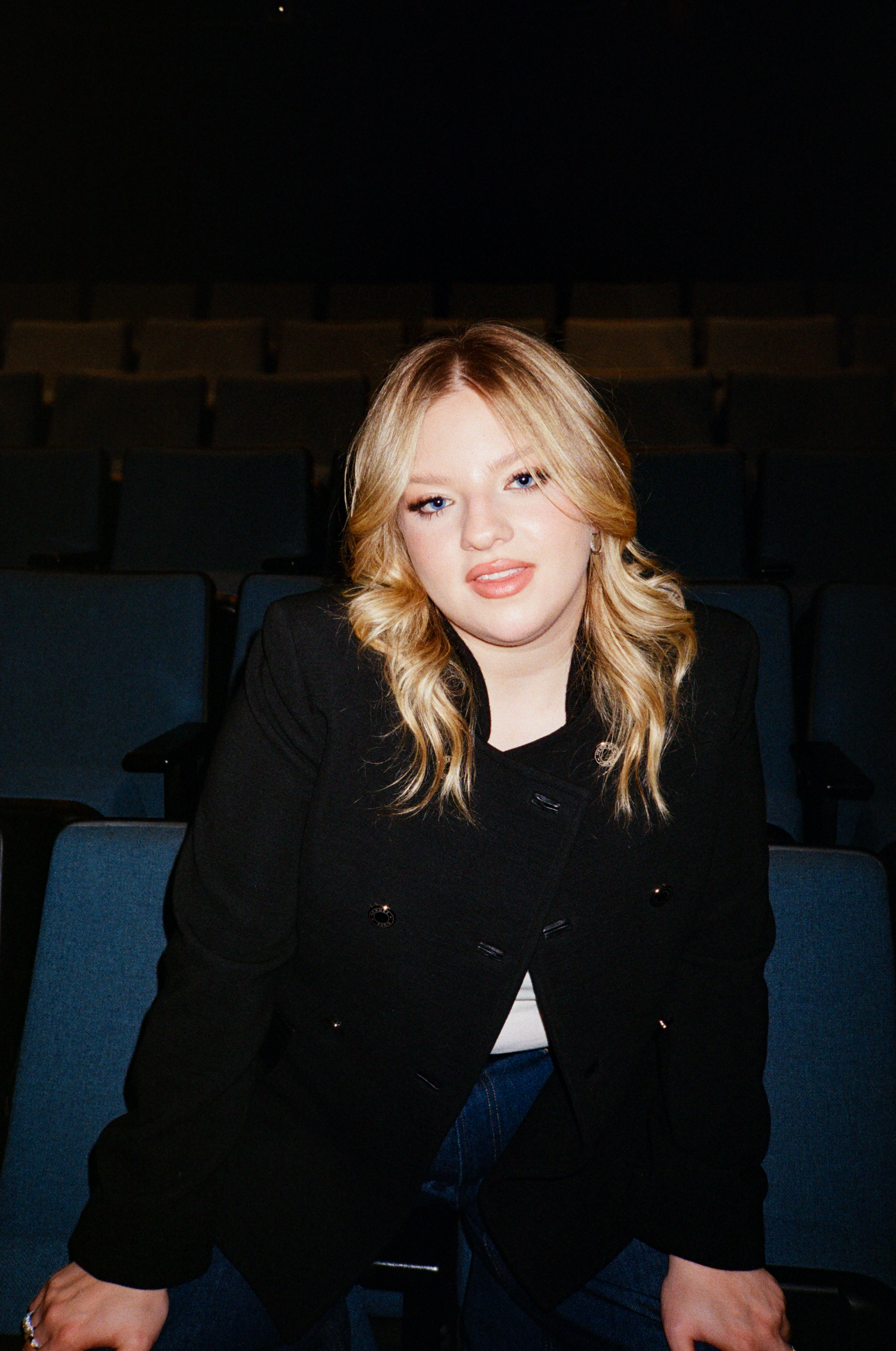
Jacket Hermes Jeans Agolde.
NEVINS: Well, I imagine you had a very distinct experience watching it. What was that like?
SCORSESE: It’s definitely a little weird. I’ve heard a bunch of those stories before, but it was different to see it unfold before my eyes and have it be told through the mouths of other people.
NEVINS: Which stories had you heard?
SCORSESE: Well, sometimes he’ll just go on and on and on about things, like a dad, and I’ll just be like, “Yeah, okay.” I won’t really pay full attention or absorb everything. But I’m also a very visual person, so watching this was a crazy experience. It was interesting how it was sectioned out into literally chapters of his life. There were some girlfriends I didn’t know he had, and that was a big jump scare. And it was interesting to dive a little deeper into his relationship with his other daughters—my sisters. It’s just so cool, everything that he managed to do and how many films… I mean, they even skipped a few.
NEVINS: He’s a pretty prolific guy.
SCORSESE: How on earth did he do that? But it just made me really excited because he’s so passionate. He’s always been so passionate. And a lot of the old home video footage was amazing. It just felt like I could see him how everyone else sees him. I know him so much more personally. And it was very emotional and hard to watch the last episode.
NEVINS: You mentioned your relationship with your sisters, with whom there’s a big age gap.
SCORSESE: Big.
NEVINS: And you guys had drastically different experiences growing up, partially because your father got older and came into a better understanding of how to parent while working.
SCORSESE: Each of us had very different versions of him.
NEVINS: Right. How cognizant of that were you?
SCORSESE: I’ve known. I mean, we’re close. There’s definitely, I wouldn’t say animosity, but it’s a little bit of a tension there, and I almost feel a little bit of guilt. You know what I mean? And I know I shouldn’t. I didn’t ask to be here. But I got a very hands-on version of him. I got the best version of him, and they didn’t really grow up with a dad. He left when they were born or very young. He had stories he wanted to tell and places he wanted to go and he just couldn’t settle down. But obviously, as he’s gotten older, he’s mellowed out a lot. He still has that same burning passion, but he was able to settle down with my mom and with me.
NEVINS: Right. Before we get into your work in particular, I’m curious: What’s it like to watch a movie with your father, and how often do you get a chance to?
SCORSESE: We used to do it every weekend. It’s like our way of bonding, almost. We sit back, we have some pizza, and we watch a film. And a lot of the time it’s like, “Oh, I wanted to show you this because you were talking about this thing, or you’re working on this documentary, or you’re going to be in this film, so you have to watch this.” Or he’s like, “I haven’t seen it yet and I have to watch it for an interview.” That’s what happened the other day when we watched Don’t Look Now. I had a pretty strong reaction to it and my dad was like, “Geez!” And then he felt disappointed, like he thought he disappointed me. And I was like, “No, not at all. I thought it was a beautiful film. There were just parts of it that were confusing or weird or didn’t really make sense, and plot holes.” And I really saw him be a little bit shocked by my own opinion, but he’s given me that ability to have that opinion and voice my opinions. He felt like he’d let me down in a way. And I was like, “Dad, you just showed me a movie. I’m okay.” You know what I mean?
NEVINS: It’s funny, because you can Google “Martin Scorsese’s favorite international films” and “Martin Scorsese’s favorite comedies” and there’s almost always some incredibly comprehensive guide he’s made. Of course, you and I have grown up in a culture of obsessive list-making.
SCORSESE: Obsessive.
NEVINS: From Letterboxd to Spotify Wrapped, the culture encourages us to denominate things.
SCORSESE: And he’s been doing that since the 1990s.
NEVINS: Right. You grew up with the world’s greatest film curriculum.
SCORSESE: Yeah, but I didn’t even know it. But for this book, I’ve had to rewatch a lot of them to remind myself.
NEVINS: That must have been fun.
SCORSESE: It is fun. I’m still going.
NEVINS: And now you’ve just made your TV directorial debut. Tell me how that came about.
SCORSESE: Well, I was such a fan of the first season of The Saints, and I was honestly in the office a lot while my dad was editing. I’d pop in and I’d watch or I’d give little notes every once in a while. And my dad was—
NEVINS: Is he like, sitting there with Thelma [Schoonmaker]?
SCORSESE: Well, not with Thelma. [Laughs] With this guy, Kevin [Chapados], currently for The Saints.
NEVINS: Is he ever like, “We’re busy”? Or is there an open-door policy for you?
SCORSESE: No, I come in, open-door policy. I’ll sit on the floor next to him, whatever. He’s in his little chair. It’s funny because we had a lot of the same opinions. I’ll say something and he’ll be like, “Yes, exactly. That’s what I was about to say. And Matti Leshem, who’s the creator of the show, he’s a good friend. So I don’t know, it just came about. They were like, “We’d love for you to do an episode.” And I was like, “I mean, I’m honored. I would love to look into it.”
NEVINS: And to what degree did you lean on or consult your father? I mean, I have no idea what it takes to direct an episode of television. I just work in Word documents. But I do know that film is a hugely collaborative medium. So did you talk to him, or mostly just learn by osmosis?
SCORSESE: Mostly by osmosis. Kent Jones wrote the script, so if there was any collaboration, it was mostly in the script for pre-production. And then I went to Italy. I was in Rome for about a month for pre-production, and my dad did not come. He was in New York doing his own thing. So honestly, I didn’t really speak to him that much. He’d call me every once in a while, but I didn’t really collaborate with him until post-production.
NEVINS: That’s pretty cool. He’s like, “Go do it.”
SCORSESE: He was just like, “Do it.” And I was like, “Oh god.” But it was nice and very liberating and cool. I was location scouting, I was casting, I was doing everything. And at the end of the day, he would receive the rushes, so he’d just text me and be like, “Rushes look great.” Or he’s like, “I’m about to watch the rushes now. Love you, bye.” I mean, then of course he was just there as a supportive dad. So he ended up watching it and had a few notes. And then for three days after that, we worked on it all together—me, him, and the editor, just tweaking things. I storyboarded everything too, so I sent him photos of that.
NEVINS: Which he’s known for doing pretty meticulously himself.

SCORSESE: Yes. He told me to make sure I had everything visually prepared. Sometimes I’d show him and he’d be like, “Can you send me scans of those?” So now he has a packet of all my drawings, which is really cute.
NEVINS: Over the course of this experience, did you surprise yourself at all?
SCORSESE: I did surprise myself. I think a lot of it was also storyboarding. I was really shocked by how well some of the shots worked and how beautiful they looked, and I was like—
NEVINS: You were prepared for things to have to change a little bit?
SCORSESE: Yes, exactly. But also, there were just a lot of men around, and I’m just this young little blonde American girl running around telling them what to do. And a lot of the time, people were pretty defiant or looked down on me a little bit. But the first day on set, I really asserted myself, and it was really wild to see those men actually respecting me. I felt very accomplished. Like, “Fuck yeah, they better.” And then in the end, by the last day of shooting, I was best friends with everybody and they were all so sweet and lovely to me because I think they realized I actually knew what I was doing, in a sense. Also, I mean, I’m the daughter of the executive producer. “Oh, she just got it because she is who she is.” I mean, yes, but also hopefully I bring some talent to it. I’ll try my best at what I’m doing.
NEVINS: Well, it’s good to be honest about the opportunity that you’ve been afforded, but also—
SCORSESE: You have to be good at what you do.
NEVINS: Right. And you seem to take it seriously.
SCORSESE: I think a lot of people really put my own work in an unfair light. People will compare it to my dad’s. I am like, “This is my first or second thing. Why are my student films on Letterboxd?” You know what I mean?
NEVINS: [Laughs] And what’s next for you?
SCORSESE: I need to be occupied. I get into these big holes of depression or anxiety if I’m not constantly doing something. So this just came out, which is super exciting. I’ve also been going to a bunch of events for Chanel, I just went to something for Michael Kors. I’m writing this book. I’m about to shoot my next short film. I’m editing a documentary, actually, with my best friend—a feature-length documentary about my family.
NEVINS: Cool. So, you made a list of your favorite movie theaters in New York for us.
SCORSESE: I did, yeah.
NEVINS: In the spirit of celebrating the theatrical moviegoing experience, for which your dad is one of our biggest advocates, I’m going to go down the list and have you tell us about a particularly fond memory or screening you’ve had at each one. Let’s start with Anthology Film Archives, where you were photographed today.
SCORSESE: Anthology, yes. I was actually just there this week because right before the Chanel runway show, they had a screening of a bunch of short films, which included Agnès Varda’s four-minute-long documentary on [Pier Paolo] Pasolini walking through Times Square in the ’70s. It’s absolutely incredible, and I’d never seen it before. And I went with Ines [Barquet], my friend who I’m doing this documentary with. I also went there the first time I saw [The] Last Temptation of Christ. It’s lovely and it’s good vibes in there.
NEVINS: Really good vibes. I almost feel like I’m in an elementary school hallway.
SCORSESE: Right? I feel like I’m learning when I’m there.
NEVINS: Next up: the Angelika [Film Center].
SCORSESE: Angelika—I’ve been on a few dates there. I think I saw Queer there, which is beautiful.
NEVINS: And we’ve also got The Roxy [Cinema New York].
SCORSESE: I think it’s so cute. It’s picture perfect. You go in there and it feels nostalgic and old-timey. I went to the premiere of a short film that I was in called Fame And Other Four Letter Words. That was this year.
NEVINS: Cool. And I love that you picked IPIC Seaport. I saw La La Land there really zonked on edibles.
SCORSESE: [Laughs] Stop. I went with a bunch of my friends and we saw The Meg in 4D. The seats are moving. There’s water splashing you. It’s like a rollercoaster. And Jurassic Park, I also saw there in 4D. I live right by there, so it’s a nice little walk. I love that little area; it almost feels like a little village or a little town.

NEVINS: Next up, we have MoMI [Museum of the Moving Image].
SCORSESE: Yeah, I’m actually on the board at the Museum of the Moving Image now. I definitely want to do a lot more with them. Basically, I’ve seen all these films that my dad showed me that he’s written down over the years. Actually, he has his own screening room. If there was an epic film he wanted to show me, like 2001: A Space Odyssey or Lawrence of Arabia, he would bring me to MoMI or the Director’s Guild Theater, which is also on my list. So I went and I saw films at MoMI for the first time— big, grand epics. We rented out the theater. It was just us and this massive screen.
NEVINS: Amazing. And you also picked the AMC Lincoln Square. I think I saw the Claire Denis space movie there, the one with Robert Pattinson.
SCORSESE: I’ve just gone to a lot of events there—a lot of premieres. I just went for Die My Love and I went for The Running Man. The premieres are always really fun there and the popcorn’s good.
NEVINS: Next up is Metrograph.
SCORSESE: That’s actually where I saw Taxi Driver for the first time.
NEVINS: How old were you when you first saw Taxi Driver?
SCORSESE: I think I was 15. It was a great experience.
NEVINS: What’s your go-to movie theater refreshment?
SCORSESE: Okay, this is ridiculous, but just cold water, because popcorn gets stuck in my throat. I also like a slushy. But I need water if I go because I will choke on the popcorn and cause a scene in the theater, and it’s embarrassing.
NEVINS: What’s your favorite film of your dad’s?
SCORSESE: Goodfellas or Italianamerican.
NEVINS: Least favorite film of your dad’s?
SCORSESE: I think I’m going to say Age of Innocence. I was really young when he showed it to me and I think it went over my head. I think it was just a little slow for me then. [Laughs] He’s going to hate that.
NEVINS: Last movie that made you cry?
SCORSESE: This is ridiculous… Soul, the animated film. It is so beautiful, and I’ve been trying to get my dad to watch it.
NEVINS: Name a movie you’ll only watch on a big screen.
SCORSESE: 2001.
NEVINS: Best New York movie theater for a date.
SCORSESE: Angelika or IPIC, because that’s a vibe.
NEVINS: If you could appear in one of your dad’s films, which would it be?
SCORSESE: His next one.
NEVINS: With Leo [DiCaprio] and Jennifer [Lawrence]?
SCORSESE: Yeah.
NEVINS: I know I’m not going to get anything out of you about that, but I have to ask.
SCORSESE: I’ve read the script. It’s great. I was actually at the table read. They had me play J. Law’s character for the table read. It was just ridiculous.
NEVINS: Very cool.
SCORSESE: [Laughs] No pressure.
NEVINS: Name an actor you really want to work with, or one that you want your dad to work with.
SCORSESE: I want my dad to work with Colman Domingo. I love him. I love his vibe. I love his everything.
NEVINS: And lastly, what’s your pick for Best Picture this year?
SCORSESE: Queer came out this year, right?
NEVINS: I think Queer would have been last year.
SCORSESE: Stop. [Laughs] Oh, fuck. What the hell did I watch? What’s your pick?
NEVINS: In a just world, One Battle After Another will win Best Picture.
SCORSESE: That’s PTA [Paul Thomas Anderson], right? My dad was like, “I cannot believe you didn’t see it. He’s amazing.” So maybe I should just say that.