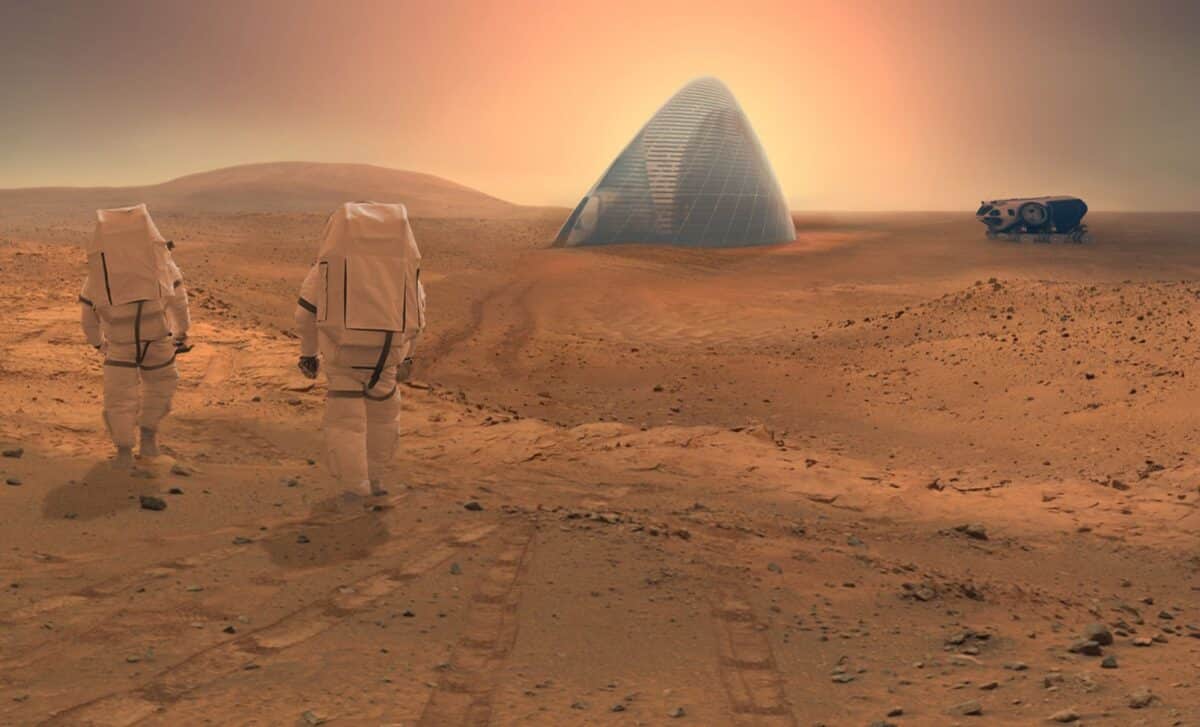
Building a city on Mars using ice might sound far-fetched, but new research published at the American Geophysical Union’s annual meeting has brought this idea a step closer to reality. Scientists suggest that the frozen water abundant on the Red Planet could be molded into durable structures.
The study proposes that ice could be used to create insulated, protective habitats for astronauts, capable of withstanding the harsh Martian environment. With over 5 million cubic kilometers of frozen water on and beneath Mars’ surface, researchers are now investigating how this resource could be harnessed for building sustainable living spaces.
Ice: A Resource for Habitat Construction on Mars
Mars’ icy landscape could hold the key to constructing safe and livable habitats. According to a study presented at the American Geophysical Union’s annual meeting, the planet’s frozen water could be harvested and shaped into structures that provide both shelter and insulation for astronauts. This is especially important given the extreme temperatures on Mars, which can plunge to -120 °C. Researchers have modeled how a few meters of ice could raise the internal temperature of a habitat to -20 °C, a much more survivable temperature for human life.
 Thermal map of a Martian ice habitat: temperatures range from -57.8°C to -16.2°C. Credit: American Geophysical Union
Rafid Quayum, a former Harvard University student who led the research, noted that this approach could help solve one of the biggest challenges of space colonization: the need to minimize reliance on Earth-based supplies. Instead of transporting large amounts of building materials, astronauts could use the ice already available on Mars to construct their homes and research stations.
Ice’s Potential to Block Harmful Radiation
One of the most significant benefits of using ice for habitat construction is its ability to protect astronauts from Mars’ harmful radiation. Mars lacks a thick atmosphere, leaving its surface exposed to dangerous ultraviolet (UV) rays and cosmic radiation.
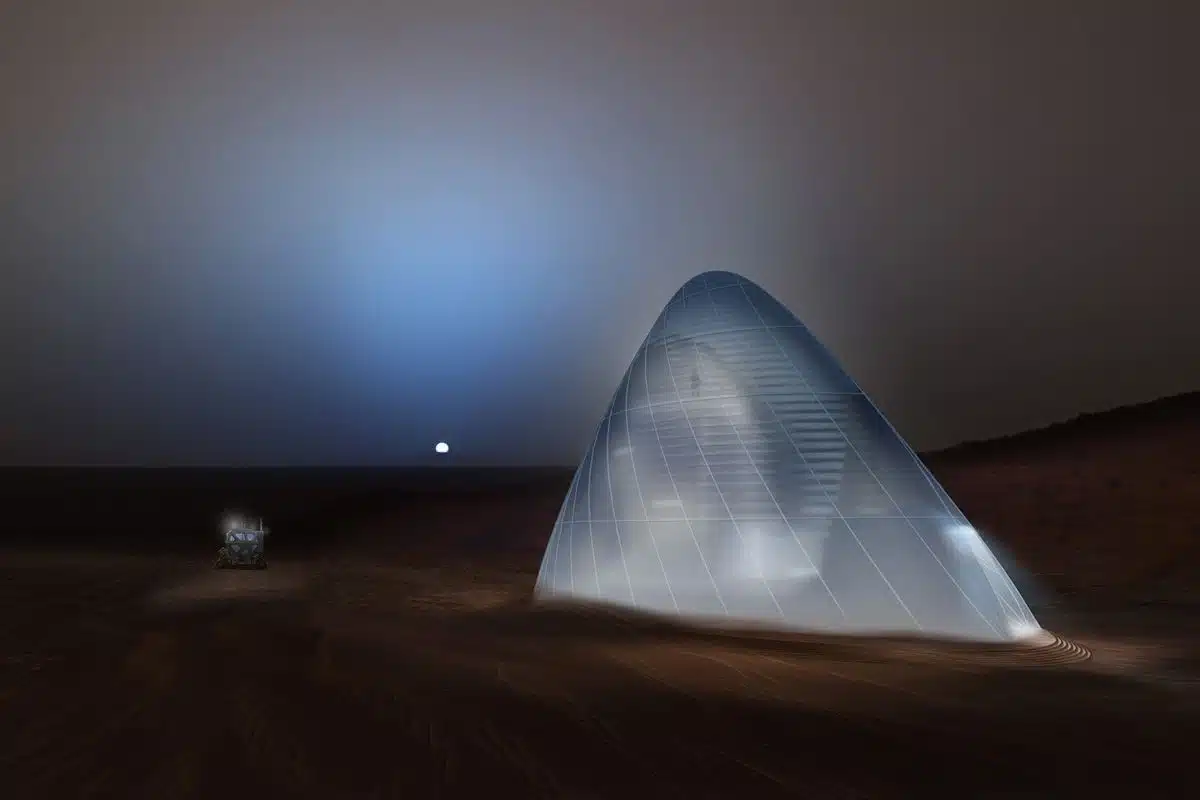 Mars ice house simulation. Credit: Clouds AO/SEArch
As mentioned in the latest research, ice blocks most of the UV light while allowing visible and infrared light to pass through. This means that ice structures could provide astronauts with protection from the Sun’s damaging radiation while still allowing essential light and heat to support both human health and plant growth.
This feature is crucial for long-term habitation on Mars, where maintaining light levels for both psychological well-being and farming is vital. The ability to combine both protection and light in one material makes ice a highly promising resource for Martian architecture.
Overcoming the Challenges of Building with Ice
The first major obstacle is the large amount of ice needed to construct even a single habitat. As stated in the journal Science, astronauts would need to process about 15 square meters of ice per day to construct a habitat, which would require a huge amount of energy, about the same as the International Space Station uses.
Another issue is Mars’ frequent dust storms. When dust settles on the ice, it can block sunlight and reduce its insulating properties. This would make ice less effective as a building material.
To solve this, scientists suggest applying a water-resistant coating to the ice to prevent it from evaporating into Mars’ atmosphere. However, this coating would likely need to be brought from Earth, which adds another layer of complexity to the process.
“It’s important to be thinking about space exploration in the medium term, as well as just what we’re going to be doing in the next few years,” said Robin Wordsworth, a planetary scientist at Harvard University