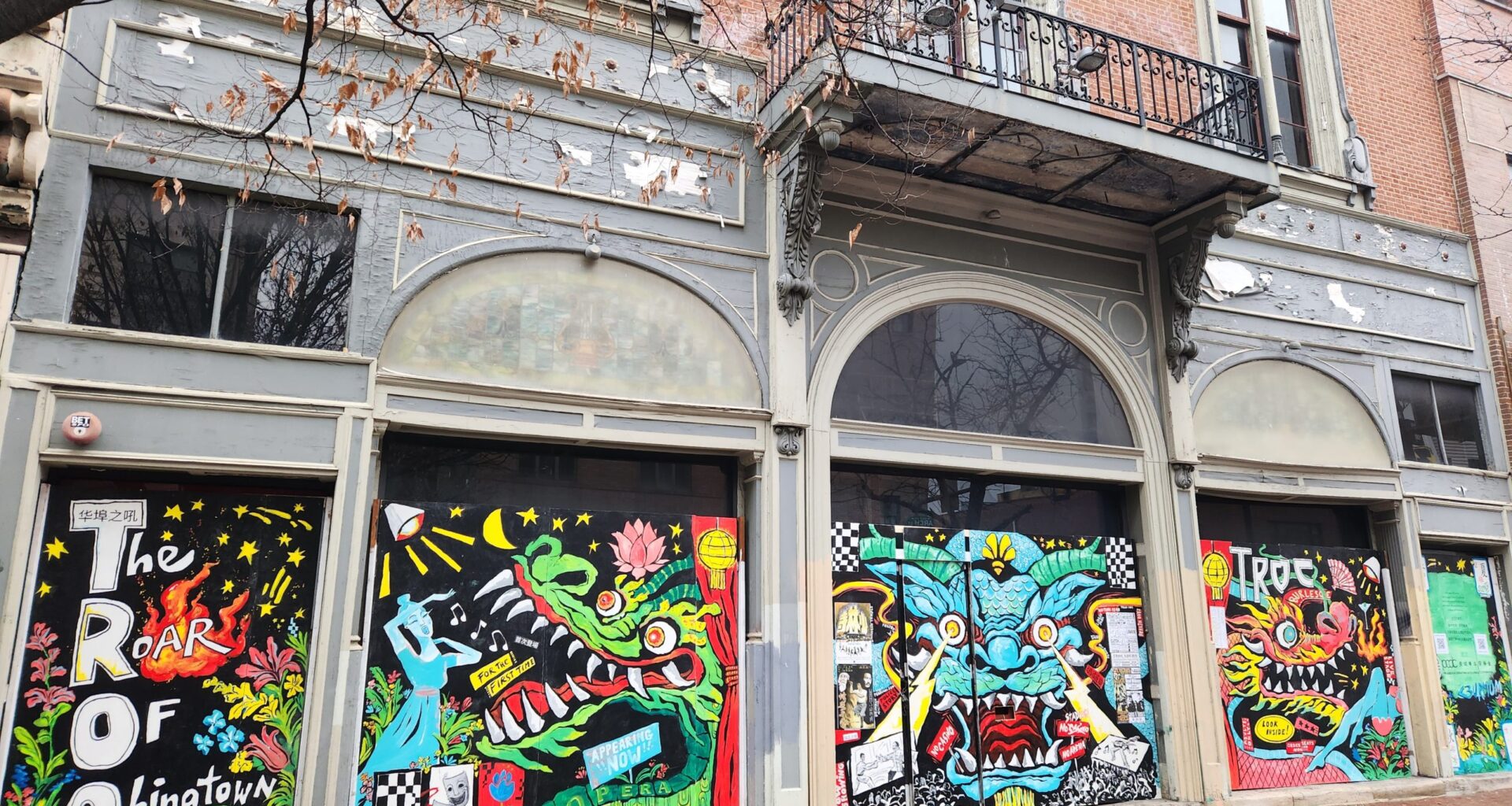
We all get lost / tell them meet me at the Trocadero
She loves punk rock / meet me at the Troc / meet me at the Troc
Those are the opening lyrics to a song by Philly artist duo
“Meet me at the TROC” also doubles as an acronym for the massive, five-panel mural featuring dragons designed to represent different eras of the Trocadero’s history – an acronym spelling out “The Roar Of Chinatown.”
Describing the design, the duo – comprised of artists Bryce and Calan, both Temple grads in graphic and interactive design – told Billy Penn that the design process was a collaborative one with the mural sponsor, the Philadelphia Chinatown Development Corporation (PCDC).
“We created the art, then we revised it together. It was a back and forth,” said Bryce. “It was really cool to learn more about Chinatown’s history. There was constant feedback so we were creating true to history. It was really cool and insightful.”
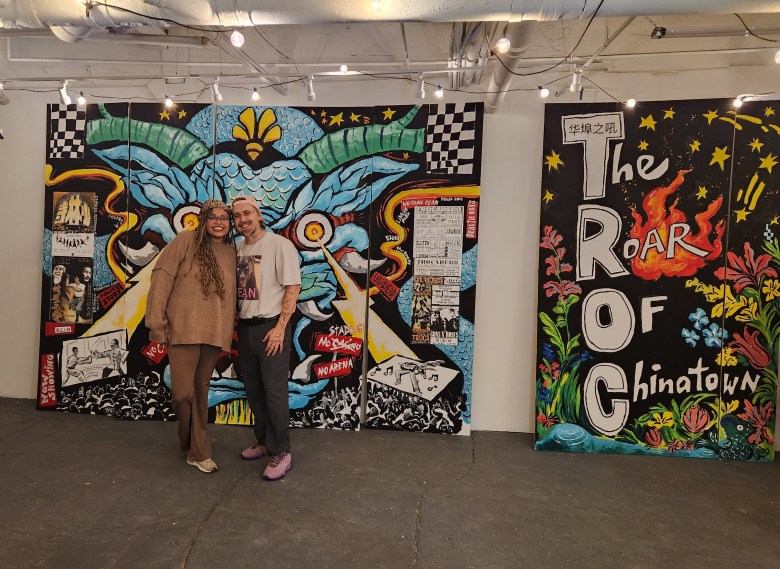 The artist duo behind
There was always a place that we could go
Called the Trocadero / we would hit it up for all the famous shows
We’d hold hands to My Chemical Romance
Though it’s long since been closed down / I don’t forget you
The mural is composed of five panels, each telling a different part of the historic theater’s history.
“The three central panels are three dragons, but then the imagery in and around them is of a different era of the Troc,” Bryce explained . “The first one is the Opera because it started in the late 1800s as an opera house and vaudeville. Then the middle one is Chinese cinema; in the ‘80s, they played kung fu classics without English subtitles there. Then it transitioned from that into punk rock, so that era was prominent.”
“So it’s been a 150-year evolution of the Troc, and during that same time, obviously, Chinatown was evolving and changing, too.”
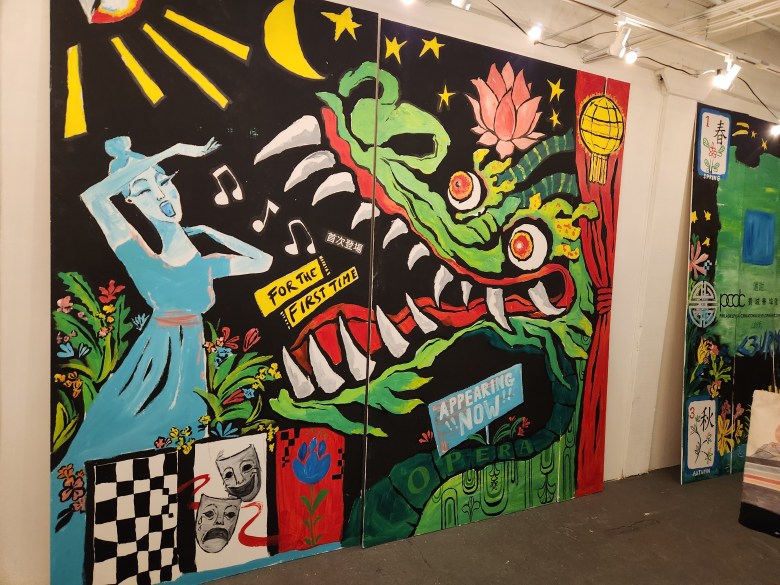 One of the five panels of “The Roar of Chinatown” mural on the historic Trocadero Theatre. (Photo by Heather J. Chin/Billy Penn)
Candy Oney remembers the feeling of walking into the Troc during its house music era in the 1990s.
“It was the atmosphere, the energy. You know how you go into some place and you’re waiting for it to get to that, but you walked into the Troc and it was already,” she said. “As soon as you walked in, you knew. You would be there for hours and love it and sweat. Back then we would get our hair done and you would sweat your hair out, dance and have fun, meet people, different artists. It was great.”
For Albert Lee, trips to the Trocadero were family affairs. “My parents would take us to the Trocadero to see kung fu movies, and they sold popcorn,” the longtime civic booster who grew up in Chinatown told WHYY’s Peter Crimmins back in 2019. “We would watch kung fu movies with no subtitles. That was the thing.”
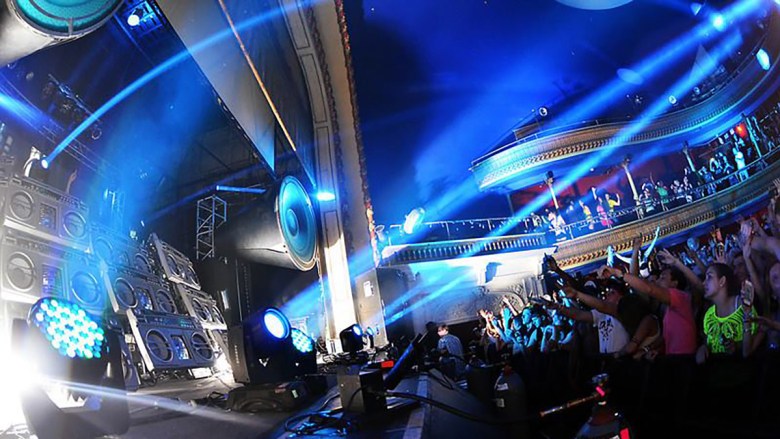 Inside the Trocadero Theatre in Philly’s Chinatown. (Billy Penn file photo)
The Trocadero also had all-ages shows, which allowed older brothers like Ken Travis to take his kid sister to her very first concert in the 1990s – seeing the hard industrial band Pigface, known for noise and dark lyrics.
For Oney, carpooling with friends from Norristown to Chinatown in the ‘90s to eat at restaurants and club-hop was a fun ritual. She noted that “the Troc became the big place that everybody wanted to go.”
“You could feel the music through your feet.”
Does the new dragon mural capture some of that essence?
“The first time I saw it, I loved it. I love the eyes, the colors coming out. The yellow,” Oney said while staring at a panel. “It’s like it’s piercing into you.”
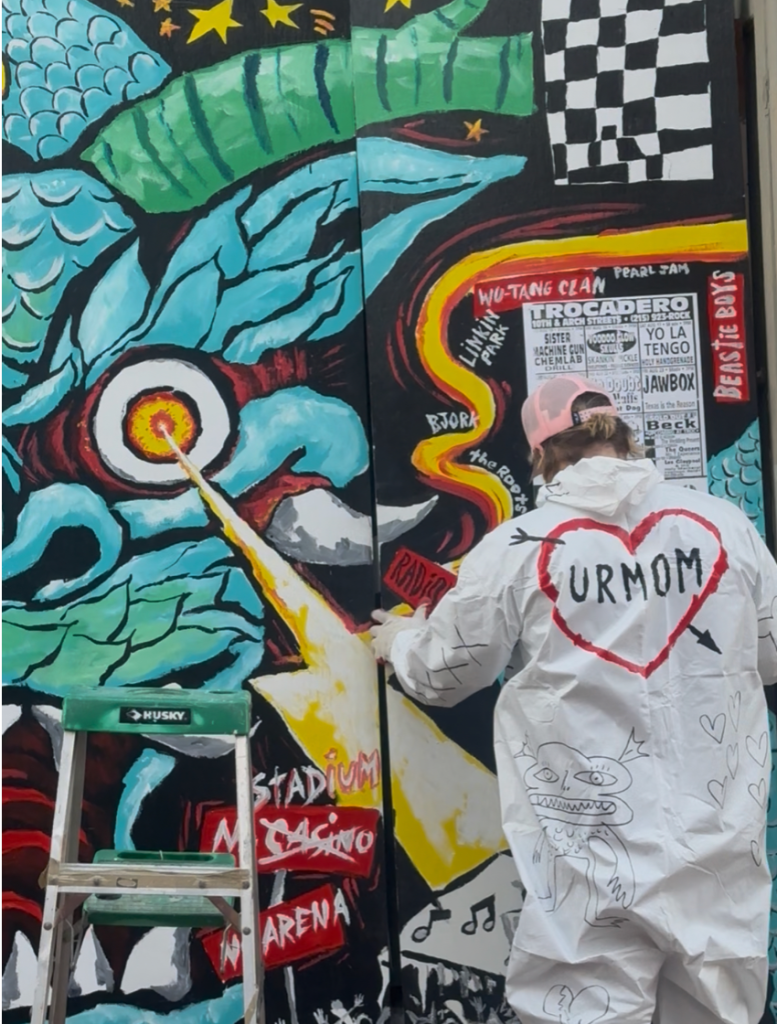 Installation of the “Meet me at the TROC” mural by
Visualizing an Evolving Neighborhood
We reminisce while we’re riding around
so many times they tried to turn our world upside down
In Chinatown / they tried to build a stadium / a casino and the arena, too
all that we went through / this shit made me numb
But we’re still here
The passage of time in Chinatown has included changes to storefronts, real estate, and resident demographics alike.
But even today, the Trocadero stands out – but now as one of the few vacancies in Chinatown, and a looming presence right next to the Chinatown Friendship Gate.
“We have a pretty robust and vibrant business community,” said Haoyi Shang, commercial corridor manager for the Philadelphia Chinatown Development Corporation (PCDC). “But we noticed that throughout the year, there’s lots of graffiti on the panels of the boarded-up storefront of the Trocadero.”
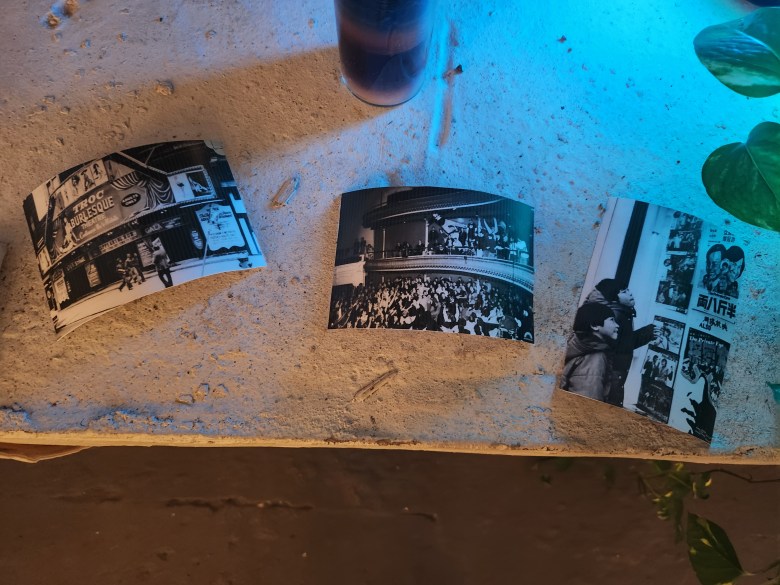 Photographs of the historic Trocadero Theatre in Philadelphia’s Chinatown. (Photo by Heather J. Chin/Billy Penn)
The former grand, elegant theater-turned-hotspot closed in 2019 after 155 years as a central hub for the country’s evolving music scene, from opera to vaudeville, Chinese cinema to punk rock.
In recent decades, the space attracted up to 1,200 people at a time for concerts by the likes of Bob Dylan, Pearl Jam, Radiohead, Sonic Youth, Fugazi, My Chemical Romance and various zombie proms, battles of the bands, comedy acts, and more.
“We all know the Trocadero is a very important building, not only to Chinatown, but to the entire Philadelphia community,” Shang said. “So we want to make it pretty, attractive. Luckily we got a state grant – through the Neighborhood Assistance Program with the Pennsylvania Department of Community and Economic Development – that allowed us to partner with the city for a tax credit program for funding for ‘temporary storefront improvement.’”
With funding secured, PCDC reached out to property owner Stephen Pang, who was on board. “He sees the same issue and doesn’t want to paint over graffiti over and over again,” Shang said.
The resulting public request for proposals from local artists yielded around a dozen candidates, from which
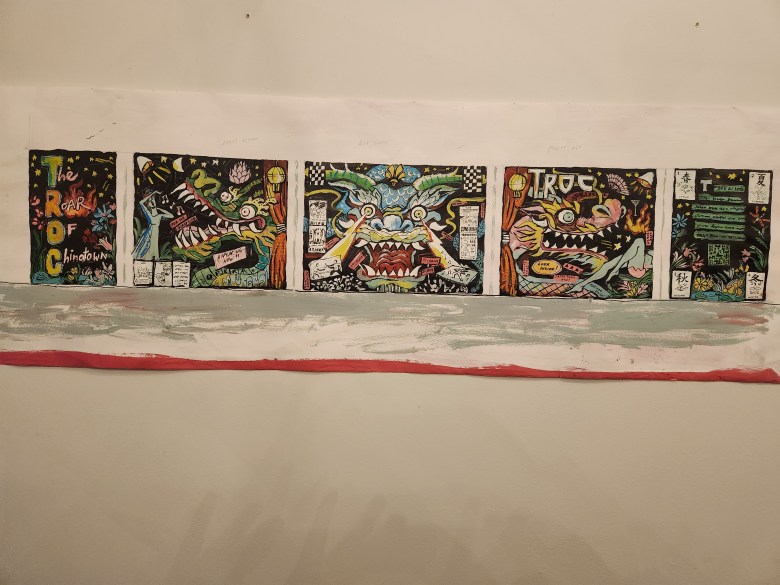 A mockup of the five panels of “The Roar of Chinatown” mural on the historic Trocadero Theatre. (Photo by Heather J. Chin/Billy Penn)
“We said the proposals should be either related to or have to be related to the history of the Trocadero or the history of Chinatown,” she said. “Theirs captured both ideas very well.”
With a new year – hello, 2026! – first impressions are important, Shang noted.
“It’s right next to the Chinatown Friendship Arch. We will have maybe thousands of visitors coming to see the Gate every day and we want the Trocadero to attract more tourists, as well,” she said.
Past, Present and Future
Though it’s long since been closed down / I don’t forget you / … noches
We’re still here…
Meet me at the Troc…
We all get lost / tell them meet me at the Trocadero …
Here for the daylight, gone tomorrow
We all get lost…
[Cantonese]
… Girl, I love you till I drop / til my heart stop / baby meet me at the Troc …
The building at 1003 Arch Street opened officially on August 29, 1870, as the Arch Street Opera House. Built by architect Edwin F. Durang, a prominent designer of East Coast churches, the theater initially hosted vaudeville and minstrel shows, before becoming a popular destination for burlesque, then also adding movie screenings.
A century after it first opened, in 1986, the historically-designated space was remodeled and turned into a concert hall-slash-dance club.
Though it wasn’t ever the fanciest spot (or the cleanest), the Troc’s central location helped it become a defining part of Philadelphia nightlife.
Bands who stopped there before blowing up include Guns N’ Roses, Bob Dylan and Die Antwoord. The main event stage and the balcony bar hosted everything from wholesome school fundraisers to psychedelic PEX parties, grungy tribute concerts and slick TV specials.
Then, in late August 2019, with a final performance by Big Mess Cabaret, that all ended, relegating nights at the Trocadero to collective memory.
 The QR code to listen to “Meet me at the TROC” song that accompanies The Roar of Chinatown, a public mural in Chinatown at the historic Trocadero Theatre. (Courtesy of
Now, those memories will hopefully be evoked for passersby who walk or drive past the grand Victorian building over the next year, looking at the giant dragon faces or scanning the QR code that allows them to listen to “Meet me at the TROC.”
“We wanted to get it right. To plan out the plywood and the backing [and] to make sure we’re telling Chinatown’s story right and in the best way,” said
“We put the protesting and saying ‘No Stadium’ [on a panel and in the song] because it’s like, ‘we’re still here,’” Calan continued. “When you see this piece, even if the Troc shut down in 2019, we’re still here, this is a big part of Chinatown. I love this story we were able to carry along with these dragons.”
The “Meet me at the TROC” song melody is “a mix of genres that starts out a little songwriter-y with strummed guitar, then changes in the middle to very punk rock,” said Bryce, who provides the primary vocals.
Calan added that one of her “favorite things to do is tell stories that haven’t been told yet or haven’t been told in song. We did a Ruby Bridges song. We love telling these stories through songs.”
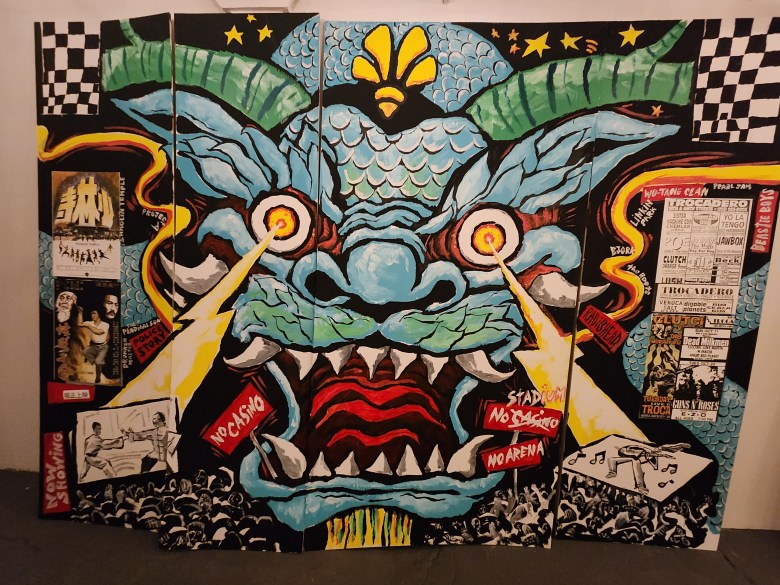 One of the five panels of “The Roar of Chinatown” mural on the historic Trocadero Theatre. (Photo by Heather J. Chin/Billy Penn)
Bryce drew a parallel to their own experience working to create and find opportunity in Philly’s artist and storytelling communities.
“The community and us as artists, we’re not going anywhere, so it’s kind of a testament to that,” he said. “We feel grateful to be invited into this space to tell the story.”
“We hope people come to Philly and to Chinatown, get the story of Chinatown, then also see the love that we put in it,” Bryce said. “We’re ‘love your mom,’ and that’s such a big part of our art and our craft, putting love and positivity back out into the world.”