
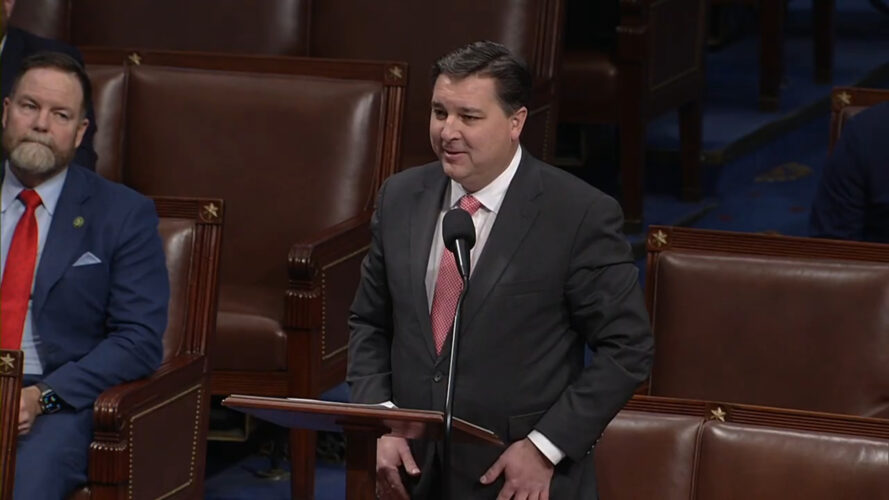
 A new House bill could reshape the definition of protected and unpolluted waterways in an attempt to help farmers and developers. (Photo Courtesy of Rep. David Rouzer)
SOUTHEASTERN N.C. — A new House bill could reshape the definition of protected and unpolluted waterways in an attempt to help farmers and developers. However, it also would diminish protections under the Clean Water Act, and for the Cape Fear, ground zero of PFAS, it could further exacerbate contamination troubles.
The act passed the House of Representatives on Dec. 11 in a 221-205 vote down party lines but sits in the Senate awaiting review from the Committee on Environment and Public Works.
READ MORE: Mark Ruffalo-produced documentary chronicles 8-year PFAS fight
Titled the “Promoting Efficient Review for Modern Infrastructure Today (PERMIT) Act,” the bill aims to streamline permitting and is supported by the U.S. Chamber of Commerce, construction and home-building associations, agribusiness and others. However, it also limits the scope of the Clean Water Act, established in 1972 to regulate and protect U.S. waterways from pollution.
Tucked inside the act are proposals to remove regulatory steps regarding water quality certification for development and infrastructure projects, pesticides and the general permitting process.
“It’s a giveaway to the industry,” Cape Fear River Watch Riverkeeper Kemp Burdette told Port City Daily. “Industry and developers have less in their way when they want to pollute and less in their way when they want to develop.”
The PERMIT Act removes protection from waste treatment systems, temporary waterways, prior converted cropland and groundwater as navigable waters, making them more susceptible to pollution or contamination from corporations. It essentially eliminates the need for a permitting or regulatory process and allows the Environmental Protection Agency or U.S. Army Corps of Engineers to exclude protections of any waterway without public input or oversight.
Rep. David Rouzer originally proposed some of the changes as part of three bills — Improving Water Quality Certifications and American Energy Infrastructure Act, Reducing Regulatory Burdens Act and the Nationwide Permitting Improvement Act — in June. The bills would cut additional steps from permitting processes for developments and farmers and put more regulatory authority in states’ hands.
The measures come following a presidential push for economic and agricultural development that has also been the framework for the EPA’s “Powering the Great American Comeback” initiative, to combine development with clean energy.
“Time is real money, and Americans should not be weighed down by unnecessary red tape or uncertainty when they are working to grow their businesses and strengthen our economy,” Rouzer said in a press release about the act.
Though Rouzer’s bills failed to gain traction, they were wrapped into the larger Permit Act. Now it has eight co-sponsors, including representatives from Georgia, California, Colorado, Utah, Missouri, Minnesota, Arizona, and Ohio.
Port City Daily reached out to Rouzer to ask about environmental concerns related to the bill and the projected economic benefit to farmers and other industries; however, a response was not received by press.
According to Burdette, the PERMIT Act comes at a time when U.S. waterways are already being targeted from within the EPA, as Administrator Lee Zeldin is pushing for reduced jurisdiction of the Clean Water Act. The Environmental Protection Agency is the protective authority of Waters of the United States under the Clean Water Act, and is in charge of providing permits for pollutant discharge. Industries, factories, corporations and the like can apply to dump pollutants into U.S. waters, usually through a point source like piping.
On Nov. 17, the EPA announced it’s considering removing seasonal or temporary waterways from the Clean Water Act. The EPA held three public sessions — two in person in North Dakota and Pennsylvania and one virtually this month — to give a presentation on the EPA’s waterway rule change and receive public input. The public comment period is still open for submission.
According to the environmentalist nonprofit Natural Resources Defense Council, between 38 million and 70 million acres of wetlands are at risk of pollution around the country, if the waterway protections are reduced as proposed by both the EPA and now the House bill.
Already wetlands have become more vulnerable as of 2023. A court case titled Sackett v. EPA significantly reduced the definition of wetlands, by saying they have to include a continuous surface connection to a larger body of water. Following the decision, isolated wetlands are no longer under federal jurisdiction, but could still be regulated by the state.
The map created by Natural Resources Defense Council, in response to the EPA’s announcement on Nov. 17, predicts roughly 16.5% of the wetlands across New Hanover, Brunswick, Pender, Columbus, and Onslow counties will be at risk of pollution and related damages, should the removals from the Clean Water Act suggested by the EPA come to pass.
Columbus and Pender counties lead the pack with 5.8% and 4.3% of their wetlands to be affected, followed closely by Onslow County at 3.1%, Brunswick at 2.6% and New Hanover County at the lowest rate of impact with 0.7% of its wetlands at risk. These numbers do not consider pollutants that could move laterally, as Burdette suggested, with rainfall.
“Ephemeral streams flow into perennial streams,” Burdette explained, the latter being permanent, year-round waterways. “All that pollution can make its way into that perennial stream, even if that perennial stream was a drinking water supply.”
If pollution reaches perennial streams, it could affect fish habitats and drinking water. Thus Burdette speculated, should the Senate pass the bill, it could mean higher water bills, to account for more water treatment processes. And it could affect food that ends up on diners’ plates.
“It means our fish are going to be full of pollutants,” Burdette said. “If we catch a fish and put it on the dinner table to eat, we don’t know if it’s a safe fish.”
Beyond environmental concerns, he added there are more harmful effects from the reduced protections.
“This bill is an early Christmas present to industry,” Burdette said.
While it is unclear whether or not the Senate will approve the bill, it has been read twice. If any changes are proposed to the bill, it will need to be returned to the House to be passed again. Should it pass in the Senate, the bill will be sent to the President’s desk.
Have tips or suggestions for Emily Sawaked? Email emily@localdailymedia.com
At Port City Daily, we aim to keep locals informed on top-of-mind news facing the tri-county region. To support our work and help us reach more people in 2026, please, consider helping one of two ways: Subscribe here or make a one-time contribution here.
We appreciate your ongoing support.