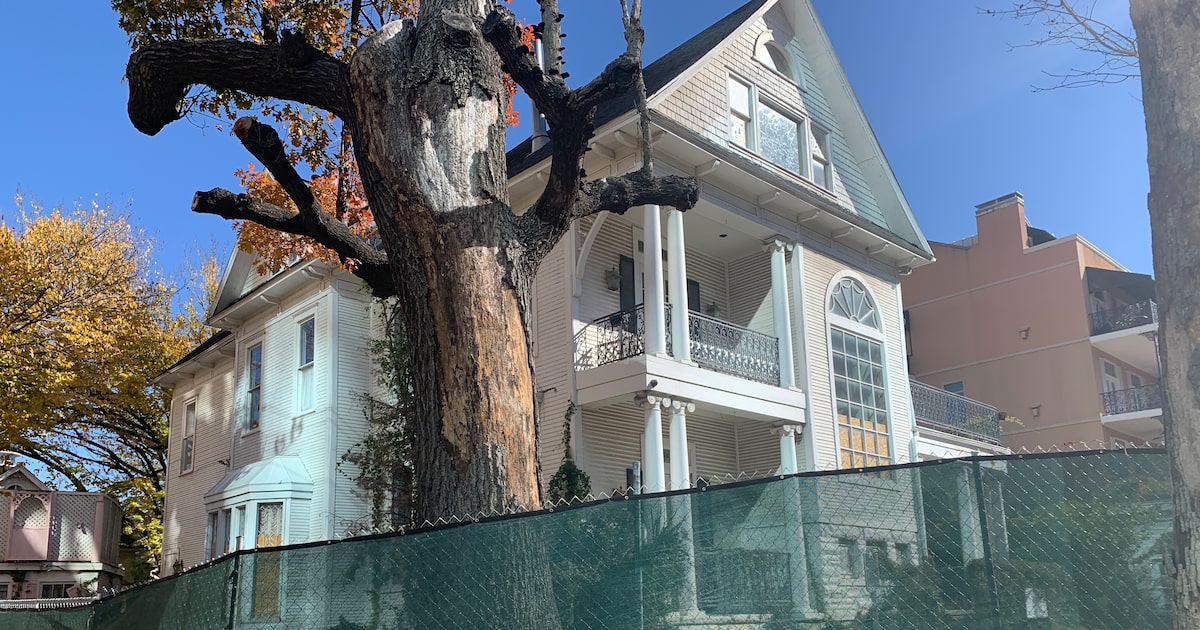

Sarah Crain, executive director of Preservation Dallas, wasn’t thrilled with the photo I texted her Tuesday afternoon. It’s the same one you see here, of the former Hotel St. Germain on Maple Avenue, across from The Crescent, wrapped with fencing and adorned with a rezoning sign for — what else? — a high-rise. Behind the green shroud and the chain link, a historical-markered Victorian mansion rescued and renovated a handful of times since its construction in 1897 crumbles yet again.
“You don’t bring me tidings of joy during this season,” Crain said.
Every phone call made and text sent to preservationists in town went about the same. They all knew something was up with the once-mighty manse The Dallas Morning News called “one of the city’s earliest homes” in October 1947, when Dallas was barely a century old. They just didn’t know what was up with it. Or when. Or why.
Architect Larry Good co-authored the 1999 book The American Institute of Architects Guide to Dallas Architecture, in which the house is hailed as “the best remaining example of Maple Avenue’s turn-of-the-century role as the city’s silk-stocking district.” He told me this week it may be too late to spare the house — “way too late” — but he was surprised the zoning case hasn’t received more attention from preservationists.
When I asked preservation architect Marcel Quimby about it, she, too, was unaware but with good reason: “We’ve all had our heads down and our hands full with City Hall.”
Opinion
It’s nice that folks think I.M. Pei’s brutalist ziggurat on Marilla Street stands a chance against this City Council. But one way or the other, that house on Maple is a certified goner in coming months to make way for another tall building trying to squeeze into a small space.
This one comes courtesy Robert Colombo, the native New Yorker who became a bold-faced name around town in the 1980s when he helped bring San Simeon and Sfuzzi — nightclubs dressed up for fine dining — to McKinney Avenue. His new venture is the 24-story Monclair Hotel & Residences, which looks like 1925 Manhattan looks in the movies.
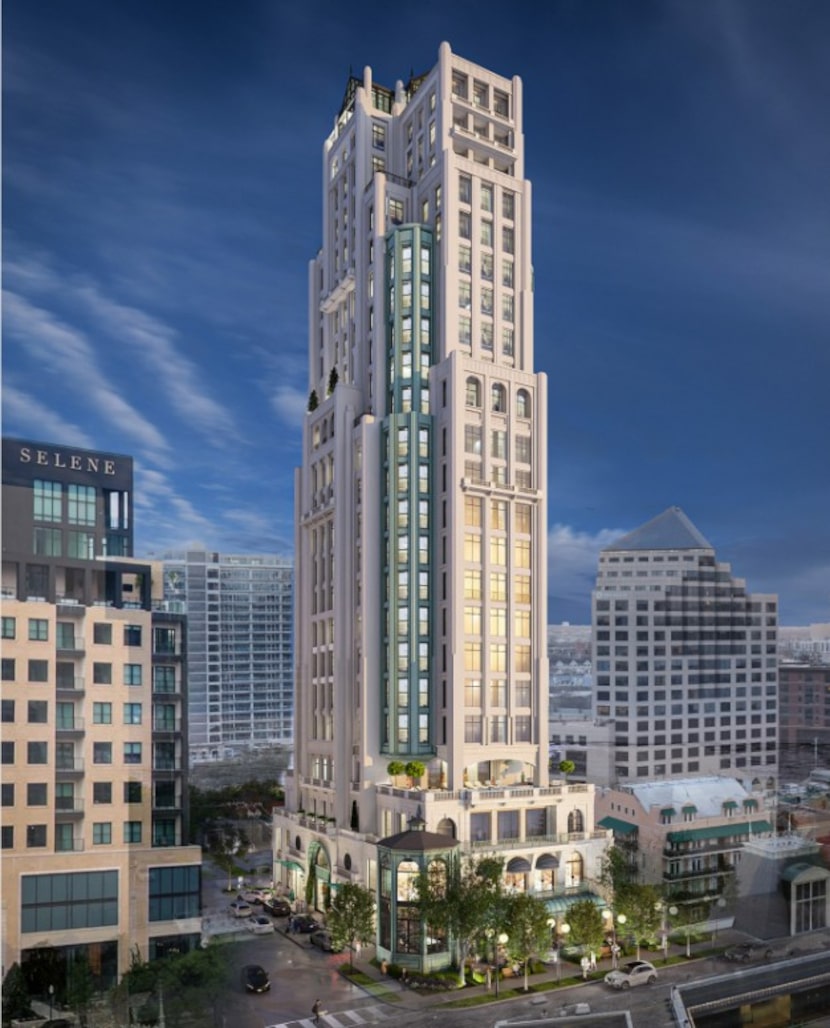
This is the Monclaire Hotel & Residences, which developer Robert Colombo hopes to begin building along Maple Avenue, on the former Hotel St. Germain site, within the year.
Courtesy St. German Development LLC/Nunzio Marc DeSantis Architects
“It’s going to be a beautiful, beautiful structure,” Colombo said last week of the tower designed by Dallas-based Nunzio Marc DeSantis Architects. “It’s more of a Robert Stern design. We wanted it to be what’s appropriate for being the neighbor of The Crescent versus being the easiest thing to do, which is to put up a glass building. We tried to shy away from it. Fortunately, I grew up in New York. I actually enjoy the creativity of the architecture, and we think it will be a nice addition to the city.”
So, too, does the Oak Lawn Committee, which was twice briefed on the 80-unit Monclair this year, with only a handful of its more than 100 members raising questions about, among other things, its impact on traffic along Maple. With the committee’s sign-off, the Monclair’s zoning case heads to the City Plan Commission next month.
All over town, it would seem, high-rises are all the rage — rage, in some cases, being the operative word.
Only two miles away, off Oak Lawn Avenue near the Highland Park border, residents are unhappy with the prospect of a 21-story luxury apartment tower being planted along a stretch of Newton Avenue filled with the two-story garden apartments for which the neighborhood is zoned. Several folks unhappy with the prospect of living in its shadow have reached out in recent weeks to condemn the tower, which would rise in the place of the two-story, 33-unit Chimney Six Condos built some 60 years ago — and still quite affordable at $1,300 a month.
“The proposed 21-story high-rise doesn’t align with the current zoning regulations or the scale of our community,” says the opposition’s website. “It poses a threat to neighborhood safety and infrastructure.”
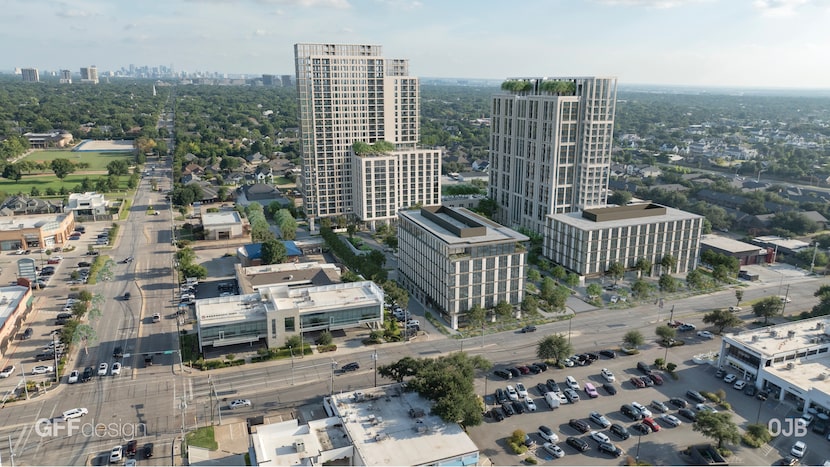
Burk Interests and Greenway Investment Company are joining forces to develop a $650 million mixed-use project at the corner of Preston Road and Royal Lane.
GFF
South Dallas residents and the CPC have already made a loser of the would-be helipad-capped Winners Tower that would have swallowed a stretch of Martin Luther King Jr. Boulevard. But perennial mayoral candidate Ed Okpa refuses to surrender, as he plans to appeal the case to the City Council as early as next month.
If you really want an earful about the rise of the high-rise, try getting something to eat or drink on the corner of Preston Road and Royal Lane where the 2019 tornado turned an office complex into a slab still awaiting its resurrection. That’s where former City Council candidate Leland Burk hopes to plant a 28-story hotel and condo tower alongside a 24-story luxury apartment building.
I haven’t once stepped foot in White Rock Coffee or Escondido in recent weeks without catching an earful from old friends about how such an expansive development is inappropriate for the neighborhood. I tell them I can’t figure out how doing nothing is better than filling in a blank space that contributes nothing to a city in need of every cent it can raise, no matter how high in the sky.
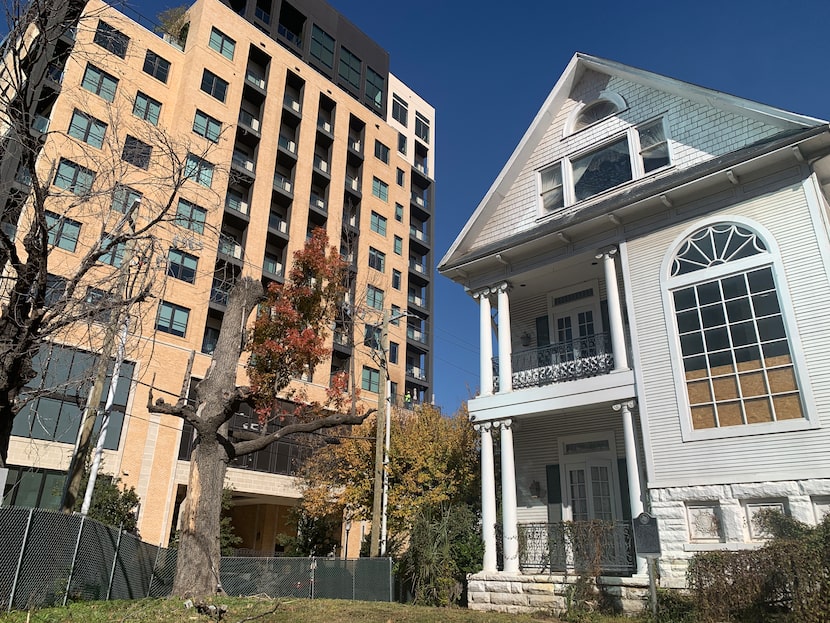
The circa-1897 house, most recently the Hotel St. Germain, has looked more and more out of place along Maple Avenue in recent years. Said its current owner, as Uptown goes downtown, it’s time to think bigger. Much, much bigger.
Robert Wilonsky
I suspect the Monclair won’t greet much resistance because of its location — next door to the expanse of luxury apartments along Maple called the Selene, across Maple from The Crescent, in the midst of so much other construction casting a shadow over a vestige of one of the city’s oldest neighborhoods. The city’s center has shifted beneath the foundation of a historic home.
“Uptown has organically become the Dallas business district,” Colombo said. “That change is positive to a large degree, unless you want a sleepy city, and Dallas isn’t sleepy anymore.”
Yet it would be a shame if a significant part of the city’s past was just erased to make way for its seemingly inevitable future.
Colombo said he’s talking to a few people about cutting the house into pieces so it can be moved to a plot of empty land, which is how the circa-1880s Rosenfield house in the Cedars was spared seven years ago. But on this, Colombo and preservationists agree: Moving the manse under power lines and across freeways won’t be easy or cheap.
The house has been rescued before. That 1947 News piece celebrated the “Mid-Victorian opulence” contained in that “old landmark,” which three women, including two daughters of longtime owner John Murphy, had just restored and reopened as a wedding venue called The Laurels. In 2019, Flashback:Dallas proprietor Paula Bosse offered a thorough history of the home, which over the decades spent time as a boarding house, a club called The Haunted House, a doctor’s office, an art gallery, an insurance office, community radio station KCHU and an antique shop before it was boarded up in the 1980s and readied for demolition.
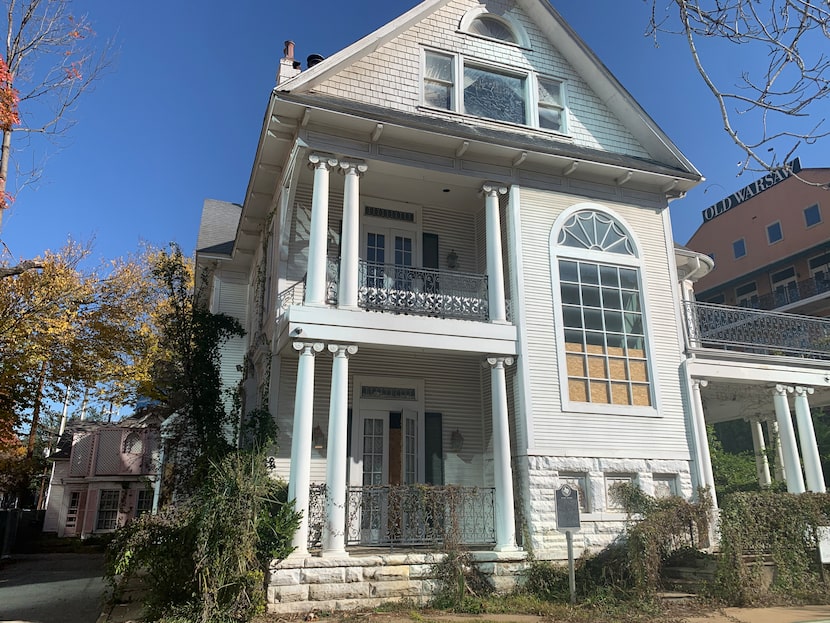
In 1906, Capt. John Murphy bought this house on Maple Avenue, Since then it’s been many things — a club, a radio station, an art gallery and on and on — but it would appears its days are numbered to make room for a high-rise hotel and condo tower.
Robert Wilonsky
Claire Heymann, a New Orleans native who adored the charm of the crumbling manse in a receding neighborhood, saved it yet again, and in 1991 opened the Hotel St. Germain. In his 1997 review of its restaurant, the Dallas Observer’s Mark Stuertz wrote that Heymann’s vision was “boldly imaginative for a city like Dallas.”
But Heymann sold the hotel to Colombo in 2023. So now the empty old house is imperiled once more. No doubt its longtime owner, a long time ago, would be fine with its demise. Because in 1906, the house was sold to John Murphy, namesake of the real estate development firm Murphy & Bolanz, which four years later helped sell Dallas City Hall to Adolphus Busch for a new hotel. And the circle is now complete.