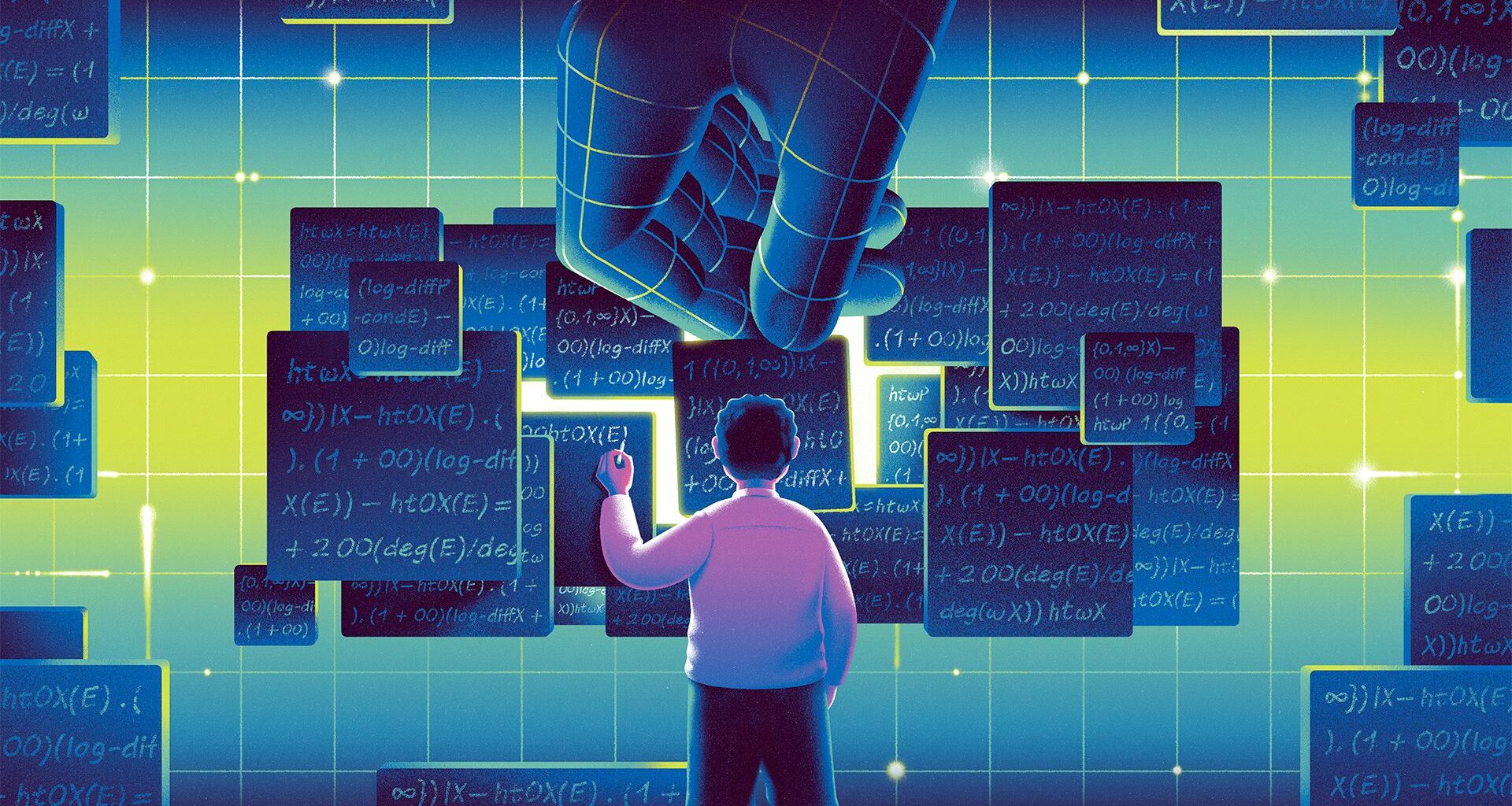
In October 2024, news broke that Facebook parent company Meta had cracked an “impossible” problem that had stymied mathematicians for a century.
In this case, the solvers weren’t human.
An artificial intelligence (AI) model developed by Meta determined whether solutions of the equations governing certain dynamically changing systems — like the swing of a pendulum or the oscillation of a spring — would remain stable, and thus predictable forever.
You may like

Science Spotlight takes a deeper look at emerging science and gives you, our readers, the perspective you need on these advances. Our stories highlight trends in different fields, how new research is changing old ideas, and how the picture of the world we live in is being transformed thanks to science.
After looking under the hood, however, mathematicians were less impressed. The AI found Lyapunov functions for 10.1% of randomly generated problems posed to it. This was a substantial improvement over the 2.1% solved by previous algorithms, but it was by no means a quantum leap forward. And the model needed lots of hand-holding by humans to come up with the right solutions.
A similar scenario played out earlier this year, when Google announced its AI research lab DeepMind had discovered new solutions to the Navier-Stokes equations of fluid dynamics. The solutions were impressive, but AI was still some distance from solving the more general problem associated with the equations, which would garner its solvers the $1 million Millennium Prize.
Beyond the hype, just how close is AI to replacing the world’s best mathematicians? To find out Live Science asked some of the world’s best mathematicians.
While some experts were dubious about AI’s problem solving abilities in the short term, most noted that the technology is developing frighteningly fast. And some speculated that not so far into the future, AI may be able to solve hard conjectures — unproven mathematical hypotheses — at a massive scale, invent new fields of study, and tackle problems we never even considered.
“I think what’s going to happen very soon — actually, in the next few years — is that AIs become capable enough that they can sweep through the literature at the scale of thousands — well, maybe hundreds, tens of thousands of conjectures,” UCLA mathematician Terence Tao, who won the Fields Medal (one of mathematics’ most prestigious medals) for his deep contributions to an extraordinary range of different mathematical problems, told Live Science. “And so we will see what will initially seem quite impressive, with thousands of conjectures suddenly being solved. And a few of them may actually be quite high-profile ones.”
You may like
From games to abstract reasoning
To understand where we are in the field of AI-driven mathematics, it helps to look at how AI progressed in related fields. Math requires abstract thinking and complex multistep reasoning. Tech companies made early inroads into such thinking by looking at complex, multistep logical games.
In the 1980s, IBM algorithms began making progress in games like chess. It’s been decades since IBM’s Deep Blue beat what was then the world’s best chess player, Garry Kasparov, and about a decade since Alphabet’s DeepMind defeated the period’s best Go player, Lee Sedol. Now AI systems are so good at such mathematical games that there’s no point to these competitions because AI can beat us every time.
But pure math is different from chess and Go in a fundamental way: Whereas the two board games are very large but ultimately constrained (or, as mathematicians would say, “finite”) problems, there are no limits to the range, depth and variety of problems mathematics can reveal.
In many ways, AI math-solving models are where chess-playing algorithms were a few decades ago. “They’re doing things that humans know how to do already,” said Kevin Buzzard, a mathematician at Imperial College London.
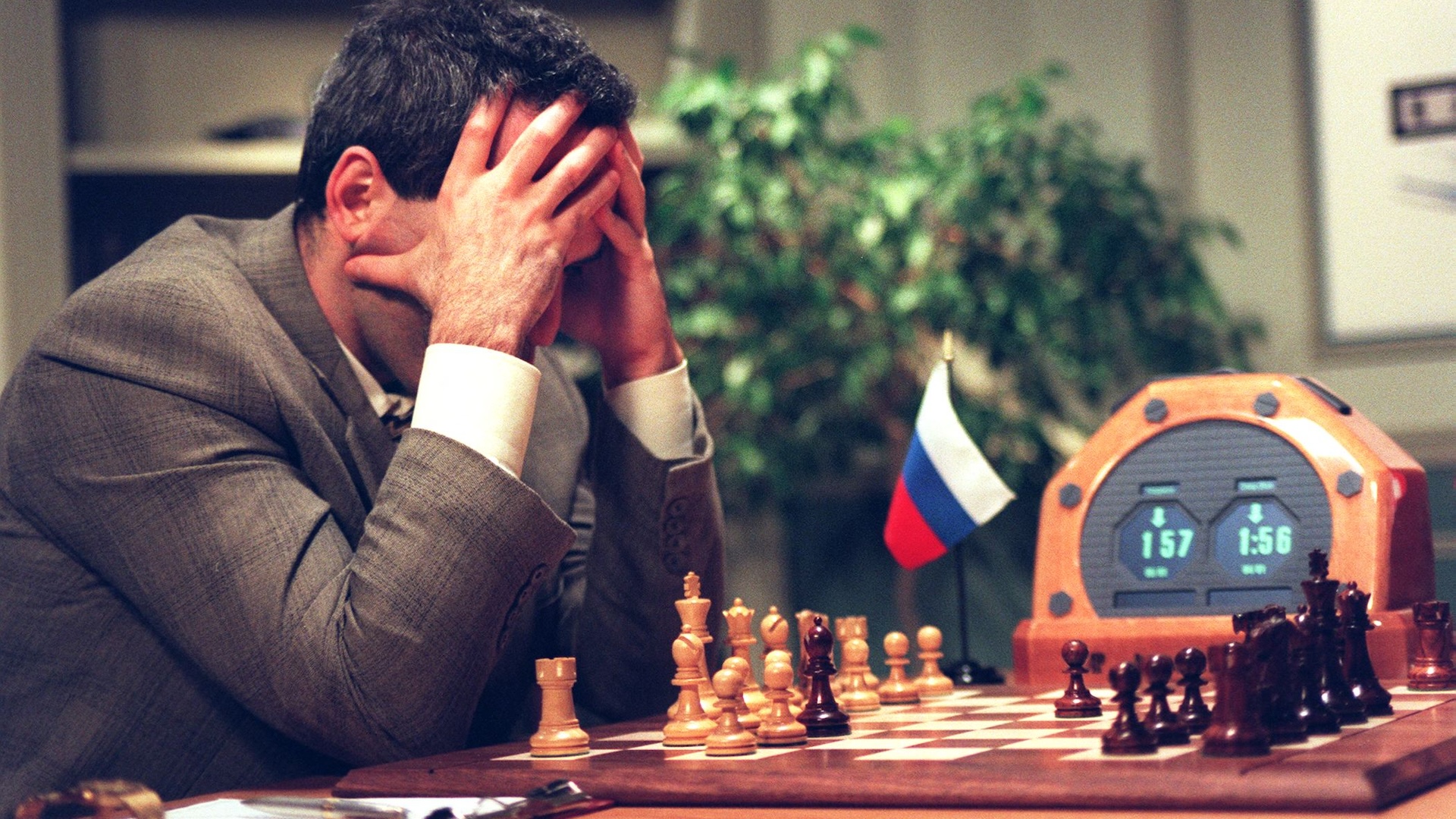
World Chess Champion Garry Kasparov competing against the IBM Deep Blue algorithm. (Image credit: STAN HONDA via Getty Images)
“The chess computers got good, and then they got better and then they got better,” Buzzard told Live Science. “But then, at some point, they beat the best human. Deep Blue beat Garry Kasparov. And at that moment, you can kind of say, ‘OK, now something interesting has happened.'”
That breakthrough hasn’t happened yet for math, Buzzard argued.
“In mathematics we still haven’t had that moment when the computer says, ‘Oh, here’s a proof of a theorem that no human can prove,'” Buzzard said.
Mathematical genius?
Yet many mathematicians are excited and impressed by AI’s mathematical prowess. Ken Ono, a mathematician at the University of Virginia, attended this year’s “FrontierMath’ meeting organized by OpenAI. Ono and around 30 of the world’s other leading mathematicians were charged with developing problems for o4-mini — a reasoning large language model from OpenAI — and evaluating its solutions.
After witnessing the heavily human-trained chatbot in action, Ono said, “I’ve never seen that kind of reasoning before in models. That’s what a scientist does. That’s frightening.” He argued that he wasn’t alone in his high praise of the AI, adding that he has “colleagues who literally said these models are approaching mathematical genius.”
To Buzzard, these claims seem far-fetched. “The bottom line is, have any of these systems ever told us something interesting that we didn’t know already?” Buzzard asked. “And the answer is no.”
Rather, Buzzard argues, AI’s math ability seems solidly in the realm of the ordinary, if mathematically talented, human. This summer and last, several tech companies’ specially trained AI models attempted to answer the questions from the International Mathematical Olympiad (IMO), the most prestigious tournament for high school “mathletes” around the world. In 2024, Deepmind’s AlphaProof and AlphaGeometry 2 systems combined to solve four of the six problems, scoring a total of 28 points — the equivalent of an IMO silver medal. But the AI first required humans to translate the problems into a special computer language before it could begin work. It then took several days of computing time to solve the problems — well outside the 4.5-hour time limit imposed on human participants.
This year’s tournament witnessed a significant leap forward. Google’s Gemini Deep Think solved five of the six problems well within the time limit, scoring a total of 35 points. This is the sort of performance that, in a human, would have been worthy of a gold medal — a feat achieved by less than 10% of the world’s best math students.
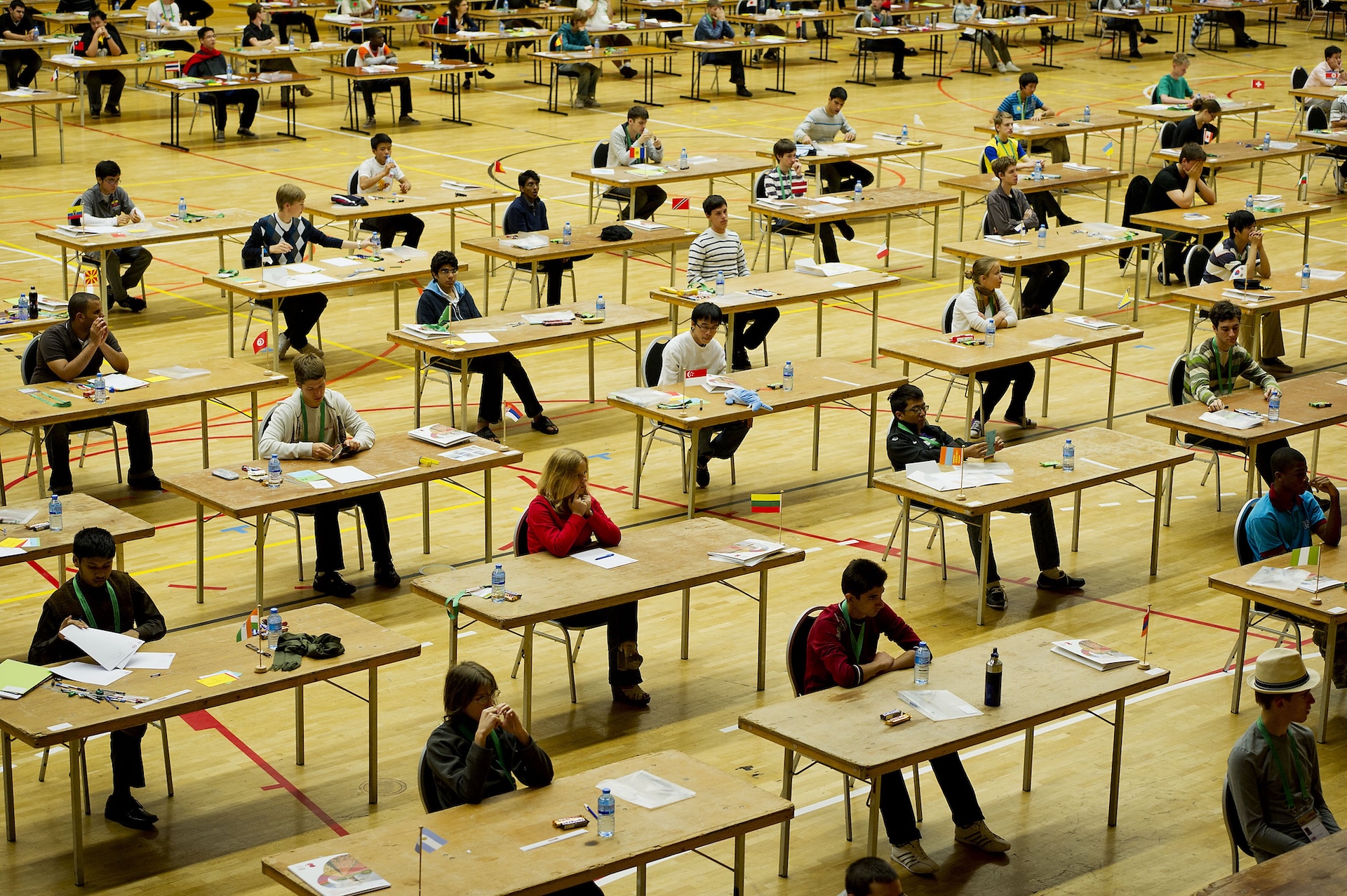
The 2011 International Mathematical Olympiad in Amsterdam (Image credit: VALERIE KUYPERS via Getty Images)Research-level problems
Although the most recent IMO results are impressive, it’s debatable whether matching the performance of the top high school math students qualifies as “genius-level.”
Another challenge in determining AI’s mathematical prowess is that many of the companies developing these algorithms don’t always show their work.
“AI companies are sort of shut. When it comes to results, they tend to write the blog post, try and go viral and they never write the paper anymore,” Buzzard, whose own research lies at the interface of math and AI, told Live Science.
However, there’s no doubt that AI can be useful in research-level mathematics.
In December 2021, University of Oxford mathematician Marc Lackenby‘s research with DeepMind was on the cover of the journal Nature.
Lackenby’s research is in the area of topology which is sometimes referred to as geometry (the maths of shapes) with play dough. Topology asks which objects (like knots, linked rings, pretzels or doughnuts) keep the same properties when twisted, stretched or bent. (The classic math joke is that topologists consider a doughnut and a coffee cup to be the same because both have one hole.)
Lackenby and his colleagues used AI to generate conjectures connecting two different areas of topology, which he and his colleagues then went on to try to prove. The experience was enlightening.
It turned out that the conjecture was wrong and that an extra quantity was needed in the conjecture to make it right, Lackenby told Live Science.
Yet the AI had already seen that, and the team “had just ignored it as a bit of noise,” Lackenby said.
Can we trust AI at the frontier of math?
Lackenby’s mistake had been not to trust the AI enough. But his experience speaks to one of the current limitations of AI in the realm of research mathematics: that its outputs still need human interpretation and can’t always be trusted.
“One of the problems with AI is that it doesn’t tell you what that connection is,” Lackenby said. “So we have to spend quite a long time and use various methods to get a little bit under the hood.”
Ultimately, AI isn’t designed to get the “right” answer; it’s trained to find the most probable one, said Neil Saunders, a mathematician who studies geometric representation theory at City St George’s, University of London and the author of the forthcoming book “AI (r)Evolution” (Chapman and Hall, 2026), told Live Science.
“That most probable answer doesn’t necessarily mean it’s the right answer,” Saunders said.
“We’ve had situations in the past where entire fields of mathematics became basically solvable by computer. It didn’t mean mathematics died.”
Terence Tao, UCLA
AI’s unreliability means it wouldn’t be wise to rely on it to prove theorems in which every step of the proof must be correct, rather than just reasonable.
“You wouldn’t want to use it in writing a proof, for the same reason you wouldn’t want ChatGPT writing your life insurance contract,” Saunders said.
Despite these potential limitations, Lackenby sees AI’s promise in mathematical hypothesis generation. “So many different areas of mathematics are connected to each other, but spotting new connections is really of interest and this process is a good way of seeing new connections that you couldn’t see before,” he said.
The future of mathematics?
Lackenby’s work demonstrates that AI can be helpful in suggesting conjectures that mathematicians can then go on to prove. And despite Saunders’ reservations, Tao thinks AI could be useful in proving existing conjectures.
The most immediate payoff might not be in tackling the hardest problems but in picking off the lowest-hanging fruit, Tao said.
The highest-profile math problems, which “dozens of mathematicians have already spent a long time working on — they’re probably not amenable to any of the standard counterexamples or proof techniques,” Tao said. “But there will be a lot that are.”
Tao believes AI might transform the nature of what it means to be a mathematician.
“In 20 or 30 years, a typical paper that you would see today might indeed be something that you could automatically do by sending it to an AI,” he said. “Instead of studying one problem at a time for months, which is the norm, we’re going to be studying 10,000 problems a year … and do things that you just can’t dream of doing today.”
Rather than AI posing an existential threat to mathematicians, however, he thinks mathematicians will evolve to work with AI.
“We’ve had situations in the past where entire fields of mathematics became basically solvable by computer,” Tao said. At one point, we even had a human profession called a “computer,” he added. That job has disappeared, but humans just moved on to harder problems. “It didn’t mean mathematics died,” Tao said.
Andrew Granville, a professor of number theory at the University of Montreal, is more circumspect about the future of the field. “My feeling is that it’s very unclear where we’re going,” Granville told Live Science. “What is clear is that things are not going to be the same. What that means in the long term for us depends on our adaptability to new circumstances.”
Lackenby similarly doesn’t think human mathematicians are headed for extinction.
While the precise degree to which AI will infiltrate the subject remains uncertain, he’s convinced that the future of mathematics is intertwined with the rise of AI.
“I think we live in interesting times,” Lackenby said. “I think it’s clear that AI will have an increasing role in mathematics.”