In Oak Cliff, advocates like Frederick Terry are challenging perceptions by pushing for retail investments, such as grocery stores, to combat food deserts.
DALLAS — Some say that in the Bottom District, a neighborhood in Oak Cliff, perception is reality. However, perception and reality can change.
“If we can revitalize The Bottom, we can revitalize anything anywhere,” said Frederick Terry, A Better Oak Cliff Founder.
That is why WFAA met Terry at the Bottom.
“I wanted to show people that whatever they thought…whatever vision they may have of this neighborhood, it’s not that,” said Terry. “It’s close to a lot of amenities and Bishop Arts, and other places.”
While speaking with Terry, several construction and code compliance vehicles drove through the neighborhood. The interruptions supported his truth about the progress.
“Those guys, that’s an example of…All these streets down here, they’re building,” said Terry.
If people are investing in Southern Dallas, why not more groceries?
The US Department of Agriculture defines food deserts, such as in Oak Cliff, as lower-income areas where access to healthy foods is more than a mile away.
“Until you make that investment, this is a sign that you still don’t see this as a place that should have those types of things,” said Terry.
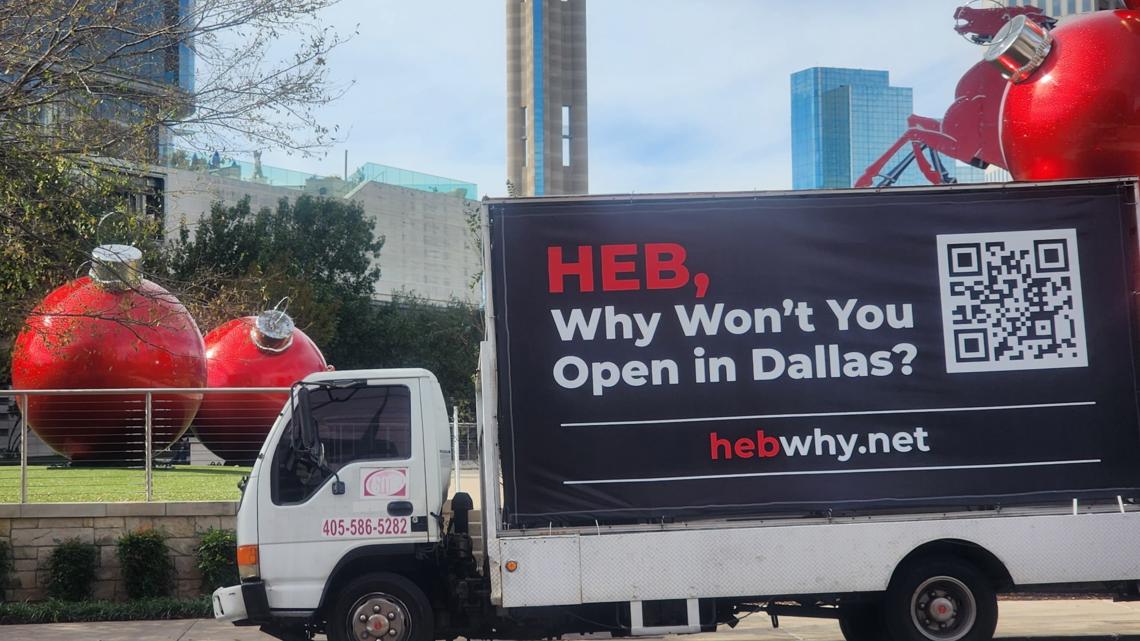
He took that sign and made a sign of his own. He spent roughly $8,000 in personal funds to rent a mobile billboard for the campaign, “H-E-B Why.” The billboard traveled around the city for weeks.
“Why are we the only major city in Texas that you service that you will not build in the inner city because Austin, San Antonio, and Houston have stores,” said Terry.
That’s changed recently. The Dallas City Council approved a zoning request for H-E-B to build its first store within city limits.
“They bought. They planned. They got the city to rezone it all in less than a year, yet they own property at Beckley and Davis that they’ve held for now, we’re going on nine years,” said Terry.
WFAA asked H-E-B about its plans for the Oak Cliff property purchased in 2017. They said in a statement, “We don’t have anything to share.”
“H-E-B doesn’t want to come to the southern part of Dallas,” said Maxie Johnson, Dallas City Council District 4.
Councilman Johnson said it has been an ongoing battle. “Here’s the issue I have with H-E-B. They want to give money and charity to support our initiatives, but they don’t want to be a real partner,” said Johnson.
It is a partnership that both Johnson and Terry said H-E-B and other large chains could find beneficial.
“We are capable consumers, and we can afford groceries,” said Johnson.
“You might think that the density doesn’t work, but because there’s no one else around, where else are we going to go?” said Terry.
It’s a reality still hopeful for perception to change. “I won’t contend until they build one,” said Terry.