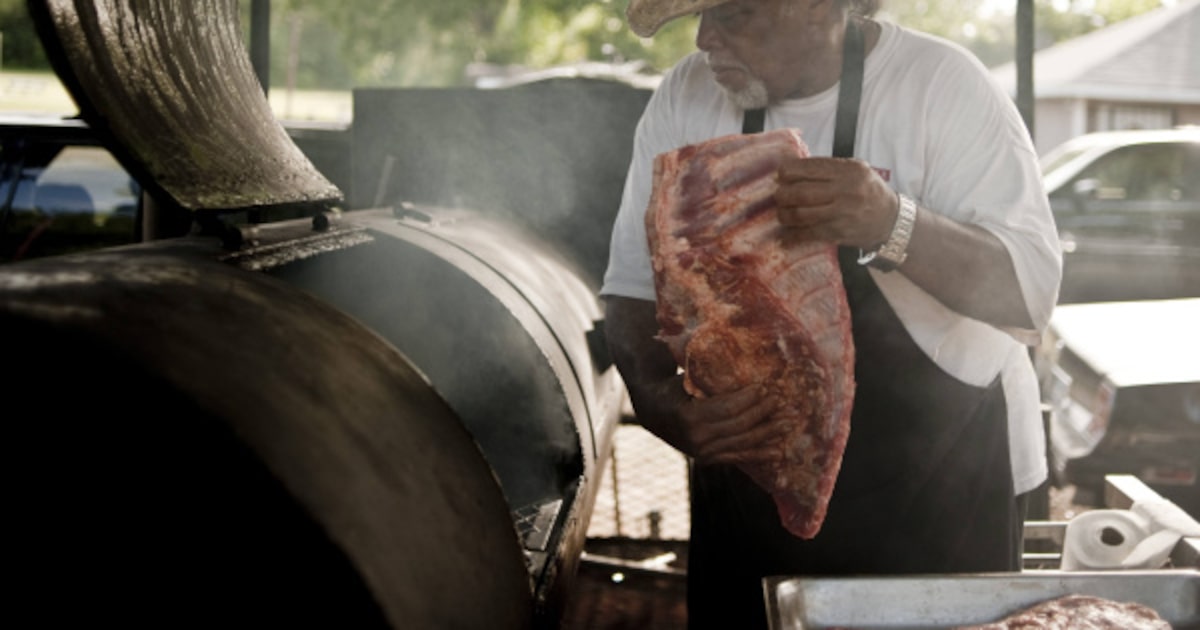
Clyde Biggins of Clyde’s Old Fashioned Hickory Smoked Barbecue has died, according to his daughter.
The barbecue pit master was a local institution while he owned his West Dallas barbecue joint from the late ‘70s to the early ‘90s.
But a serious drug conviction and 20-year prison sentence in 1993 derailed his career — until a comeback saw him at the pit once more.
He was 81 years old and died Thursday of medical complications from various ailments, she said.
Breaking News
His daughter Lisa Biggins Dickson said barbecue was her father Clyde’s passion and how he connected with family, neighbors and the community.
“Everybody knew him and they called him the mayor of West Dallas,” she said.
Clyde Biggins was a serious barbecue enthusiast, competing year-round and focusing on old-fashioned smoking.
“He talked about all these people using ovens, but real barbecue uses natural wood,” Biggins Dickison said. “He was a stickler on using hickory even though that was more expensive than other wood.”
Related
Biggins ran two restaurants: Clyde’s Old Fashioned Hickory Smoked Barbecue on North Westmoreland and Clyde’s Restaurant in the West Dallas Shopping Center.
The former, more commonly known just as Clyde’s, was a bustling locale known for its hospitality, in part because “Everybody knew Clyde,” his brother-in-law Albert Williams told The News for a profile in 2012. Williams recalled the restaurant drawing an upper class clientele and a 1989 Dallas Morning News review by Kim Pierce praised its short-end ribs as “tender” and “robustly smoky.”
Biggins hosted large cookouts after L.G. Pinkston High School football games to give kids a place to go where they could stay out of trouble, Biggins Dickison said.
Biggins told The News in 2012 that Clyde’s made about $1,500 a day and at least double that on Fridays and Saturdays, with some days so busy they nearly ran out of plates. When the restaurant operated, he would sometimes ship barbecue as far as Los Angeles.
However, in 1992, Biggins got caught in a large narcotics trafficking roundup. The restaurateur worked as a middleman for a drug ring that imported cocaine and marijuana from Mexico and distributed it in Dallas.
He told The News that he had been blinded by money and gotten into the business through his brother. He was raised poor by a single mother along with five siblings in a West Dallas housing project, and he said he wanted more for his children.
Biggins was convicted of possession of marijuana and cocaine with the intent to distribute, among other charges, according to the 2012 story, and was sentenced to 20 years in prison in 1993. Clyde’s closed a few years later.
He was released from prison in 2010 after 16 years, during which Biggins worked toward his GED and recommitted to Christianity.
Out of prison, Biggins made his return to barbecue. He started by making deliveries to a few loyal customers before setting up a pit on an East Oak Cliff corner, where business was good.
However, in early 2012, police shut down the joint because he didn’t have the required food service permit or enclosed kitchen area to cook the food, according to the story.
Biggins had dreams of opening another restaurant, but the consequences of his prison sentence — little credit history and not enough money — made that difficult. Still, he served barbecue to friends and family at his home to keep his traditional methods alive.
A fire in 2016 took his house days before he was to sell it and move out. He was making plans to move into a senior center, as he was struggling with his health and receiving dialysis three times a week.
Though he never was able to put together a new restaurant, Biggins still shared his love of barbecue when he could. Just prior to the fire, he had cooked for hundreds of Dallas police officers, he said in 2016.
He continued to compete in competitions until early in 2025, when Lisa said the smoke from the barbecue pit became too much to handle.
Biggins leaves behind three children, Gregory, Clyde and Lisa, who was a longtime office manager at The Dallas Morning News.
Assistant business editor Kyle Arnold contributed to this report.