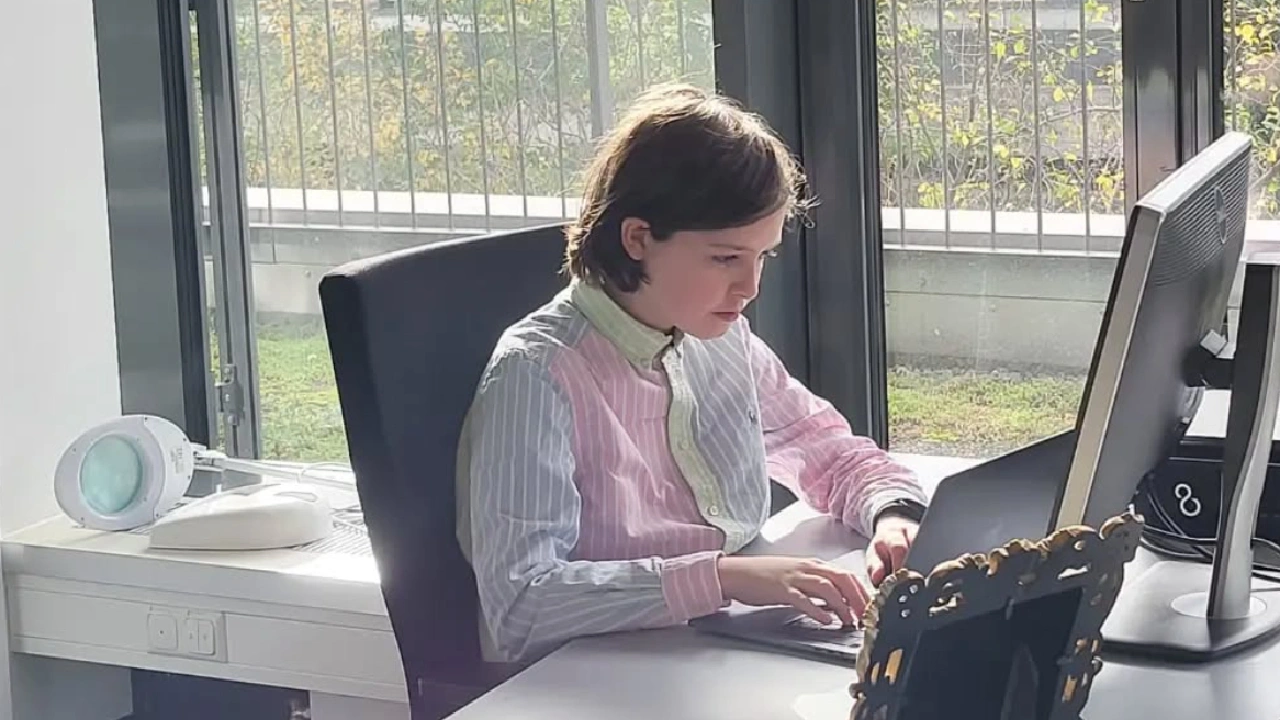
A teenager races through quantum labs and heads straight for the human blueprint. Should one prodigy’s next step set the limits for all of us?
Laurent Simons just crossed a scientific milestone most reach decades later: a PhD in quantum physics from the University of Antwerp at age 15. His thesis probed Bose polarons in ultra-cold matter, a line of work honed during an internship at the Max Planck Institute of Quantum Optics. He is now pursuing a doctorate in medical sciences with an AI focus in Munich, aiming to fuse human biology with algorithms to extend our capabilities. The idea excites and unsettles in equal measure, setting the stage for fresh debates over human enhancement.
From prodigy to PhD holder at just 15
At an age when most teenagers are preparing for high school exams, a 15-year-old Belgian named Laurent Simons has astonished observers with a doctorate in quantum physics from the University of Antwerp, making him the youngest person ever to hold such a title. His research on Bose polarons in ultra-cold matter highlights an exceptional scientific instinct, and his ambitions already reach beyond quantum physics toward a radical fusion of artificial intelligence and human biology.
A journey marked by brilliance
Laurent advanced through academia at a blistering pace. By 11, he had completed undergraduate and master’s degrees in physics, and gained hands-on experience during an internship at the prestigious Max Planck Institute of Quantum Optics, where he began linking quantum models with biological systems. His PhD thesis drew unanimous praise from his supervisors, reinforcing his status as a pioneer in the making.
The path was not without obstacles. His family left an earlier program in Eindhoven after disagreements over the curriculum, a turning point that led him to Belgium, where his determination translated into remarkable results.
From atoms to anatomy: a bold new direction
After completing his PhD in quantum physics, Laurent enrolled in another doctoral track in medical sciences with a specialization in artificial intelligence. Based in Munich, he aims to connect state-of-the-art AI with human biology to enhance human capabilities, from forecasting illnesses to supporting regenerative medicine.
These ambitions ignite both enthusiasm and debate. Integrating AI into the body could unlock breakthroughs, yet also pose ethical dilemmas and unforeseen risks that demand rigorous oversight.
A vision of AI-enhanced ‘super-humans’
Laurent’s horizon extends beyond improving today’s medical practices. He imagines creating super-humans by merging AI-augmented cognition with biological systems, potentially redefining what medicine and human performance can achieve through predictive diagnostics and individualized therapies.
- AI-driven models for early disease prediction and prevention.
- Regenerative strategies inspired by quantum-level biological insights.
- Tools designed to enhance human cognition and decision-making.
Alongside these prospects, questions persist about social equity and access, including the risk of widening divides between enhanced and non-enhanced individuals. For now, Laurent remains focused on exploring the possibilities.
The mind behind the science
Behind the headlines is a teenager propelled by deep curiosity and confidence in the power of knowledge. Institutional disputes and changes of environment sharpened his focus rather than slowing him down, channeling his energy into research with concrete impact.
At 15, he stands at the frontier of multiple disciplines, intent on pushing boundaries that many have yet to consider, and turning audacious ideas into measurable scientific progress.
Source : https://e.vnexpress.net/news/news/education/15-year-old-becomes-phd-in-quantum-physics-sets-sights-on-creating-super-humans-4986469.html