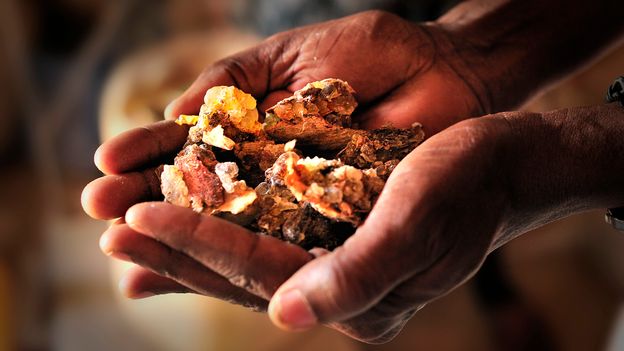
Results from the initial pilot schemes of the app, conducted from January 2023 to June 2024, showed over 8,000 harvesters had been reached. DFEC also says it supported some 1,400 harvesters to adapt to climate change through workshops and trainings to help them care for the trees. Seven tonnes of resin have so far been purchased from local communities through the app, with over 3,000 individual frankincense trees registered across dozens of farms.
DeCarlo, who has been involved with the scheme, says such verifiable, data driven traceability is critical to de-risk supply chains and create more ethical partnerships. “[It] empowers the very people who directly manage the trees,” she says. “Furthermore, it gives buyers an opportunity to invest sustainability.”
The app’s track system “seems to be working very well and makes close following, combined with credibility, possible,” says Frans Bongers, a professor of forest ecology at Wageningen University in The Netherlands who has worked on frankincense for decades but is not involved with the app. It is also comforting for resin users to know that the product is so closely watched and followed, he says, with long term monitoring of tree health becoming a possibility. “Of course this comes at a cost,” he adds.
Despite the potential of apps, some researchers argue more work still needs to be done to encourage demand for more sustainable frankincense among those purchasing the incense.
In particular, DeCarlo says the Catholic Church could use its outsized soft power to influence the market positively. While the Church accounts for just 5% of the global frankincense trade, she argues that few institutions wield its symbolic and moral influence.