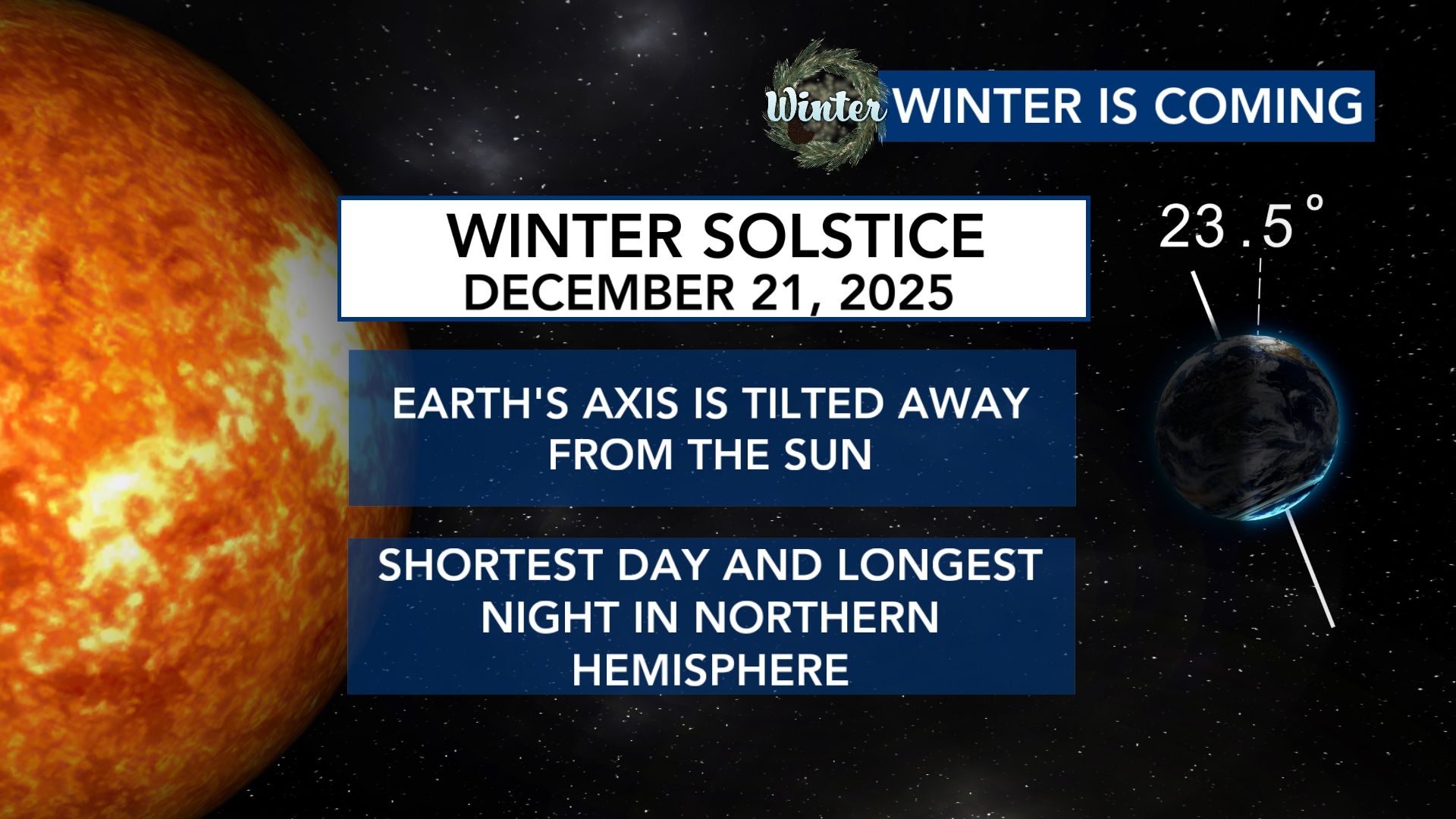
At 10:03 a.m. Sunday morning, the sun was directly over the Tropic of Capricorn at 23.5° south latitude, marking the December solstice, and the beginning of winter in the Northern Hemisphere.
The Sun also made its shortest path through the sky reaching just 31 degrees above the horizon (the horizon is 0º and directly overhead, known to astronomers as zenith, is 90º). It rose more as twice as high at the June solstice, reaching nearly 78º above the horizon.
Sunday’s short path had the Sun above the horizon for just 9 hours 44 minutes, which makes for the longest night of the year.
The latest sunrise was all the way back on Nov. 1 at 7:37 a.m. though if not for the end of daylight saving the following day, sunrise would continue to creep later until the first week of January. Sunset has been creeping a bit later since Dec. 5 when it dipped below the horizon at 5 p.m.
We won’t see a 6 p.m. sunset until Feb. 19. The first sunrise happens before 7 a.m. two days earlier.
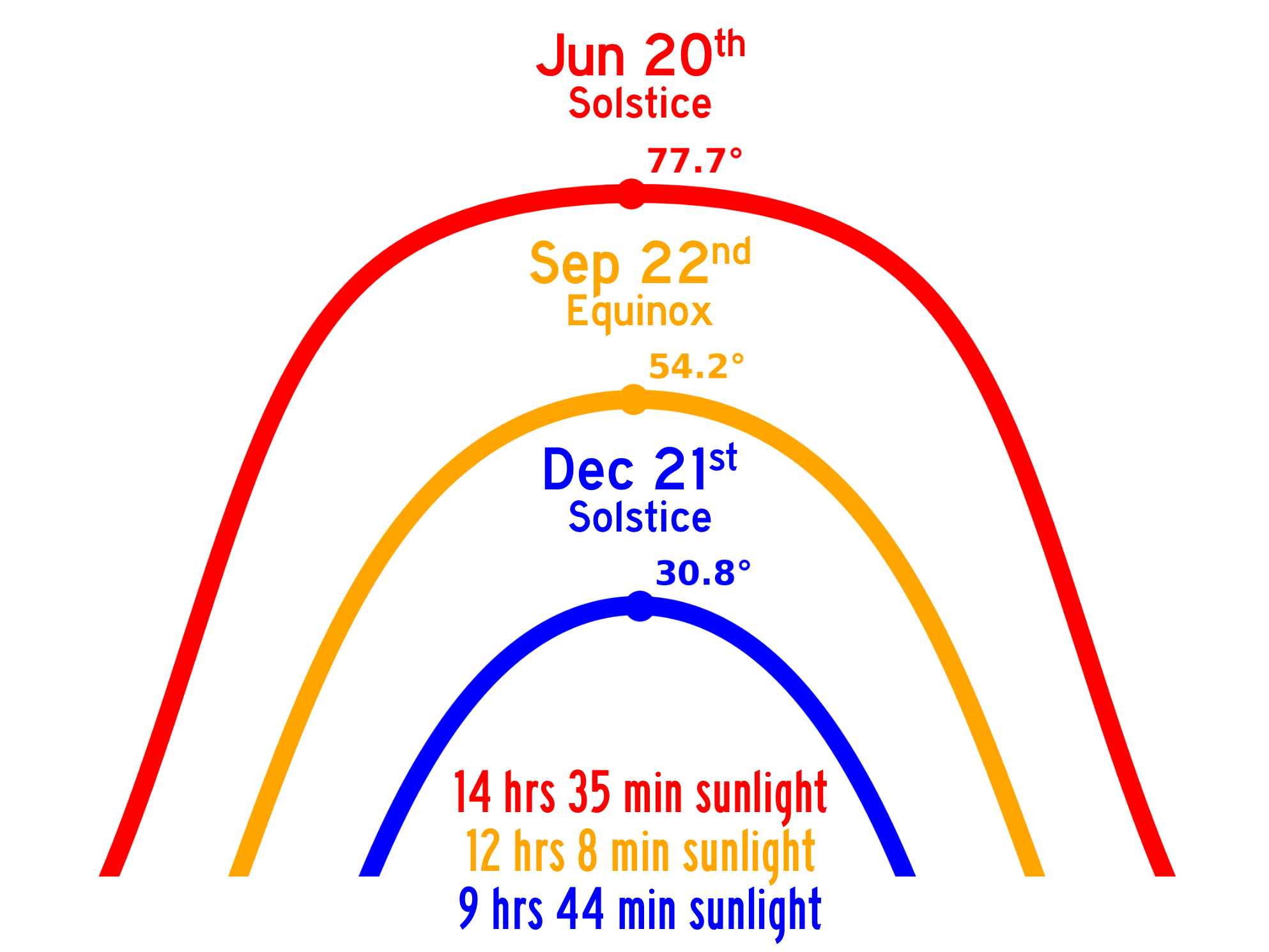 the Sun takes its shortest trip through the sky on the December Solstice
The low arc of the Sun is a direct result of Earth’s axial tilt. Because the Northern Hemisphere is angled away from the Sun, sunlight strikes the ground at a lower angle, spreading the same energy over a larger area. This is why winter days are cooler, even though Earth is actually slightly closer to the Sun in December.
The Sun’s path on the December solstice depends on your latitude.
In the mid-latitudes like most of the U.S. and Europe, the Sun stays low all day, and shadows are long even at noon. Near the Arctic Circle: The Sun barely rises or does not rise at all, resulting in polar night.
Residents in the southern hemisphere experience the opposite where the December solstice brings the start of summer. Sydney along with much of New South Wales are under a heatwave warning with temperatures reaching 34º C (93º F) on Sunday. A break is forecasted by Christmas Day with a cooldown to the mid 20s C (mid 70s F).

The Sun’s path has been tracked for thousands of years. Ancient monuments, calendars, and observatories from Stonehenge in England and the Goseck Circle Germany, to the Jantar Mantar in India to Machu Picchu, Peru and the Intihuatana stone (“Hitching Post of the Sun” which the Inca used to measure solstices and equinoxes for agricultural and religious purposes.