
Leeds United have a history of hitting Crystal Palace with long throws.
It was in April 2022, during a visit to Selhurst Park, that future Champions League Golden Boot winner Raphinha first hurled the ball as far as he could for the visitors. Leeds held on to a 0-0 draw that day, which gave them a vital point in their Premier League survival that season.
But Raphinha, now at Barcelona, did not cause Palace anything like the kind of trouble they suffered on Saturday. Three years on, Ethan Ampadu was the architect of Palace’s 4-1 demise as his missiles from the sidelines caused pandemonium in Oliver Glasner’s back line.
The Leeds captain may not have the height or distance of long-throw greats such as Rory Delap or Dave Challinor, but the Welshman’s flatter trajectory set the wheels in motion for an outstanding victory which extended Leeds’ unbeaten run to four matches — their longest run without a loss in the top flight since, ironically, Raphinha took his catapult to Croydon in 2022 during a five-match unbeaten run.
At the start of the season, had the club’s transfer committee been asked to paint a picture of the sort of goals they were recruiting for, it would have looked something like the first two scored on Saturday: Ampadu launching into a congested box of tall, powerful Leeds players competing for first and second balls and one of them steering it home from close range. The same type of goal was scored twice in the space of 11 first-half minutes.
This is the blueprint the club pursued in the summer and now seems to be bearing fruit after four-and-a-half impressive matches of physical, aggressive, combative, long-ball tactics.
“We know he (Ampadu) can throw really long,” midfielder Anton Stach told reporters after the match. “It’s a big strength because when he’s throwing it so long, we try to create chaos with all the big, strong guys in the middle. Then it can happen that the ball drops down in front of the foot.
“It’s the instinct of a really good striker, Dom (Calvert-Lewin) is there and, out of this, we score some goals. It’s really important.”
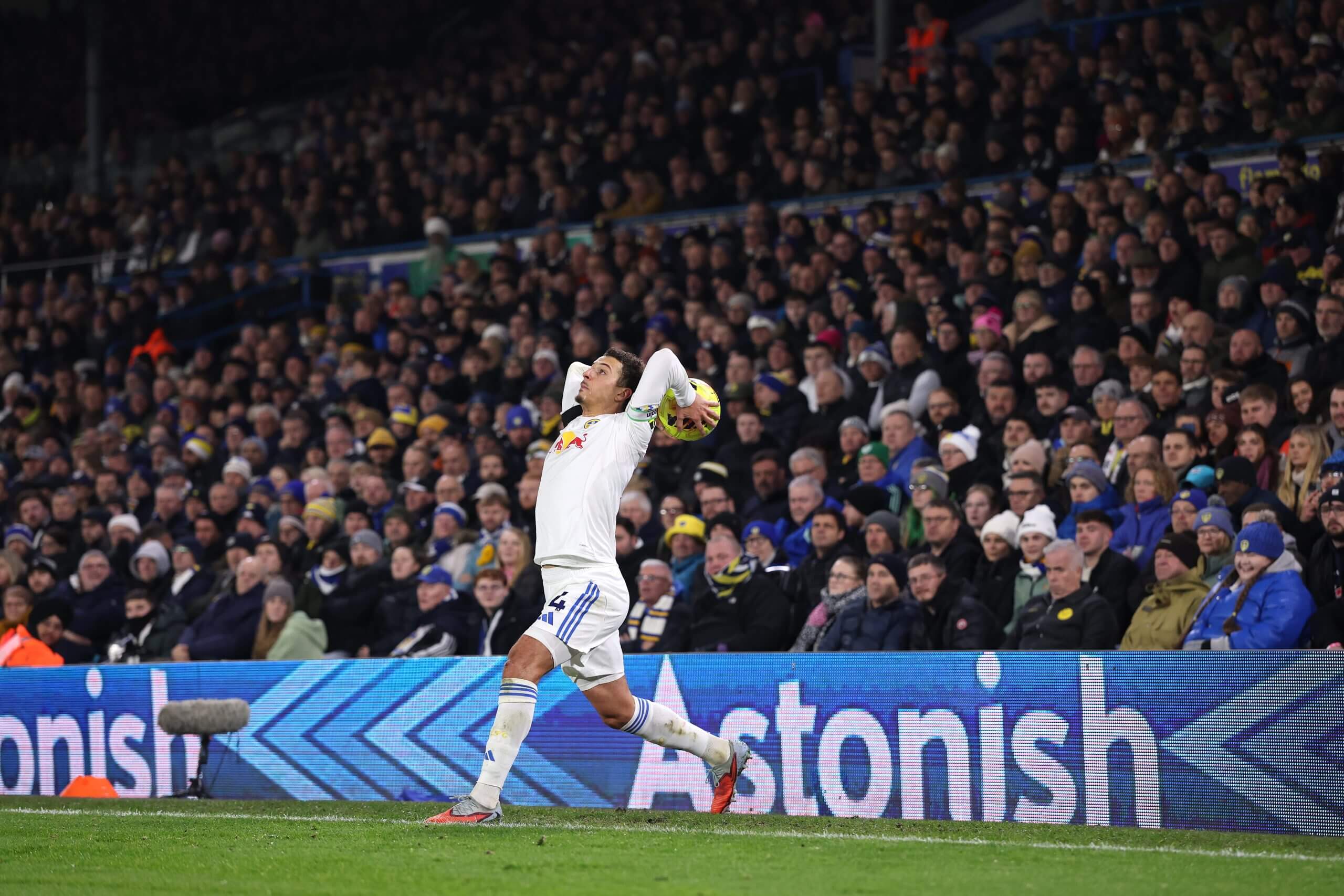
Ampadu’s long throws are proving key for Leeds (Stu Forster/Getty Images)
Ampadu aimed for somewhere between the near corners of the six- and 18-yard boxes. In the first half, Jaka Bijol and Pascal Struijk were the designated giants to get under the incoming ball.
While it was Palace defender Chris Richards who headed to Calvert-Lewin for the opener, Bijol was able to provide the perfect flick-on for the second goal. The second phase is all about the movement of Calvert-Lewin, a predator playing with confidence and instinct to finish twice from close range.
Ampadu has taken 60 throw-ins this season, so this is not a new tactic from Daniel Farke, but it’s not been as effective before.
This was not a skill we saw from Ampadu in his first two seasons with Leeds. He averaged 0.83 throws per 90 minutes in 2023-24 and 1.06 in 2024-25. That has jumped to 4.08 this term. He still trails the quantity of full-backs Jayden Bogle (5.45) and Gabriel Gudmundsson (6.34), but he plays in the centre, not down the flanks.
In his post-match press conference, Farke made the point that long throws would have been useless for the team last season because of how short his attackers were. As a possession-dominant side in the Championship, he also did not like giving a deep-lying opponent time to reset and recover while United prepared a long throw.
But the tables have turned in the Premier League.
“Right now, we know we have players who have the quality and the physicality to score out of these situations,” he said. “We have to invest so much when the ball is in play, so much intensity, more than any other team, because we don’t have the individual quality like other teams.
“We then also need sometimes a little break; when there is a long throw-in, (we) can take a breath. We are not in a position to dominate this league. We are in a position, as a newly promoted side (where) we have to fight in every game with the knife between the teeth.”
The throws, in addition to the corners of Stach and Sean Longstaff and the free kicks of the former, will continue to form part of Leeds’ wider armoury. Set-piece goals will be critical to keeping them in the league, a prospect that is looking rosier.

Pascal Struijk and Dominic Calvert-Lewin celebrate victory over Palace (Shaun Botterill/Getty Images)
United have moved six points clear of the relegation zone and are closer to Brighton & Hove Albion and Everton in ninth and 10th respectively, than they are to West Ham United in the bottom three. They have earned eight points from four fixtures, which included games against three of the current top eight, and with 19 points from 17 games, they are ahead of the one-point-per-game average the club is targeting in 2025-26.
A formation switch laid the foundations for this change in fortune and has been mixed with physicality, aggression and intent. Fans and players can be further encouraged by new tactical tweaks paying off for Farke, like the 4-2-1-3, which had Joe Rodon at right-back and Bogle on the right of a front three against Palace.
On top of all this, they have Calvert-Lewin on a hot streak, scoring six goals in five games and now level with Phil Foden and Danny Welbeck as the highest English scorer in the division.
In the 2020-21 season — when he earned his 11 England caps — and the campaign before that, he averaged 0.5 and 0.45 goals per 90 minutes respectively. In 2025-26, his average is at 0.61 goals per 90.
He has never been this prolific, and Leeds are the beneficiaries.