
One of the most detailed spectrographs ever recorded of the Sun has revealed hundreds of missing wavelengths—gaps in the solar spectrum that scientists have yet to identify. Despite over 200 years of observation and advances in solar physics, many of these mysterious absorption lines remain unsolved, their chemical origins unknown.
While most of the dark lines in the Sun’s spectrum have been matched to known elements like hydrogen, helium, oxygen, or iron, a significant number stubbornly resist classification. This puzzle, discovered in data as far back as the 1980s, raises questions about the limits of current atomic and molecular databases.
When Sunlight Leaves Clues Science Still Can’t Decode
The dark lines we’re talking about, called Fraunhofer lines, were first spotted back in 1814 by a German physicist named Josef von Fraunhofer. You can see them as little breaks in the rainbow when sunlight gets split by a prism or a spectrograph. According to ScienceAlert, each line is like a fingerprint, showing where atoms in the Sun’s atmosphere are soaking up certain wavelengths of light. Over time, scientists have matched most of these lines to known elements, which helps them figure out what the Sun (or any star) is made of.
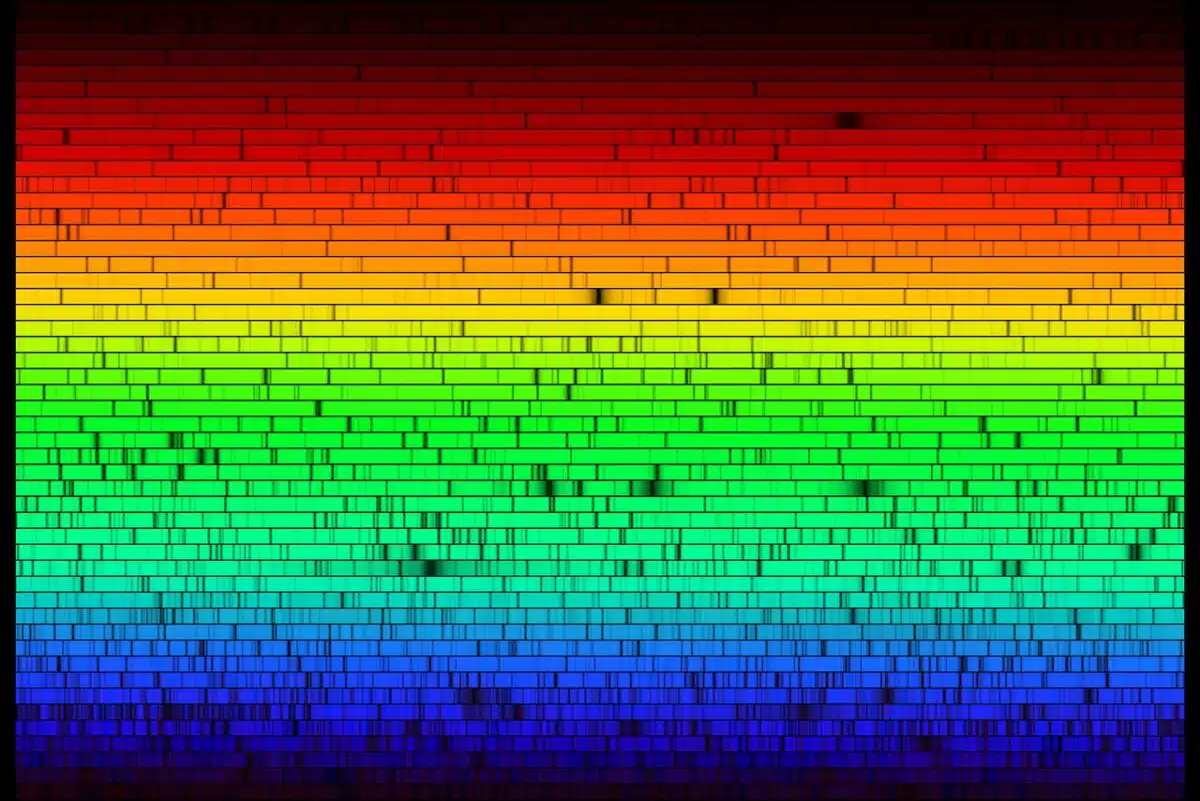 A high-resolution version of the spectrum of our Sun. Credit: NOIRLab
But even with super detailed data a bunch of these lines still don’t match anything. Their stubborn presence suggests that we’re missing something, whether it’s gaps in our atomic data or stuff we still don’t fully get about how atoms behave in the extreme environment of the Sun.
Unmatched Spectral Lines in the Solar Fingerprint
Even the most precise synthetic models of the Sun’s atmosphere fail to account for all the lines recorded in real observations. As stated by the same source, these unmatched features do not correspond to any known atomic or molecular transitions, nor do they match the synthetic spectra generated based on factors like temperature, gravity, or atmospheric layering.
One of the major culprits is the incompleteness of current atomic and molecular databases. The iron group elements, in particular, involve complex electron transitions that are hard to model and verify in laboratory conditions. Many of these transitions have not been fully catalogued, making it difficult to assign spectral lines to them with confidence.
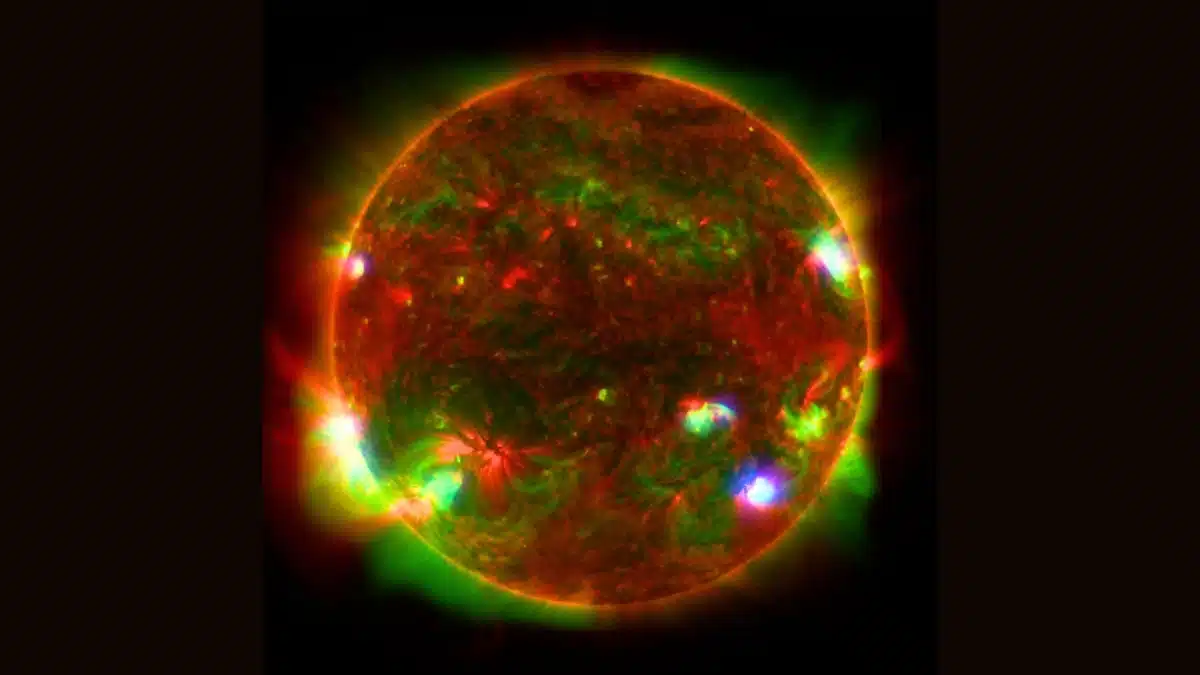 A multi-wavelength image showing the Sun in three distinct colors. Credit: JPL
A 2017 study, cited in the same article, looked into a specific subset of these unidentified features and found that, despite modern modeling techniques, the lines didn’t fit known patterns. Even subtle shifts in the Sun’s conditions can distort or obscure the features.
A Turbulent Star Complicates The Picture
The Sun is not a static object. Its surface and atmosphere are constantly shifting, with powerful convection currents and intense magnetic activity. These variations can change how absorption lines appear depending on when and how the data are captured.
Because of this, even high-quality datasets like the one compiled at Kitt Peak are difficult to interpret in full. As reported by ScienceAlert, the lines that don’t match any known reference may not just be missing fingerprints—they might be fingerprints distorted by the medium itself.
The Sun’s magnetic fields, which shift over time and from one region to another, can influence the energy levels of atoms in its atmosphere. That makes it harder to isolate the specific cause of a line, especially when it overlaps with others.
Closer To The Answers, But Not There Yet
Despite the gaps, researchers are slowly refining their models and improving data collection. Instruments have become more sensitive, and databases of spectral lines continue to grow. Every mismatch between observed and synthetic spectra now serves as a valuable clue, helping scientists better simulate real solar conditions.
That said, the full picture is still out of reach. As ScienceAlert notes, hundreds of these mystery lines persist—an intriguing reminder that the closest star to Earth still holds unresolved secrets, even when those secrets are hidden in the visible light we see every day.