Sydney Jackson / Houston Public Media
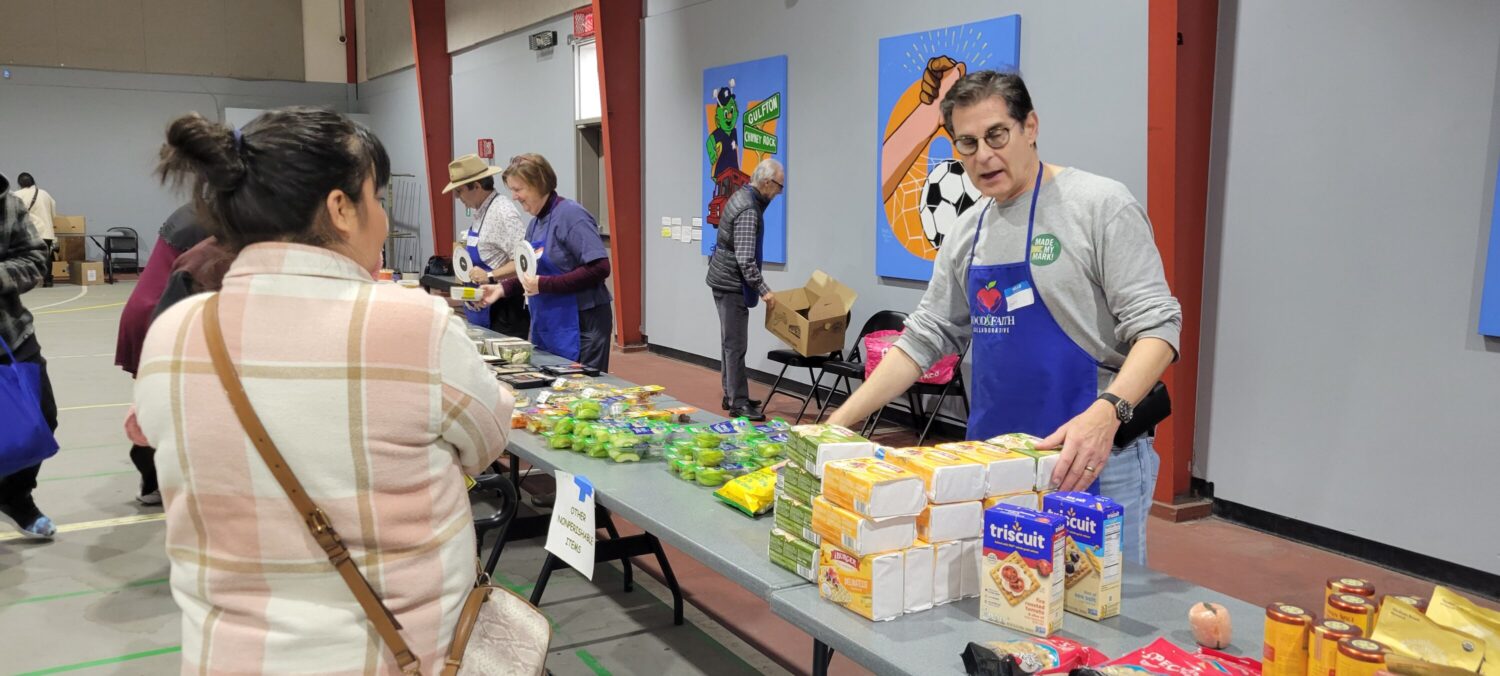
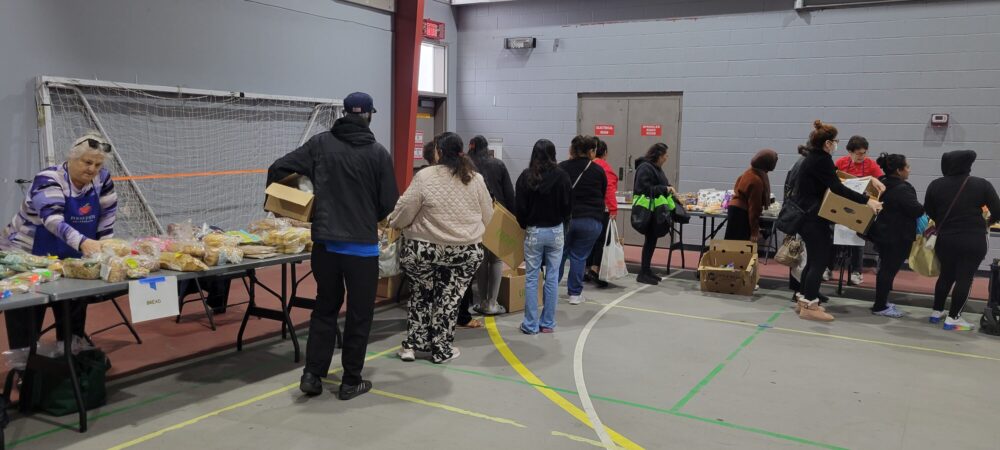
A line forms at a “PopUp Grocery Store” hosted by the nonprofit Second Servings in Houston on Dec. 5, 2025.
Inside the Burnett Bayland Community Center, dozens of families lined up, each waiting their turn to fill up their basket with vegetables, meat, organic food and something sweet. Conversing with the volunteers in bright blue aprons, they carefully selected items to help supplement their groceries for the week.
Seconding Servings, a nonprofit, was hosting a “PopUp Grocery Store” in Houston’s Gulfton neighborhood as volunteers saw a surge in need in recent months.
Reina Aquino, a wife and mom of three children from the Gulfton neighborhood, was among them. Aquino is a housekeeper and her husband works in electricity. Despite her and her husband’s dual-income household, Aquino said their work is not enough to pay for rising food prices.
“You have to pay the bills or buy food,” Aquino said in Spanish. “So you have to buy a little less food in order to pay your electricity, the rent, everything.”
About 14% of Americans and 17% of Texans are food insecure, according to the U.S. Department of Agriculture. That number is even higher in Harris County, where roughly 2 in 5 households are food insecure.
Black and Hispanic residents, like Aquino, face the highest rates of food insecurity. More than half of Black residents and nearly half of Hispanic residents in Harris County live in food insecure households, according to a study from Rice University’s Kinder Institute for Urban Research. In comparison, roughly 24% of white Harris County residents and 17% of Asian residents are food insecure.
In November, some Texans saw interruptions to their SNAP benefits, due to a federal government shutdown. While those benefits have been restored, more cuts are coming to the program. President Donald Trump signed a law this summer that includes cuts to SNAP.
Houston’s Black residents could be disproportionately impacted. A recent University of Houston poll found that 34.6% of the city’s Black residents rely on SNAP, while they make up 22% of Houston’s population.
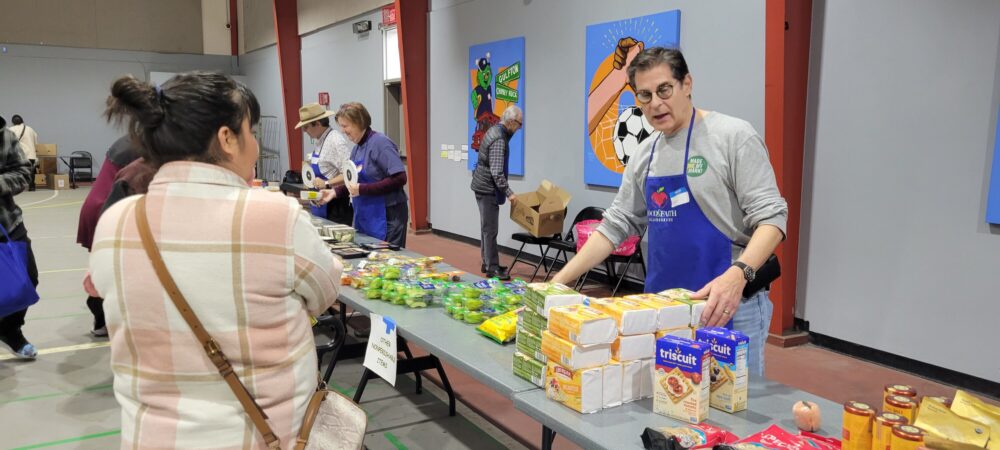
Sydney Jackson / Houston Public Media
Scott Chanin helps distribute food at a “PopUp Grocery Store” hosted by the nonprofit Second Servings in Houston on Dec. 5, 2025.
Maria Perez Arguelles, a research assistant professor at the University of Houston with an expertise in urban policy, said Houston’s infrastructure and policies might be partly to blame for racial disparities in food insecurity.
In Houston’s predominately Black and Hispanic neighborhoods, a lack of proper environmental planning and adequate zoning permits food insecurity to thrive in these neighborhoods, she said.
“I think there are several structural factors. So for starting in terms of infrastructure, for example, predominantly Black and Latino neighborhoods, they usually lack full service grocery stores,” Arguelles said. “There’s also some other patterns of historically disinvestment in some of these neighborhoods, which make these types of inequalities even higher.”
For instance, in the Third Ward, a predominately Black neighborhood in Houston, convenience stores, dollar stores and fast food restaurants are more prevalent and accessible than grocery stores that offer healthier options.
“Houston has significant food deserts, and those are especially in these communities which have limited access to affordable and nutritious healthy food,” Arguelles said.
Arguelles said there’s ways to ease the stress on these communities and reduce food insecurity – for example, making supplemental food benefit programs like SNAP or food pantries more accessible, and operating school meal programs year-round.
“I think that honestly the biggest difference for families dealing with food insecurity in this type of neighborhoods can come from making healthier foods easier to reach and more affordable,” Arguelles said.
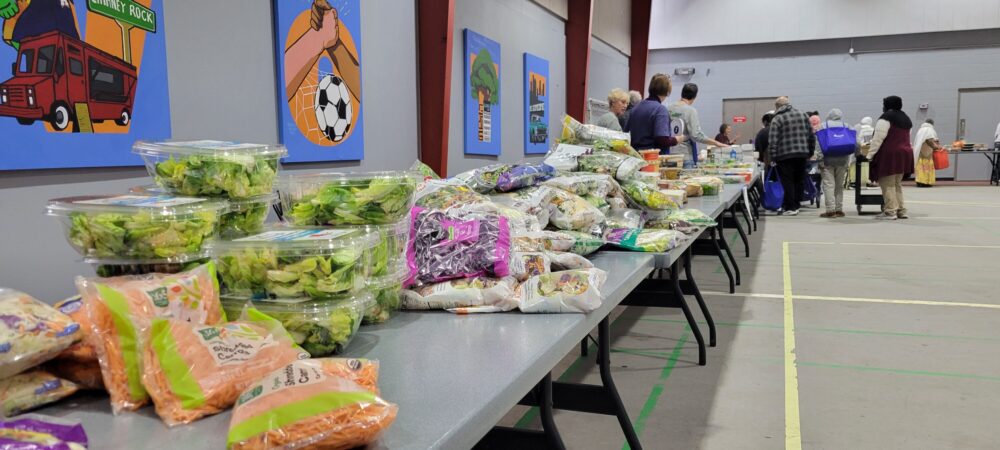
Sydney Jackson / Houston Public Media
Produce at a “PopUp Grocery Store” hosted by the nonprofit Second Servings in Houston on Dec. 5, 2025.
Valentine Gilbert, an assistant professor at UH’s Hobby School of Public Affairs with an expertise in urban economics, also said food service programs can make a difference, but argues that solutions like this are not simple.
Gilbert said even with access to grocery stores, people accustomed to less healthy options may not change their habits overnight.
Many lower-income households can’t afford healthier food options, and even when possible, they often do not have the free time to prepare organic, healthy food that has a short shelf life, he said.
“If you’re a low-income household where you don’t have a lot of time … then it might just make more sense for your family to buy pre-made food or foods that are easier to prepare,” Gilbert said.
Sydney Jackson / Houston Public Media
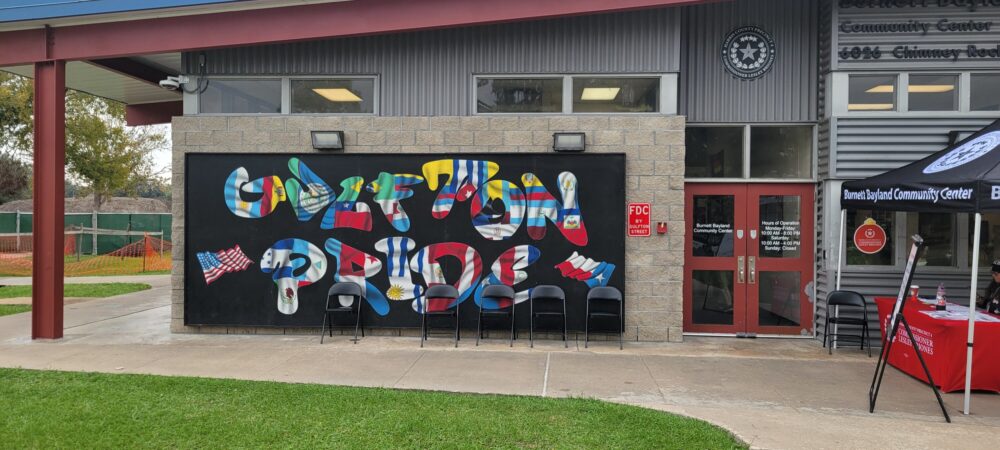
The Burnett Bayland Community Center in Houston, which hosted a “PopUp Grocery Store” run by the nonprofit Second Servings, on Dec. 5, 2025.
For low-income households in Black and Hispanic neighborhoods disproportionately impacted by food insecurity, events like Second Servings’ distribution site offer crucial support.
Davia Smith, a Black woman who lives with her grandmother and siblings, came to the Second Servings site in early December. She and her family shop at an H-E-B nearby, but also have come here for support to buy snacks and get organic fruits that are higher priced that her sister enjoys.
“It helps to come out here and be able to bring a bag and get food. It helps to save money on stuff,” she said. “It helps to save money on bills. That’s what we need this month, bills paid.”