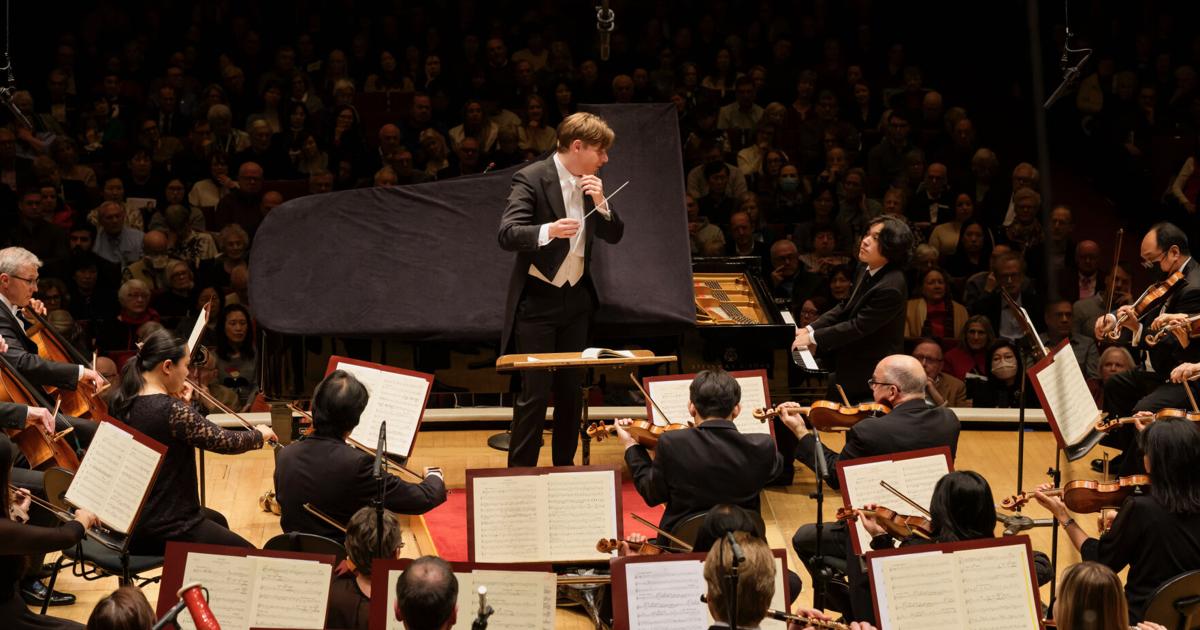
The Chicago Symphony Orchestra has closed out 2025 in style, with three concerts led by the Zell music director designate. Late last week, Klaus Mäkelä led the CSO in a wide-ranging concert featuring two popular favorites and two new works. Mäkelä does not officially become music director for almost two years, yet his popularity in Chicago continues to grow. It was a packed house on Thursday night when the first of the three concerts showed Mäkelä in top form.
The evening opened with the five-minute work “Subito con forza” (suddenly, with power), a marking Beethoven frequently used in his music. Composer Unsuk Chin, a native of South Korea, dots small Beethoven quotations throughout her piece. It opens with the same C that begins Beethoven’s “Coriolan” Overture, but immediately becomes jittery in the most modern way before low strings offer an ominous warning. The music contains much agitation and halting rhythms, and horn calls are juxtaposed with bell-like chiming sounds.
It ends quietly, moving rapidly from one idea to the next. It is rather like walking down the street and hearing snatches of a few dozen conversations from folks passing by in the opposite direction. It is more atmospheric than anything else and one can reasonably imagine that Mäkelä likes the work, as he conducted the world premiere in 2020 with the Royal Concertgebouw Orchestra in Amsterdam.
The other new work on the program was “Con brio,” Concert Overture for Orchestra by German composer Jörg Widmann. Composed in 2008, this 12-minute work is an exercise in extended techniques, with the composer providing page after page of how to realize his ideas. For example, for one part of the work for wind instruments he writes, “…only blow with a dark breathing sound through the instrument, no pitches! Thereby open both sides of the mouth and shape the oral cavity to intensify the breathing sound.” Later, players are instructed to make a “lip-smacking sound” or to unscrew the mouthpiece. Widmann has a vast set of instructions for the timpanist, so the musician rarely plays the instrument as traditionally taught through the music of composers such as Beethoven, instead producing new percussive sounds by striking it everywhere except the top.
This unusual work lasted approximately 12 minutes and near the end there were audience titters of laughter. Whether this was due to a kind of light-hearted amusement some listeners found in the music or if it was because the music had overstayed its welcome, I can’t say. I can say that my first thought when it was over was, “just because you can doesn’t mean you should.”
For many, the highlight of the evening would have been the appearance of Yunchan Lim, the youngest winner of the Van Cliburn International Piano Competition in 2022 when he was only 18. He offered a gripping performance of Robert Schumann’s Piano Concerto in A Minor. This work started as a one-movement concert fantasy for piano and orchestra, only later being turned into a piano concerto. Schumann’s wife Clara gave the first performance, part of her life-long devotion to championing the music her husband wrote.
Lim brought virtuosity and gorgeous technique, and melded that with glorious interpretive choices. His lightness of touch was at times almost magical and Mäkelä was superb at maintaining the right balance not only between soloist and orchestra, but also between buoyancy and boldness.
Lim moved easily from quiet gentleness to stormy passion while demonstrating his supple phrasing. Mäkelä beautifully managed shifts from piano to orchestra and back, as well as changes from darkness to light and from soft to loud with the kind of grace that exudes power.
It was a memorable performance by the South Korean pianist and the audience called him back repeatedly to greet him with applause and cheers while his crisp bows showed his long hair to great effect. He eventually sat down again at the piano for an encore. His maturity as a pianist exceeds his youthful age, and he spun gold from the Waltz No. 3 in A Minor, Op. 34, No. 2 by Chopin.
The final work on the concert was Beethoven’s Symphony No. 7, which explained in part Mäkelä’s modern work choices, both having been strongly influenced by Beethoven. The program notes by the admirable Phillip Huscher emphasized the composer’s wild side. “…he is an utterly untamed personality,” he quoted Goethe as writing, as well as Carl Maria von Weber’s conclusion that Beethoven was “ripe for the madhouse.”
Mäkelä didn’t offer an untamed or mad performance, but he did dig deep to draw out the excitement, the power, and the drama of this popular symphony. He was often on the quiet side of the dynamics, letting the actual musical line be the emphasis, not the volume of the line itself. And he made the symphony transparent in ways many other performances obscure, giving a slight advantage to the winds over the strings. The result was both fresh and familiar, a combination often very difficult to achieve.
The opening was genial yet noble with delectable oboe lines, and later gives way to a joyful vivace that surged with excitement from all the dotted rhythms. The Allegretto featured very quiet low strings with the most somber elements of the movement dark and brooding.
The scherzo movement is marked “presto” and this fast movement had dance-like bounce and the innocence of a hymn. The final movement, “Allegro con brio” (like Widmann’s composition), was fast and furious. Mäkelä was scrupulous in maintaining clarity even at the exhilarating pace he set for his musical forces. The result was both intoxicating and thrilling.
The audience was delighted and rose to their feet to applaud not only Mäkelä but also all the musicians. The conductor made a point to recognize various players for their superb work, one being a guest for the evening: Herman van Kogelenberg served as the evening’s guest principal flute. This member of the Munich Philharmonic was outstanding and it was a pleasure to hear him work with the CSO.