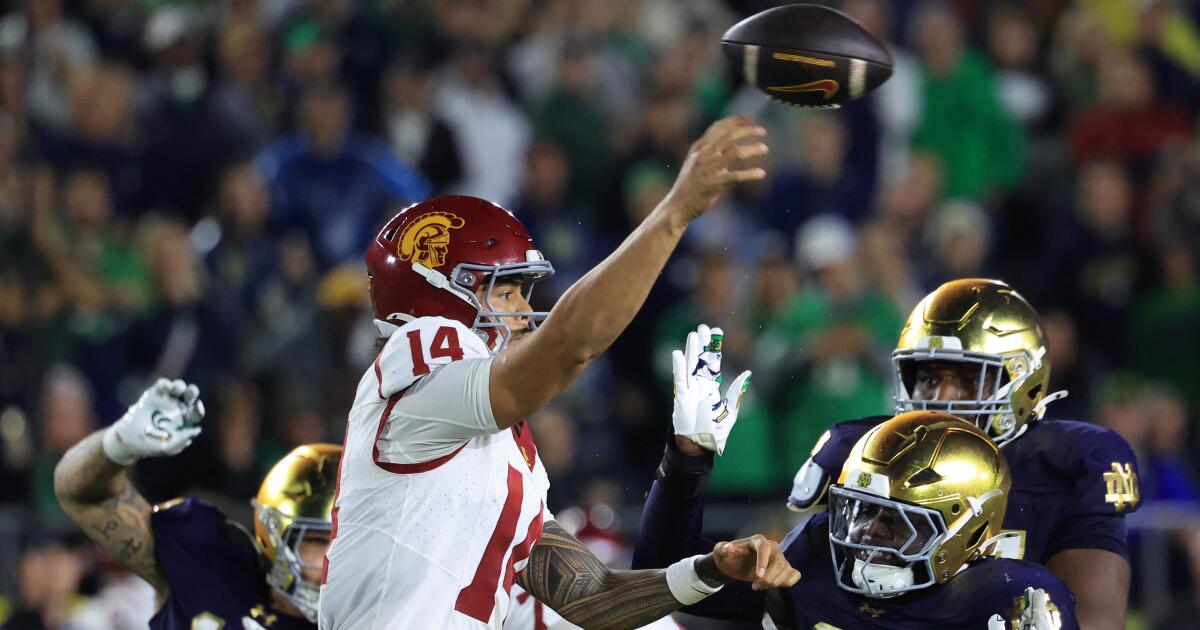
One of college football’s longest-lasting and most storied rivalries will be taking an indefinite break starting in 2026.
After months of negotiations and public posturing, USC and Notre Dame have failed to reach an agreement to continue their rivalry series.
“USC and Notre Dame recognize how special our rivalry is to our fans, our teams, and college football, and our institutions will continue working towards bringing back The Battle for the Jeweled Shillelagh,” the schools said in a joint statement they released Monday. “The rivalry between our two schools is one of the best in all of sport, and we look forward to meeting again in the future.”
Discussions between the rivals broke down in recent weeks, shortly after the College Football Playoff field was announced, a person familiar with negotiations but not authorized to speak publicly told The Times.
In the wake of Notre Dame being left out of the 12-team field, Yahoo reported that College Football Playoff officials had come to an agreement with the school last spring that assured the Irish of a playoff berth if they were ranked among the top 12 at season’s end. That agreement, applied in 2025, would have meant slotting Notre Dame in the field over Miami, which defeated the Irish early in the season.
The two schools nearly announced a continuation of the series around the time of their October matchup in South Bend, Ind. A person familiar with the negotiations told The Times that USC was ready then to compromise and stick with the rivalry’s usual cadence over the next two seasons, with Notre Dame coming to the Coliseum in 2026.
But at the time, USC officials were not aware Notre Dame reached an agreement with CFP officials that guaranteed them a playoff spot if they finish in the top 12 of the final rankings starting in 2026, the person said. To USC officials, the agreement felt like “a material advantage” to the Irish, whose place as an independent and scheduling flexibility already afforded them a considerable edge positioning for the Playoff over other programs, like USC, that are tethered to a conference.
USC also had concerns about the CFP selection committee hitting schools hard for late-season rivalry game losses. Early season rivalry game losses, however, have typically been less of a hinderance for teams in playoff contention.
After learning of the agreement, the person said, USC athletic director Jennifer Cohen reversed course on plans for a compromise, telling Notre Dame instead that the game would have to be played in Week Zero — or not at all.
That ultimatum was issued last week. Notre Dame athletic director Pete Bevacqua called Cohen on Monday morning to turn down the offer.
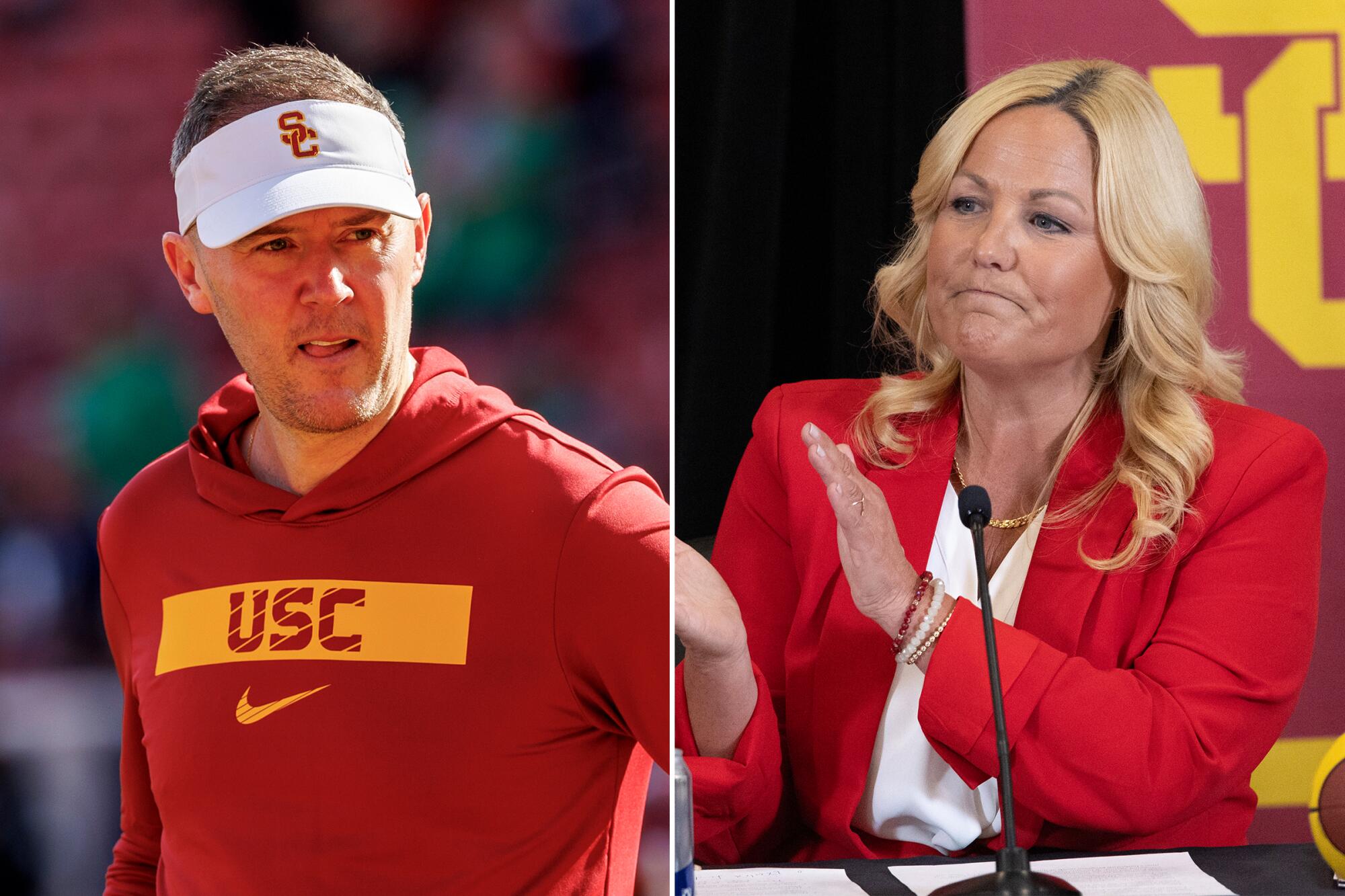
USC football coach Lincoln Riley, left, and athletic director Jennifer Cohen.
(Gina Ferazzi, Myung J. Chun / Los Angeles Times)
Notre Dame officials have indicated that the earliest the two rivals could play again would be 2030, a person familiar with discussions told The Times; though, USC has told Notre Dame it could play as soon as 2028, when the game would have been scheduled to return to the Coliseum.
Holding off until 2030 would mean five seasons without a century-old matchup that had only previously paused for World War II and a pandemic. Aside from that 2020 season, the two schools had played for 78 straight seasons, last meeting in October, with Notre Dame dealing USC a 34-24 defeat.
USC is hopeful that the matchup will pick up again in the future, perhaps as soon as 2030. But the school now turns its focus to finding a new nonconference opponent to fill out its 2026 schedule.
USC intends to find an opponent to come to the Coliseum in Week Zero, so as to take advantage of an additional bye week in the midst of a schedule that should be one of the more difficult in college football in 2026.
Ideally, it would like to find a former fellow Pac-12 school, such as Stanford or California, to fill that non-conference slot in the future, a person familiar with those discussions told The Times. But neither is likely to have the flexibility to make that happen next season.
In its place, if USC hopes to play in Week Zero, it will most likely have to schedule a team that plays Hawaii or internationally, allowing for them to schedule an additional game. Notre Dame, meanwhile, moved quickly Monday morning by announcing Brigham Young had signed a multi-year agreement to take USC’s place.
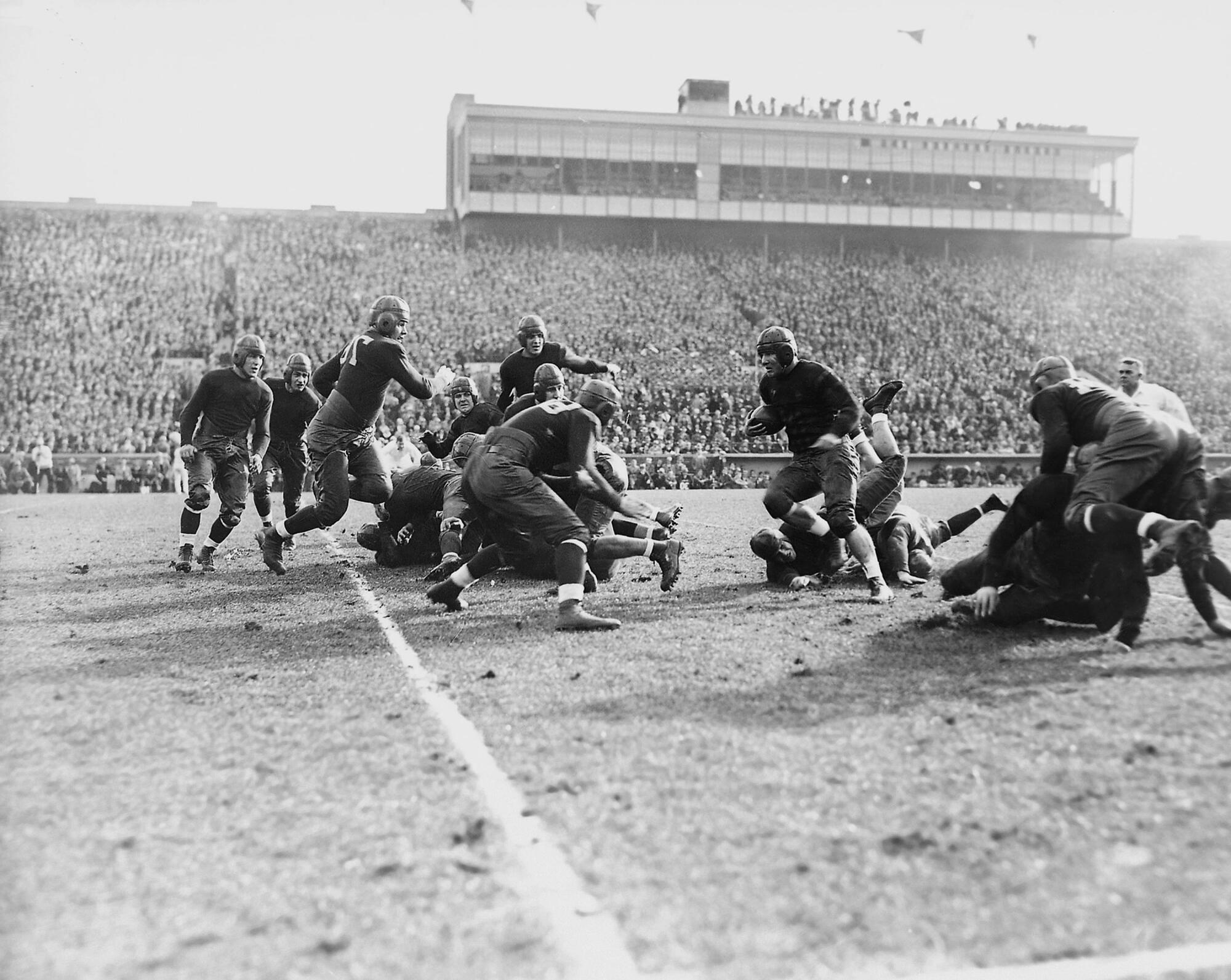
USC and Notre Dame play at Notre Dame Stadium on Nov. 21, 1931. USC rallied to a 16-14 victory.
(Associated Press)
The thought of a rivalry so steeped in history coming to a close over scheduling terms didn’t sit well with everyone, even those with deep Trojan ties.
“I can’t believe what I just heard,” standout former Trojan receiver Keyshawn Johnson said in a video on social media. “I don’t know what the F is going on with our athletic department. We’ve got people in there that are not Trojans, that don’t know anything about being a Trojan, running our athletic department. We’ve got a head coach that knows nothing about being a Trojan.”
For months, it had seemed the two schools were on the brink of an agreement. Just 10 days ago, on the Notre Dame podcast “The Echoes,” Bevacqua said that he was “hopeful” that the two sides were close.
“I can certainly speak for Notre Dame, and I can pretty much speak, and confidently speak, for USC. Both schools want to keep this going,” Bevacqua said. “They have to be obviously very aware of our schedule. We have to be aware of their schedule. We both have to be aware of the new reality in college football. But I’ve had great conversations with Jen Cohen, and we’re both committed, and Notre Dame and USC are both committed to getting something done.”
Cohen had expressed similar optimism in August, after USC extended an amended offer to Notre Dame, one that accommodated its rival’s desire for a multi-year agreement. The Trojans had previously been reluctant to lock in a long-term extension, given the uncertainty surrounding the future of the College Football Playoff format.
“We’re trying to extend the series,” Cohen said at the time. “This is an important series for us and for our fans and for our program, and hopefully we get to a resolution that supports and is in the best interest of our program.”
The rivalry has traditionally been played during the middle of the season when Notre Dame hosts and as the regular-season finale when it’s played at the Coliseum. But given the new demands of the Big Ten travel schedule, USC had pushed to move the game to the beginning of the football season.
In her recent State of Troy address, Cohen noted, without mentioning Notre Dame by name, that USC wanted to “play our non-conference opponents in the Coliseum as early as possible every year.”
“USC is the only team in the Big Ten to play a nonconference road game after Week 4 in either of the past two seasons,” she wrote. “USC is also the only team to play a nonconference game after Week 4 in both seasons.”
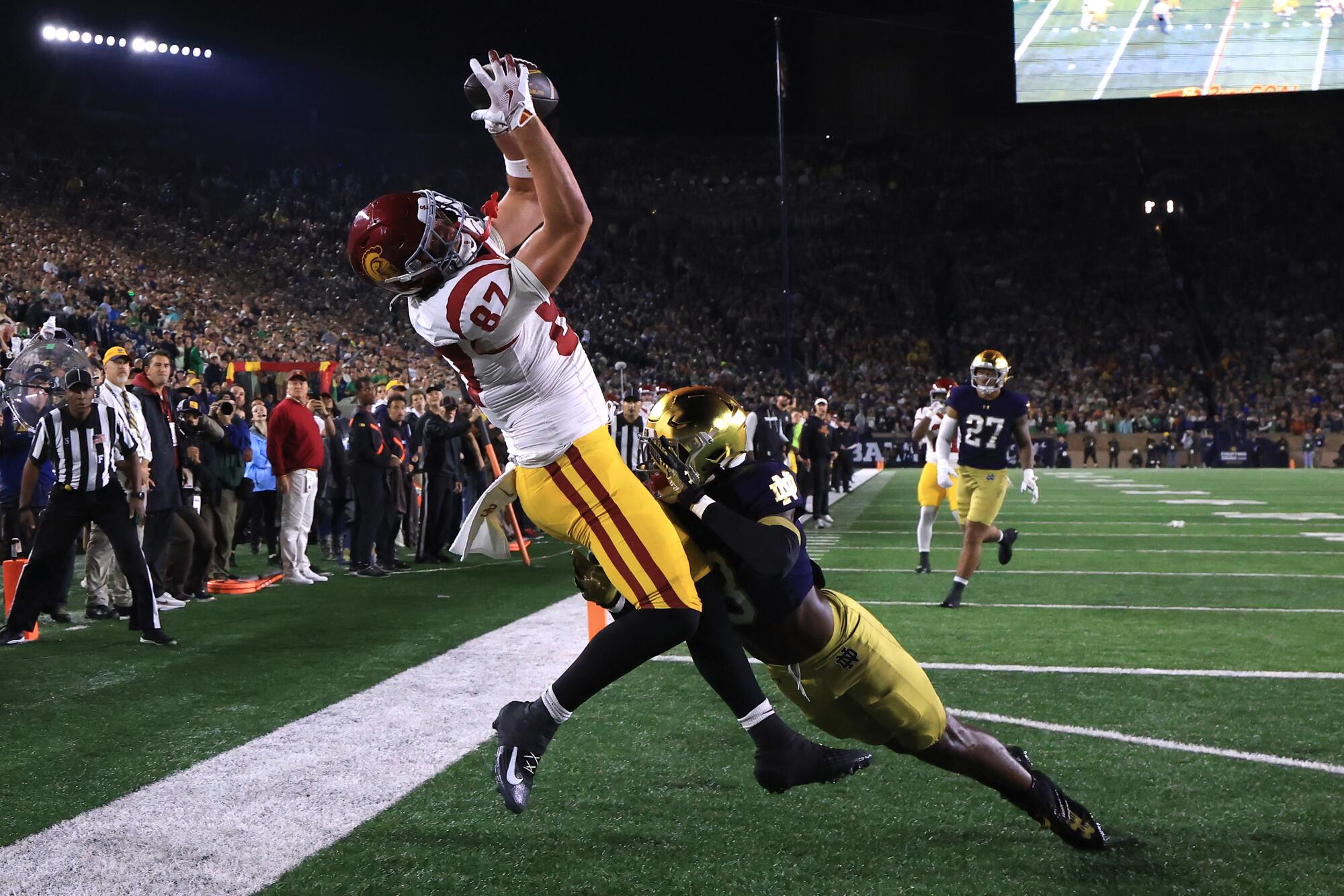
USC tight end Lake McRee catches a touchdown pass over Notre Dame safety Adon Shuler during the Trojans’ loss on Oct. 18.
(Justin Casterline / Getty Images)
But since concerns about the rivalry’s future were first broached in 2024 by the Trojans’ coach, Lincoln Riley, USC has found itself in a difficult place from a PR standpoint. At the time, Riley suggested that he would support sacrificing the rivalry with Notre Dame if that meant putting USC in the best position to win a national championship.
“Our schedules are already going to be so good,” Riley said then. “At some point, you’re like, all right, is the juice worth the squeeze in terms of playing these games?”
As recently as last month, USC officials had decided it was. But in the wake of news that Notre Dame had negotiated its own advantage with the College Football Playoff selection committee, that calculus changed.
And now, as the two rivals dig their heels in, one of college football’s most storied rivalries is left on hiatus, with no immediate return in sight.