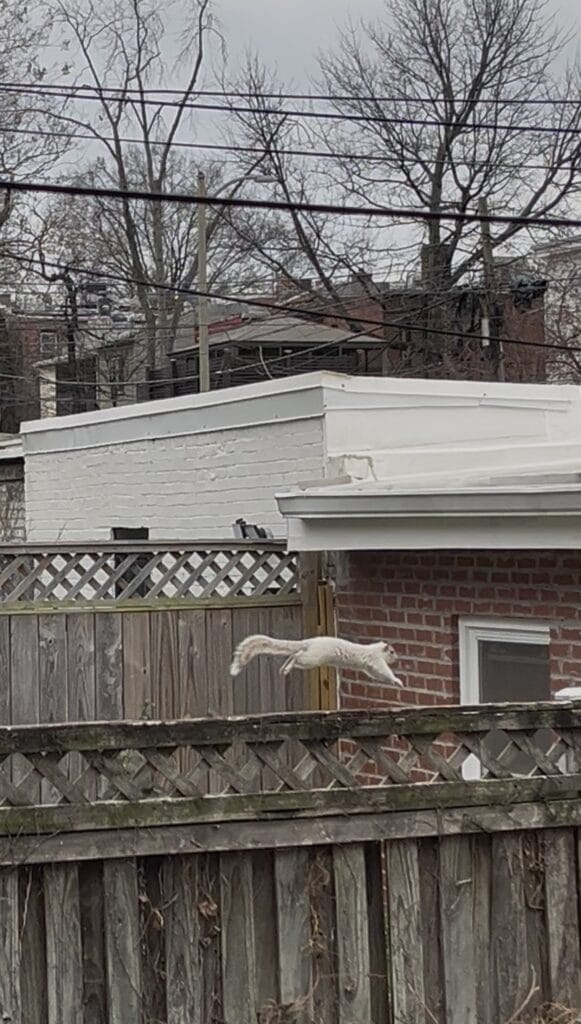
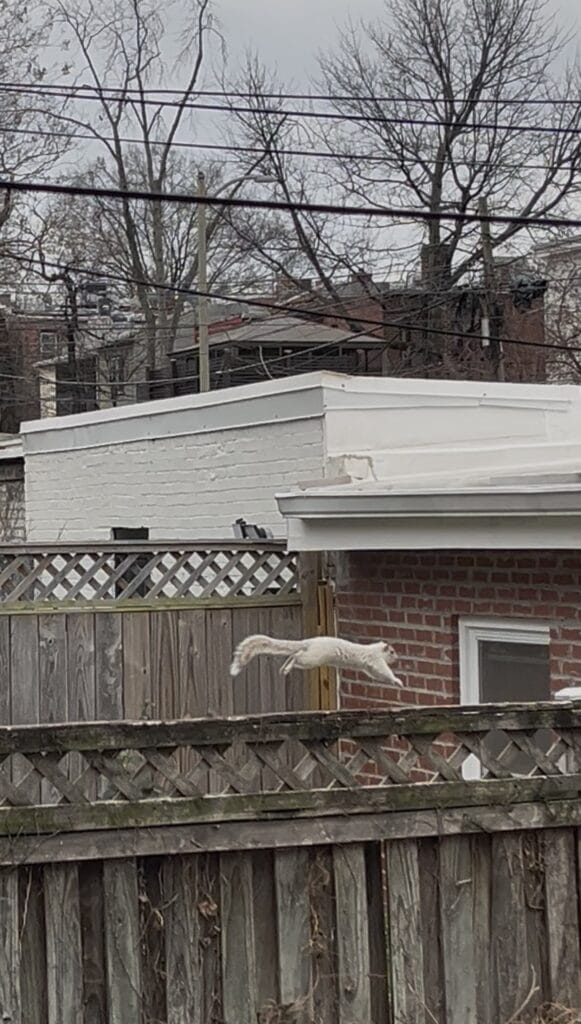
Thanks to Samantha for sending from near H Street, NE “in mid flight.”
Friends of the White Whale Society is brought to you by the team behind Hawks*** around Town. You can email your sightings to [email protected]
If you spot a hawk, any interesting wildlife or celebrity skateboarder Tony Hawk, and get a good photo please send in an email where you spotted them to [email protected]. Thanks! Hawks around Town is made possible by a generous grant from the Ben and Sylvia Gardner foundation.
From the White Squirrel Institute(!!?!!):
“What is a white squirrel?
What is a white squirrel and where did they come from? Is it a distinct species? Is it a mutation? These are some of my most FAQs. And the answer is, it depends. There is, in fact, one tree squirrel for which a white coat seems to be a characteristic of the entire species, at least in parts of its distribution. Its an Oriental Tree Squirrel of the genus (Callosciurus translates as “beautiful squirrel”) found in Thailand and other parts of South East Asia (Thorington and Ferrel, 2006). Another belongs to a yet undescribed species recently found on Palawan Island in the Philippines and thought to be endangered (for more information click here). So if you sighted a white squirrel here in North America outside of captivity, its almost certainly a color variant of one of our native species of the genus Sciurus (only distantly related to Callosciurus*). In my neighborhood, that would be the Eastern Gray Squirrel (Sciurus carolinensis). Most of what follows will be in reference to that species but white coated Fox Squirrels and Red Squirrels have been sighted, as well. Note: this posting becomes increasingly technical as it progresses, comparing the possible mechanisms by which different variants may arise; if such mechanisms are not of interest to you, I think you may want to skip down and read the last three paragraphs which focus on white squirrels, again, and are, I hope, of general interest.
Squirrel coats have a wide variation in color
There is much variation in squirrel coat color both locally and regionally. The general pattern of brown/gray on top and white below (counter shading) is considered the wild type from which other variations arose. These wild types, like most mammals, have dark eyes. The brown, reddish, gray, or even black color comes from the production of a pigment called melanin which, itself, comes in at least two varieties, eumelanin (black/brown) and phaeomelanin (red/yellow). Different combinations and arrangements of these two pigments produces a variety of hues. Alternating between one or the other (or neither) results in banded hairs referred to as agouti. All this variation can arise from change in either the genes that control the production and packaging of melanin itself, or of genes that control the distribution of melanin production. After all, most wild type gray squirrels have a white abdomen not because there are mutated genes in those cells but because there are regulatory genes which suppress the activity of melanin genes in these locations but not others (or prevent melanin producing cells called melanocytes from reaching such regions as discussed below). The white abdomen is adaptive. It makes the squirrel less visible from below against a light sky. Yet some squirrels have tan or ochre bellies (witness the now infamous Stan the rally squirrel for the 2011 St. Louis Cardinals’). Black or melanistic squirrels produce excessive amounts of melanin in comparison to the wild type and in expanded regions of the body. These variants are often found at higher latitudes and the dark color is thought to be involved in thermoregulation. The point I am making here is that while variation from wild type comes about by genetic change known as mutation, the word mutation carries a negative connotation, implying a freakish condition. In this case it produces a wealth of variation that may actually be appropriate for local conditions (including human preference). Thus, I prefer the term variant over mutant although I will use both below for variety.
White Squirrels are just another color variant of this variable species
With that said, white squirrels are just another color variant of this very variable species. The most common sightings of white squirrels are of isolated individuals with a completely white coat but dark eyes, a condition known as leucistic. This variant appears to spring up sporadically all over the species’ range and then dies out, only to pop up again somewhere else (see list of colonies and sighting). I think these are spontaneous mutants of some gene that delegates the use of the pigment (melanin) gene, not mutants of the melanin gene itself ( possible mechanism is suggested below). Instead of being produced in skin/hair cells and the eyes, it is only produced in the eyes. In another mutation, one in the genes that are directly responsible for producing melanin, no cells make the pigment and the squirrel is not only white but has pink or blue eyes. These true “albinos” are reported even less commonly, probably because without the eye pigment to reduce glare, their vision is impaired and they may suffer more from falls. Increased predation may also be a factor; a decline in the well monitored Olney Illinois albino population has been linked to cats.
Albino squirrels appear to have a normal abundance and distribution of melanocytes.
Albino squirrels can’t produce melanin, period, skin or eyes; the subcellular structures where melanin is typically stored are empty (Searle, 1968). The leucistic condition can also be explained by interference in the normal develpment of these pigment producing cells. As they migrate and take up residence in the skin, the melanoblasts remain immature non-pigment producing cells. Normally they are destined to become mature pigment producing melanocytes under the influence of chemicals secreted by surrounding cells in the skin (fibroblasts and keratinocytes). Mutations are known (Wolpert et al, 1998:298) where these chemical inducers are altered or not recognized by the melanoblasts which remain immature (and thereby pigmentless) for life. Since this occurs locally in the skin after migration, it would not effect the normal induction of melanin production in the eyes. Variants that result from the lack of a receptor or chemical inducer, like those that result from non-functional enzymes as in albinos, are usually recessive. That is, all it takes is one normal version of the gene responsible and the wild type would be produced (credit victoria at http://www.dresshead). The unusual variant, in this case leucistic, probably requires a double dose, one from each parent although this has not actually been demonstrated. Finally, melanistic squirrels produce eumelanin in excess to that of the wild type, possibly under the influence of Melanocyte Stimulating Hormone from the pituitary. There is no a priori reason to think that this condition has to be recessive as suggested by Shorten (1945). There is no missing “ingredient,” only a change in proportions. The fact that crosses between melanistic and wild type squirrels produces intermediate offspring as reported in Searle (1968) means that this trait is not recessive according to the classical definition.”