ARLINGTON — When the 911 call warned of a man with a gun, the first arrival was not an officer in a patrol car.
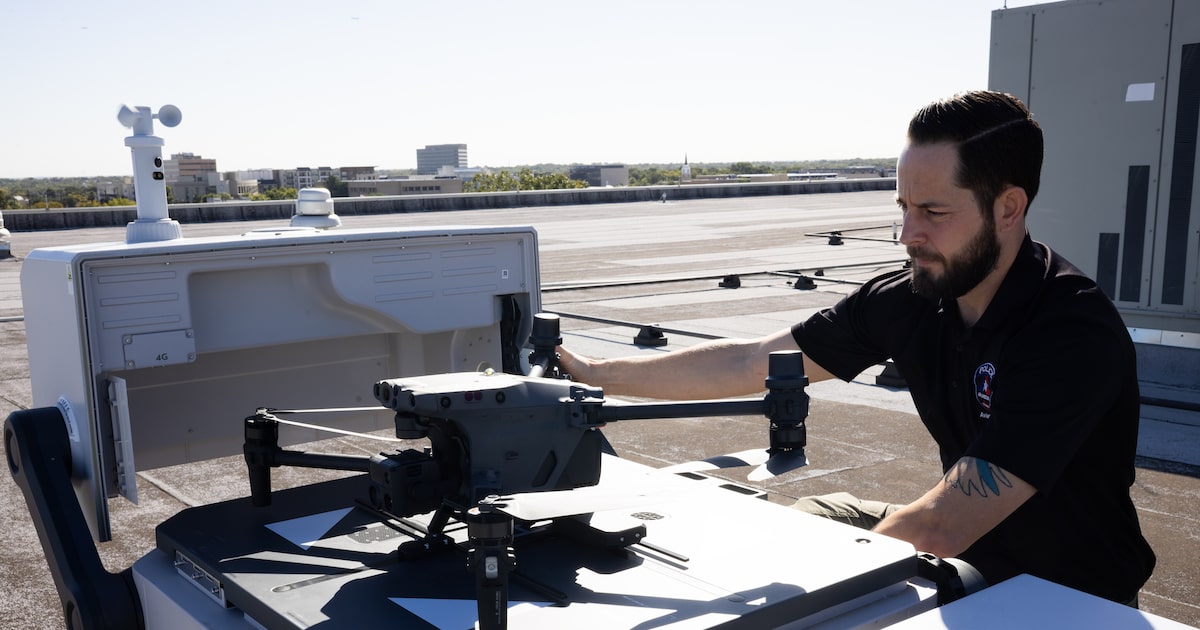
On the roof of Arlington’s police department, a box that blended in with the building’s mechanical clutter stirred to life. It released a quad-propeller drone that flew nearly two miles north toward an apartment complex where a woman had fled after her boyfriend allegedly aimed a firearm at her.
The remotely controlled drone reached the scene ahead of officers, helping police track the man.
“That suspect would not have been in custody had that drone not responded,” Sgt. Robert Robertson, who leads the department’s aviation unit, said in a recent interview, recalling the September arrest.
Breaking News
Drone setups like the one atop Arlington police headquarters are spreading through police departments nationwide, including across North Texas. Department officials say the drones can reach volatile calls faster than patrol cars, stream live video and reduce risks for officers and civilians by showing what officers are walking into — or whether they need to go at all.
Dallas’ police chief has said the city may take part in a “drone first responder” program, as it looks for ways to cut emergency response times.
That promise of speed using drones is what worries civil liberties and privacy advocates, who say the technology could normalize routine aerial surveillance. They say the need is often overstated and want clearer limits when drones can be deployed and what can be recorded. They say strong oversight and reporting will increase public trust.
“Do we want the technological equivalent of three police officers standing on every block in our city watching us all the time?” said Jay Stanley, a senior policy analyst with the ACLU Speech, Privacy and Technology Project.
He said decisions about whether and how police deploy the technology should be made through the democratic process, calling them value choices rather than purely technocratic policing decisions.
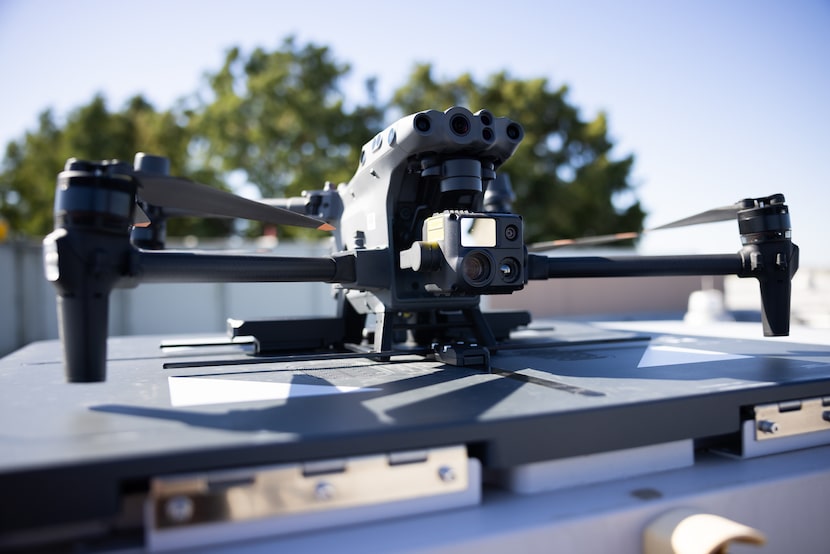
A drone used by the Arlington Police Department’s Aviation Unit sits on the dock nest for a demonstration at the Police Department in Arlington on Tuesday, Oct. 21, 2025.
Juan Figueroa / Staff Photographer
Federal policy may soon make programs like Arlington’s easier to launch.
The Federal Aviation Administration has proposed a rule to normalize “beyond visual line of sight” flights, creating a more standard pathway for operations. That could reduce how often operators would need case-by-case FAA approval.
The pitch in Dallas, where response times aren’t hitting goals
Since taking over in April, Dallas police Chief Daniel Comeaux has said cutting 911 response times is a major focus.
Earlier this month, Robert Uribe, the department’s 911 administrator, told the City Council’s public safety committee response times are down from last year, but said “there’s a lot more work to do.”
As of Dec. 16, year-to-date police data show:
- Priority 1 calls: Officers were taking about 10.8 minutes on average to reach the city’s most urgent emergencies, longer than the department’s goal of eight minutes. These calls include shootings, robberies or burglaries in progress, stabbings or cutting and major freeway crashes.
- Priority 2 calls: The average response time was about 95 minutes versus its 12-minute goal. These calls include major disturbances, suspicious-person reports, 911 hang ups and suicides.
- Priority 3 calls: Officers were averaging about 251 minutes to respond, above the goal of 30 minutes. These include minor crashes, random gunfire reports, missing-person reports, intoxicated-person calls and drug house reports.
- Priority 4 calls: The average response time was about 282 minutes, exceeding the goal of 60 minutes. These lower-priority calls include loud-music disturbances, minor disputes or abandoned property.
Cutting response times depends on more than a single tool. The challenge blends staffing, including the department’s push to hire hundreds of additional officers, with questions about how police deploy existing resources and whether new technology can help close gaps.
Comeaux has pointed to the possibility of a drone first responder program as part of that mix.
In October, during a question-and-answer session with a downtown group, Comeaux said the city was working to launch the program. Rather than using drones primarily for the most urgent 911 calls, Comeaux said he sees them as a way to handle lower-priority calls.
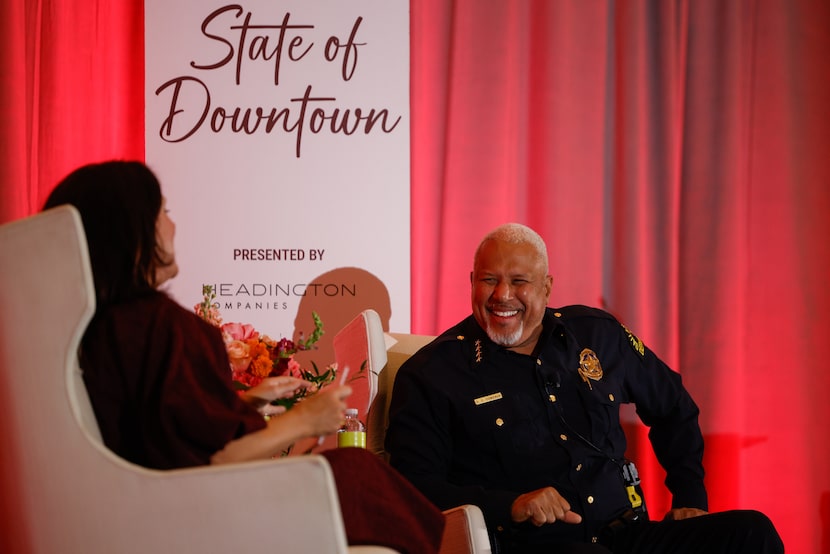
Dallas police Chief Daniel Comeaux laughed while speaking with Jennifer Scripps, Downtown Dallas president and CEO, during the 2025 State of Downtown event Wednesday, Oct. 29, 2025, in Dallas. Comeaux spoke on changes the police department has made.
Christine Vo / Staff Photographer
If drones can help resolve lower-level calls more quickly, he said, officers could be freed up for emergencies. He said the department was “close” to getting the program up and running.
Dallas police declined an interview request and did not answer written questions about the planned drone first responder program, saying in a November statement that additional details would be released later.
A brief study in Arlington indicated drones could make an impact.
Last year, the department partnered with Jaya Davis, a criminology professor at the University of Texas at Arlington, to study whether drones could speed responses and reduce costs. Her review found that drone deployments cut average response times for priority 1, 2 and 3 calls and allowed about 30% of incidents to be cleared without an officer on the ground.
The review also found that roughly 30% of calls were able to be cleared without an officer on the ground.
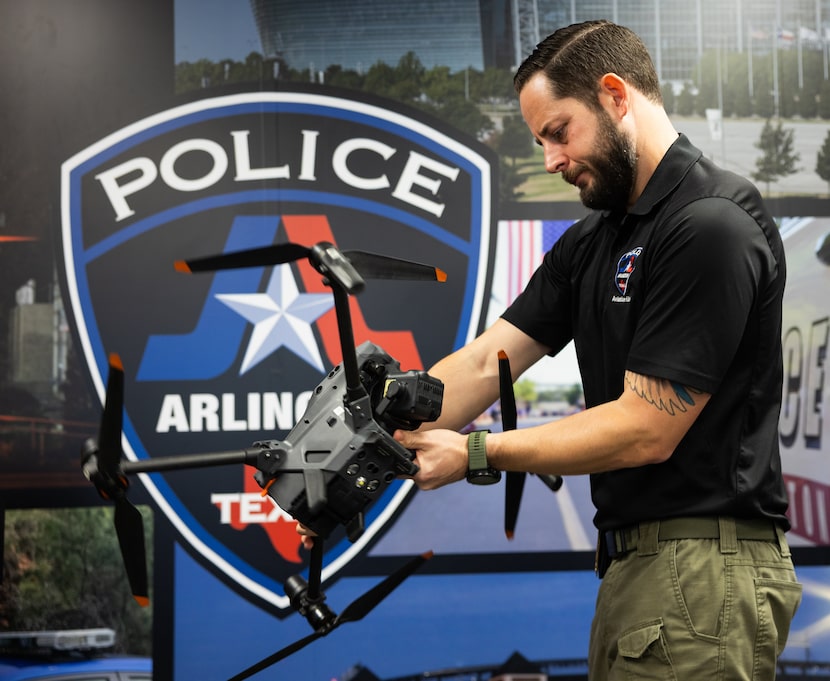
Sgt. Robert Robertson, supervisor of the Arlington Police Department’s Aviation Unit, demonstrates one of the unit’s DJI drones at the Police Department in Arlington on Tuesday, Oct. 21, 2025.
Juan Figueroa / Staff Photographer
What worries critics about police drones
Stanley, the ACLU analyst, said concerns about police drones center on privacy, oversight and how programs can grow with little public scrutiny.
“If law enforcement says that it’s valuable in clearing calls, I can understand how that would be true, but clearing calls is not the highest value that we should have,” Stanley said. “The jury is still out on how Americans feel about hearing drones buzzing overhead that they know are operated by the police.”
Those concerns have surfaced in Dallas. Council-appointed members of the city’s Community Police Oversight Board have raised questions on some technologies, including facial recognition, license plate reader cameras and drones.
During a drone briefing, some board members pressed police on when and how drones would be deployed, with District 3 appointee Walter Higgins calling for clearer rules and privacy safeguards.
Arlington offers an example of what guardrails can look like. It’s written drone policy — reviewed by The News through an open-records request:
- Bars officers from using drones for surveillance tied to a criminal investigation without a warrant or a recognized legal exception.
- Prohibits drone use for traffic enforcement and “non-consensual monitoring.”
- Requires public reporting, including a city website with information about the aviation unit, drone launches, scheduled flights and program expansions
Robertson, the sergeant overseeing the aviation unit, said Arlington does not record while drones are en route, beginning recording only once a drone is on scene and with clear legal basis.
Dallas has its own internal rules governing drone use, with the unit’s mission statement pledging to carry out operations efficiently while respecting the law and residents’ privacy.
Oversight board members said they expect discussions about drones and other technologies to continue.
“We will be going deeper on this for the citizens of Dallas,” Higgins said.
Fast help or flying surveillance?
· How it works: Drones sit in rooftop launch boxes, ready to deploy within minutes to 911 calls and stream live video back to police.
· Why police want it: Departments say the “drone first responder” programs can cut response times, help officers assess dangerous situations and can confirm whether officers are needed on lower-priority calls.
· Where it’s spreading: Arlington is among a growing number of agencies nationwide with a drone first responder program, with Dallas officials working to launch one.
· What could change next: A proposed FAA rule would make it easier for police departments to fly drones beyond an operator’s direct view, reducing how often they’d need special, case-by-case permission.
· The concern: Civil liberties advocates warn the technology could normalize routine aerial surveillance and are calling for clear limits, public reporting and community oversight.