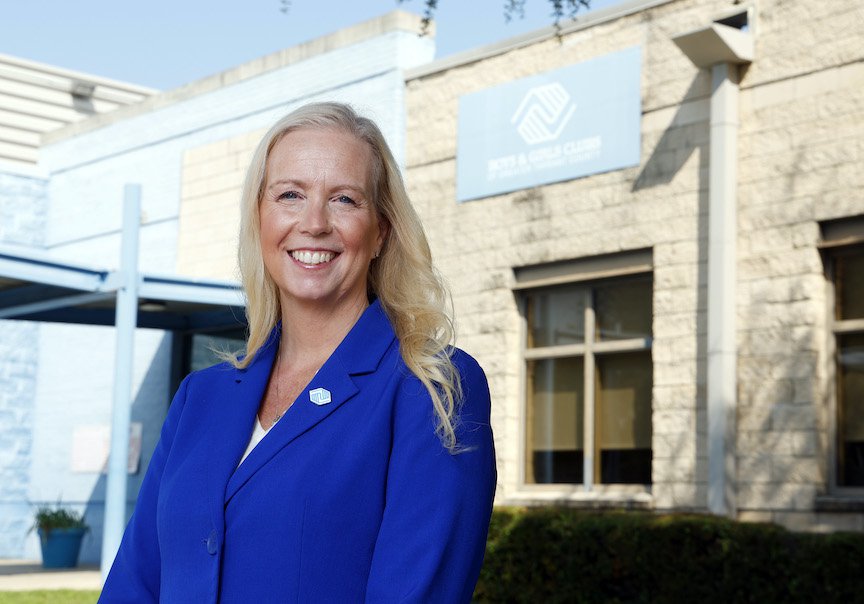
In Daphne Barlow, the Boys & Girls Clubs of Greater Tarrant County has more than a devoted soldier of compassion as its CEO.
The almost 100-year-old nonprofit has a visionary leader whose two-decade tenure has been defined by entrepreneurial innovation and thoughtful strategy in carrying out its fundamental mission of meeting the critical societal need of molding young people in desperate need of connection and belonging, and positive adult role models.
The organization serves as a vital “third place” for youth, offering a safe and supportive environment outside of home and school.
“You hear things about the ‘third place.’ Have you heard about this?” she asks me. Nope, I tell her. “It’s the idea that where you work or go to school and where you go home are your first and second places, and your third place is maybe where you play basketball or where you work out.
“A lot of people don’t have a third place, but that third place is where you’re going to have most of your attachment to making you a better human being.”
The Boys & Girls Clubs is the third place for tens of thousands of young people in Tarrant County. This third place, she says, “is particularly crucial for providing mentorship and building confidence in young men.”
The Boys & Girls Clubs of Greater Tarrant County traces its roots to 1926, when Fort Worth established its first boys club. That year, during the Rotary Club’s annual banquet, guest speaker Lucien Bonaparte Price — owner of the L.B. Price Mercantile Company — and Christopher J. Atkinson, executive secretary of the Boys Clubs Federation of America, challenged local Rotarians to create a club for underprivileged youth.
Price pledged $1,000 of his own money toward the cause but died suddenly soon after delivering his impassioned plea. Inspired by his final words, Fort Worth Rotarians rallied to raise funds by selling “boy bonds” across the city. The new organization was initially called the L.B. Price Memorial Boys Club before adopting the name Panther Boys Club. Its headquarters were on the second floor of a building on East Third Street in downtown. It became the second-oldest boys club in Texas.
Developments under Barlow’s leadership in more recent years have extended the nonprofit’s outreach. The first was a merger of the Fort Worth and Arlington clubs in 2018, creating a unified Tarrant County organization and enabling greater scale and impact just before the start of the pandemic.
COVID-19 actually served as a catalyst for major innovation. In response to community needs, the organization launched the Blue Door Kitchen to provide high-quality, nutritious meals and the Mobile Clubhouse to deliver services to children who had no access to a physical building.
These innovations led to dramatic growth, expanding the organization’s reach from serving 5,000 children to 76,000 children annually across Tarrant and Denton counties.
“It’s literally having a whole other family that is made to sit there and push you to be your best,” says Ja’Miyah, 17, a Mansfield high school student who adds that she came into full bloom after being a somewhat reluctant member two years ago. She is the BGCGTC’s 2025 Youth of the Year.
Ja’Miyah, who will be going to Prairie View A&M to study architecture next year, has participated in a variety of clubs within BGCGTC. She founded and coaches a BGCGTC cheerleading team to support the club’s basketball league, and during summer hours, she has led a “morning boogie” dance session. Last year, she was part of a club cohort that traveled to Washington, D.C., to meet with legislators and represent the needs of Texas youth.
Barlow, 50, will tell you that it was at the club that her professional life, too, came into full bloom.
“Next year, I will have spent half of my lifetime here working at the Boys and Girls Club, which is equivalent to a quarter of our entire history as an organization,” she reminds. “I didn’t plan to.”
Barlow began her career here as a volunteer at Christmastime, asking for donations for toys for children. She had just recently graduated from college, and a friend asked her to help out.
“I could have never imagined that I would be here at this point in time,” Barlow says. “I sort of fell into it by accident.”
What we call coincidence is often the quiet choreography of purpose, someone once said.
She ended up with a job at the club, and “I really learned the organization from the inside out.” Eventually, she had roles in programs, fundraising, and “really just moved my way through.”
When the longtime CEO left, she threw her name in the hat. She looked at the short list of people who were the last five people to be interviewed by the board. And I thought, “That is not good for this either.”
“I thought I had to go find another job; I can’t work for these folks,” she says. “Or I have to apply. Those are my two options. In a split second, I thought, ‘Well, then I’m going to apply. I can do this.”
She became CEO at age 30. It has made all the difference for her, the organization, and the children it serves.