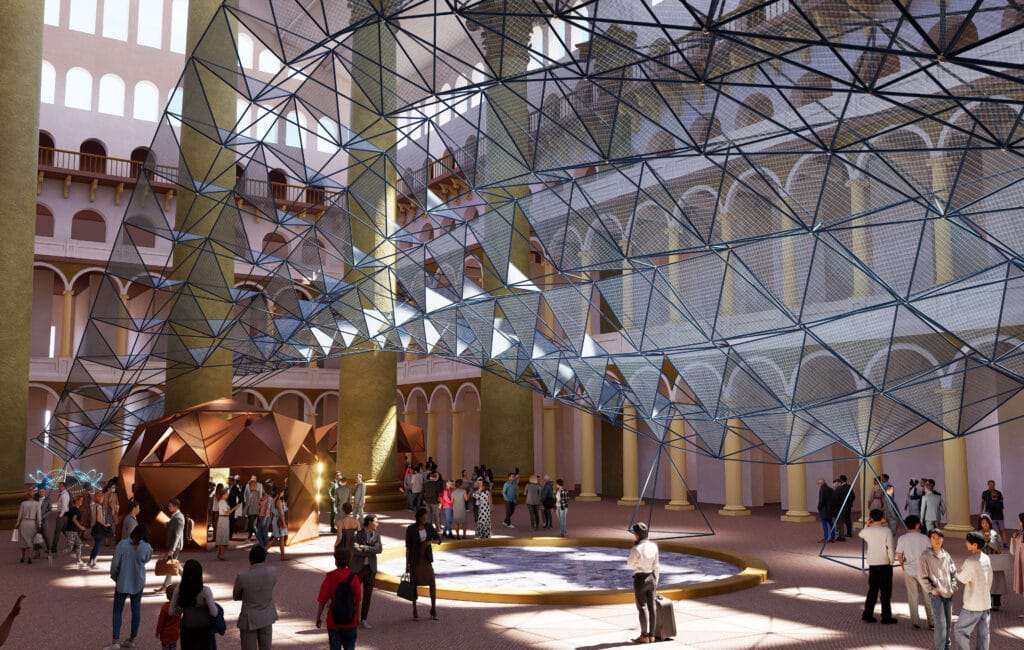
rendering via National Building Museum
From the National Building Museum (401 F Street, NW):
“Architecture students from The Catholic University of America will build a massive floating spaceframe in the National Building Museum in Washington, D.C., using sustainable materials and new technology that was designed in part by a student and professor at the University.
This new approach could revolutionize spaceframe design and construction to be more sustainable, efficient, flexible, and affordable. Spaceframes appear in everything from geodesic domes and long-span roofs to solar arrays, aerospace systems, stadiums, and entertainment venues like The Sphere in Las Vegas.
The Catholic University students will build The Wave, a soaring 180-by-55-foot, 4,300-pound recycled aluminum spaceframe in the National Building Museum’s Great Hall from Dec. 18 to 19, 2025. The completed installation will be on view from Dec. 27, 2025 through Feb. 8, 2026.
The sculpture will hover above the heads of visitors. Lightness of Strength: The Wave, will wrap around four of the Great Hall’s massive Corinthian columns. A high-tech fabric envelope is tensioned across the spaceframe to provide enclosure and depth.
“The National Building Museum is proud to open our Great Hall as a living laboratory for the next generation of architects and innovators. The Wave is the result of a multi-year collaboration between Catholic University and our exhibitions team, and it exemplifies what can be achieved when students and professionals work together. Watching this groundbreaking spaceframe come to life is a powerful reminder that the world we design and build matters, and that its future begins with imagination, craft, and the courage to explore new ideas,” said Aileen Fuchs, president and executive director of the National Building Museum.
An exhibition inside a geodesic dome will explain the innovation, sustainability of the aluminum and hi-tech fabric, and how spaceframes have evolved. The recycled aluminum has been donated by Hydro and the fabric is Dyneema® Composite Fabric.
Spaceframe Innovation by Team Including Professor, Student Spaceframes are popular for building because the structures are lightweight and flexible. Interlocking steel or aluminum struts form rigid 3D triangles that provide strength over immense spans compared to other building materials. The struts (or tubes) can be very thick and may have an external wire to provide tension and strength.
An innovation designed by Mike Graves of DSI Spaceframes and his colleagues, working with Catholic University Professor Tonya Ohnstad and graduate student Dave Stephen uses a strut with tensioned cables anchored inside the tube. This means the struts can be a standard width and thinner, longer, and therefore lighter.
This innovation could revolutionize spaceframe design by making it more sustainable, affordable, and flexible: less material, lower fabrication costs, and more flexibility for structure design.
“This is not a conventional space frame. It is a prestressed tendon stabilized strut. As far as we are aware there is no previous architectural system built at this scale using this arrangement of elements,” said Graves.
Students have worked with industry professionals to create The Wave, according to Tonya Ohnstad, associate professor of architecture at Catholic University, “They learned to navigate real-world challenges, including delivery timelines, drawing discrepancies, personalities, material lead times, budgets, and the many constraints that shape built work.”
This is the third large-scale build led by Ohnstad since 2022 that has focused on structure, material, and collaborative construction. This includes reconstructing a medieval truss of Notre-Dame de Paris Cathedral on campus and in a collaboration with the National Building Museum. Architecture students also restored the first long-span geodesic dome erected in North America with the Smithsonian’s National Museum of American History in 2023.
“The Wave is the first real-world test of a new structural system that grew directly out of earlier collaborations. Seeing it come to life inside the National Building Museum and watching students assemble it is extraordinary,” Graves said. He added that the collaborative work “shows what happens when people work together in the right way.”
Lightness of Strength: The Wave is sponsored by Amazon, Architectural Systems, Hydro, AIA, Dyneema, Harmon, United Rentals, and the Graves Family.”