Article Summary
- In a 6-3 decision Tuesday, the U.S. Supreme Court left in place a lower court order barring President Donald Trump from deploying National Guard troops to Chicago while the underlying legal challenge continues.
- Justices said the administration failed, at least at this stage, to show legal authority to use the military for domestic law enforcement in Illinois, echoing lower court findings that political opposition does not amount to “rebellion.”
- The case stems from Trump’s Chicago-focused “Operation Midway Blitz” immigration enforcement campaign this fall, which sparked protests and clashes between civilians and federal agents
This summary was written by the reporters and editors who worked on this story.
SPRINGFIELD — The U.S. Supreme Court on Tuesday kept in place a lower court’s ruling temporarily barring President Donald Trump from deploying National Guard troops to Chicago as part of his administration’s crackdown on illegal immigration.
The 6-3 ruling, which comes more than two months after the Trump Administration made an emergency appeal to the high court, effectively prevents the federal government from using federalized troops in Chicago while the underlying court case challenging the deployment continues.
“At this preliminary stage, the Government has failed to identify a source of authority that would allow the military to execute the laws in Illinois,” the court wrote in the unsigned opinion denying the request for a stay.
Conservative justices Samuel Alito, Neil Gorsuch and Clarence Thomas dissented.
Trump administration lawyers had argued the judicial branch had no right to “second guess” a president’s judgment on national security matters or resulting military actions.
The ruling represents a major setback for the Trump administration and a triumph for Gov. JB Pritzker and state Democratic leaders, who fiercely opposed and pushed back on the concept and practice of federal troops patrolling American streets.
Pritzker called the ruling “a big win for Illinois and American democracy.”
“This is an important step in curbing the Trump Administration’s consistent abuse of power and slowing Trump’s march toward authoritarianism,” the governor said in a statement. “American cities, suburbs, and communities should not have to face masked federal agents asking for their papers, judging them for how they look or sound, and living in fear that President can deploy the military to their streets.”
Attorney General Kwame Raoul, whose office presented the state’s case, was also pleased with the court’s ruling.
“Nearly 250 years ago, the framers of our nation’s Constitution carefully divided responsibility over the country’s militia, today’s U.S. National Guard, between the federal government and the states — believing it impossible that a president would use one state’s militia against another state,” Raoul said. “The extremely limited circumstances under which the federal government can call up the militia over a state’s objection do not exist in Illinois, and I am pleased that the streets of Illinois will remain free of armed National Guard members as our litigation continues in the courts.”
Read more: Judge’s block on deploying National Guard extended indefinitely as Supreme Court weighs case | DOJ lawyer says it’s ‘wrong to allege’ Operation Midway Blitz is over
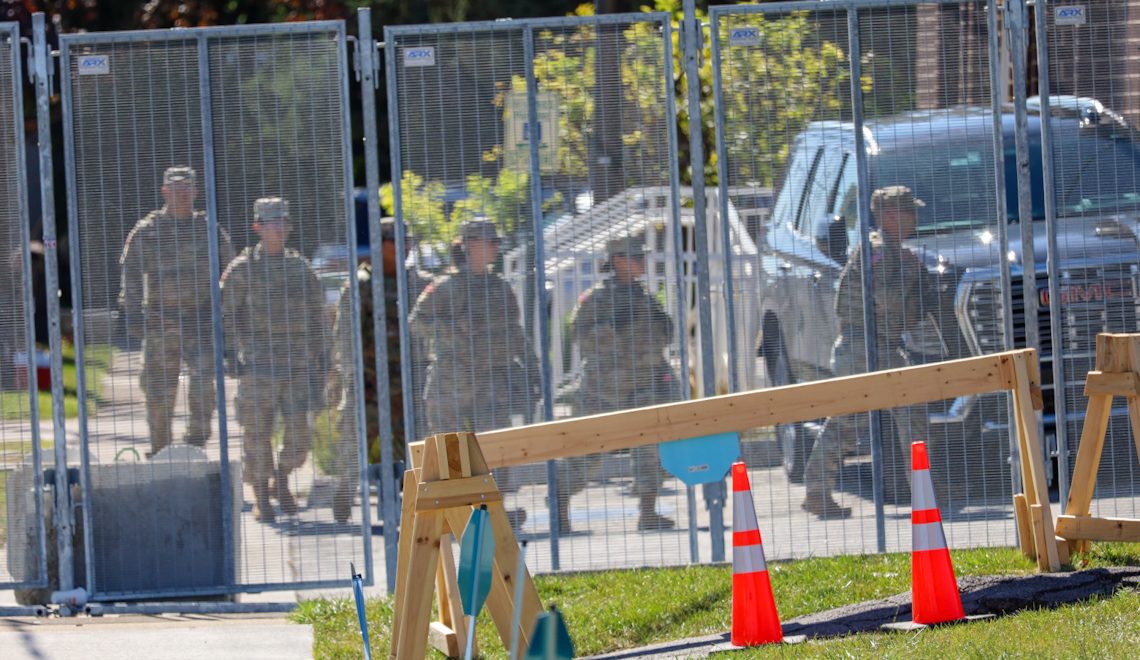
In early October, Trump ordered the federalization of 300 Illinois National Guardsmen over Pritzker’s objections and deployed 200 members of the Texas National Guard to Chicago.
The order came in as tensions flared outside the U.S. Customs and Immigration Enforcement’s processing facility in Chicago’s near-west suburb of Broadview, which had become the epicenter of protests against the Trump administration’s Chicago-focused “Operation Midway Blitz” immigration enforcement campaign launched in September. The administration claimed activists were violent and the National Guard was needed to protect federal agents and the ICE facility.
Trump’s deployment of troops to Los Angeles this summer marked the first time in 60 years that a president had taken control of a state’s National Guard without a governor’s consent. He’s also authorized troop deployments to Washington, D.C. and Portland, Oregon. All have been met with legal challenges, but the attempted deployment to Chicago was the first to reach the nation’s high court.
Operation Midway Blitz’s heavy immigration enforcement presence in Chicago and its suburbs continued through mid-November when U.S. Customs and Border Patrol Commander Gregory Bovino and his 200 agents abruptly left the area. During the more than more than two months of aggressive enforcement actions, agents arrested more than 3,000 people in the U.S. without legal authorization.
National Guard troops were only active for a day at the Broadview ICE facility before U.S. District Judge April Perry issued a temporary restraining order blocking their deployment. While Texas guardsmen were sent back to their state at the same time Border Patrol agents left Chicago last month, the 300 members of the Illinois National Guard have remained under the Trump administration’s authority. Federal officials have said both the Illinois and Texas guardsmen spent their time doing training exercises.
After their deployment, clashes between federal agents and civilians shifted from Broadview to Chicago neighborhoods, where agents — including Bovino, often used force like tear gas and other riot control weapons like tear gas and pepper balls to disperse crowds.
Read more: Bovino ordered to make daily court appearances after three days of tear gas in Chicago | Judge grants restraining order protecting protesters, journalists in Chicago-area clashes
As those confrontations shifted, so did the arguments from Trump Administration lawyers, who said the militarized manpower was necessary to protect federal agents and property from “rioters” that they alleged have aimed fireworks at agents “and have thrown bottles, rocks, and tear gas at them.”
In a separate lawsuit, protesters, journalists and clergy won a preliminary injunction last month restricting agents from using from using riot control weapons. But after an initial ruling in the case from the 7th Circuit Court of Appeals cast doubt on the judge’s legal authority to limit how immigration agents do their jobs, the plaintiffs asked that the case be dropped. Perry’s Oct. 9 ruling, in which she found “no credible evidence that there is a danger of rebellion in the state of Illinois,” was later backed up by a three-judge panel on the 7th Circuit Court of Appeals, which wrote that “political opposition is not rebellion.”
Raoul argued that the troop deployment violates Illinois’ rights as sovereign state to carry about its own law enforcement, as well as 1878 Posse Comitatus Act that bans the military from participating in domestic law enforcement.
National Guard members are often federalized for overseas missions. At the state level, the are often deployed by governors to respond to natural disasters and civil unrest.
Prior to this year, the last time a president federalized a state’s National Guard without a request from a state’s governor was in 1965, when President Lyndon B. Johnson sent federal troops to protect civil rights protesters in Alabama without the cooperation of segregationist Gov. George Wallace.
Capitol News Illinois is a nonprofit, nonpartisan news service that distributes state government coverage to hundreds of news outlets statewide. It is funded primarily by the Illinois Press Foundation and the Robert R. McCormick Foundation.