Sifting through leaves on the forest floor, Andie Carver and her boyfriend, Christopher Obst, shouted with delight when they spotted three Texas Star mushrooms growing near a decaying log.
“Mushroom, mushroom, mushroom!” Carver said proudly while pointing them out. “We did it.”
The mushrooms hadn’t yet opened into the characteristic star shape that the state mushroom is known for, so the couple left them unharvested. But they were excited to have successfully identified the mushroom that was the goal of the day’s foray.
The foraging walk, held at River Legacy Parks in Arlington, was hosted by the North Texas Mycological Association. The group, founded in 2021, hosts monthly forays and other educational events to build community and advance scientific understanding of the world of fungi.
D-FW Weather Wise
Obst, of Denton, said he got interested in mushrooms while hiking and noticing all the unique flora and fungi. This foray was his first, in addition to a mushroom cultivation class Carver got him for his birthday. He expressed some interest in foraging for food, but wasn’t sure about his ability to identify mushrooms correctly.
Obst added that most foragers are either “old or bold,” but that you can’t be both.
For the foray’s leader, Sebastian Tabibi, his expertise and experience were evident. Also the president of the mycological association, he guided about 20 people through the park’s trails in the 33-degree conditions on an overcast December morning. After he reviewed some basic tips, the expedition broke off into smaller groups, scouring the ground for fungal growth.
On this particular foray, participants were searching for the Texas star, a mushroom only known to grow in select parts of Texas. Several young ones were identified, or the pieces of an open one that had been devoured by an animal, but the group did not find any mature ones that were still intact.
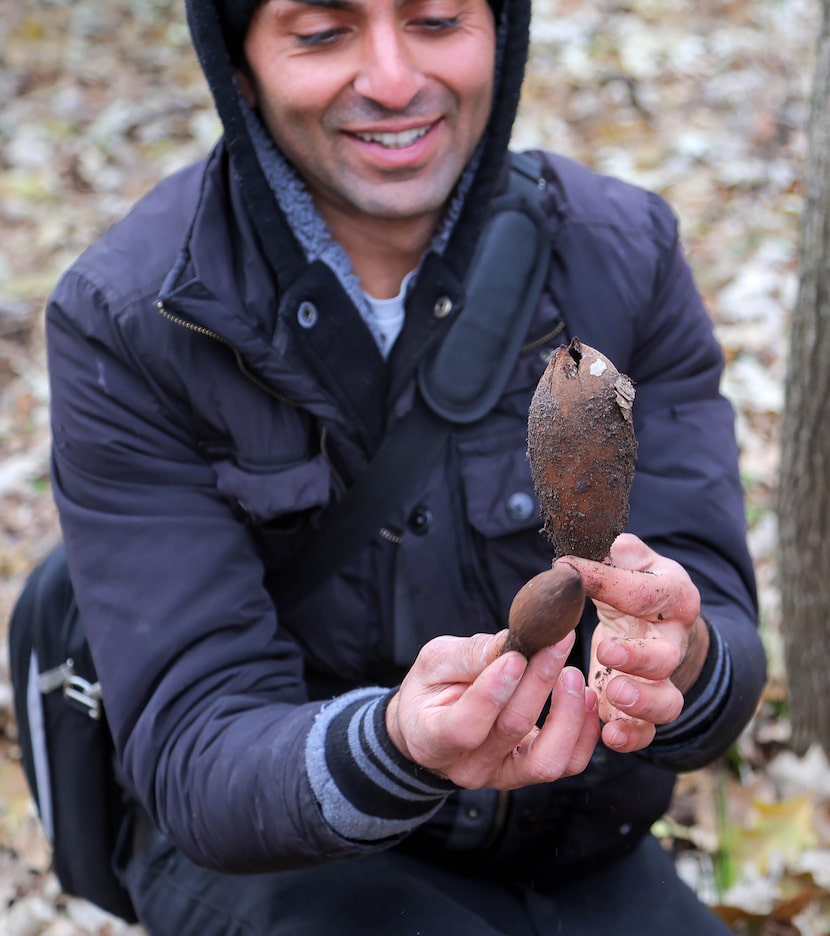
Sebastian Tabibi explains the development of Texas star mushrooms to foraging students on Sunday morning, December 14, 2025, at River Legacy Parks in Arlington. (Steve Nurenberg/Special Contributor)
(Steve Nurenberg / Special Contributor)
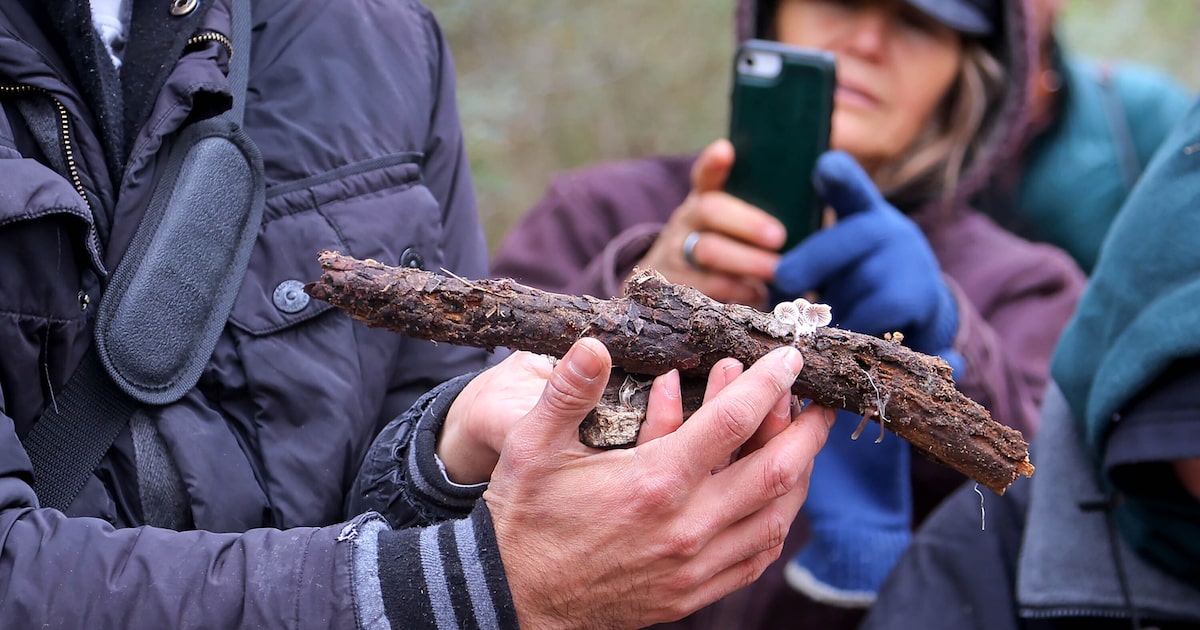
Despite that, the group still found several other mushrooms, which they brought to Tabibi for him to identify. Whether a lumpy bracket or a split gill, Tabibi explained the characteristics that he used to identify each mushroom, including the surface it’s growing on, the color, the stem shape and thickness.
Yihyoung Li, of Addison, said this was his first experience foraging. He was brought by a friend who had been participating for several months and wasn’t sure what to expect. Despite that, Li said he enjoyed it, adding that things that look ordinary can have so much more to them.
“I normally don’t pay attention to mushrooms at all, and it’s just really interesting to hear Sebastian talk about them,” Li said.
Related
Tabibi said he’s been interested in fungi since he was a teenager, but about a decade ago, his focus shifted to mushrooms’ medicinal purposes. This area of scientific study has been expanding, Tabibi said, as new health benefits are uncovered.
His work focuses on teaching people how to safely engage with mushrooms, as well as expanding the scientific understanding of fungi in North Texas. He’s working to start a new program, the Texas Foraging Academy, that would have full-day and multiday classes covering both fungi and plant species. The first classes will be in March and April 2026.
For those interested in getting started foraging on their own, Tabibi noted that foraging in Texas does have stricter rules. Individuals must obtain permission to forage, regardless of whether they’re heading out on public or private lands. He said lands farther outside of the metro area with old-growth forests are by far the best bet to find a greater diversity of species, but some more common ones — like oyster, lion’s mane and chicken of the woods — can be found in public parks.
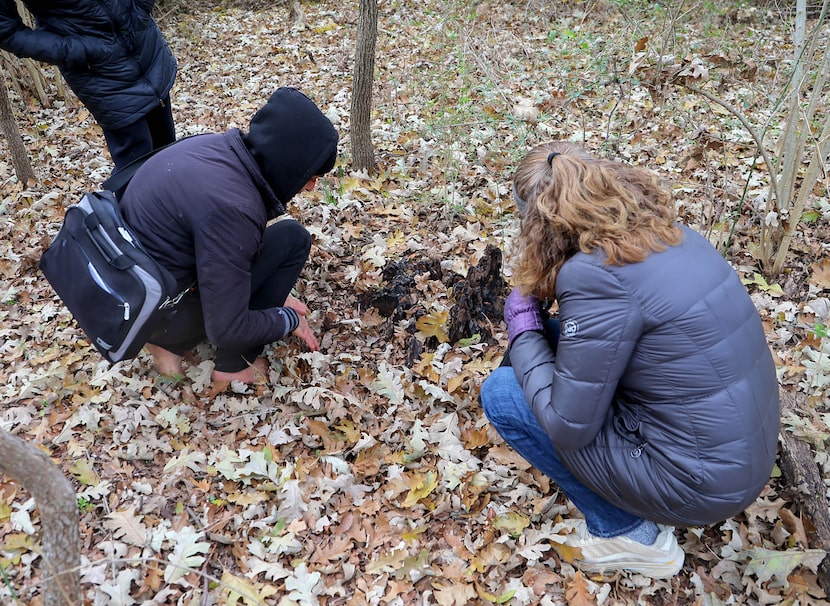
Sebastian Tabibi (L) guides an attendee of the foraging walk as they search for mushroom growth on a decaying tree stump, Sunday morning, December 14, 2025 at River Legacy Parks in Arlington. (Steve Nurenberg / Special Contributor)
(Steve Nurenberg / Special Contributor)
“The farther people are able to get off the trail and away from civilization, the better chances that they’ll find fungi,” he said.
When it comes to safety, Tabibi said it’s crucial to get multiple sources to identify a mushroom before eating it — whether that’s through the iNaturalist app or Facebook groups like Texas Mushroom Identification. He warned that AI tools to identify mushrooms have grown significantly in popularity, but they can make mistakes and should not be relied on exclusively.
He said it’s important to take good pictures of the mushrooms you find, including what they’re growing on, before harvesting them. Those pictures, and any other details you can record, will be able to help other mushroom experts positively identify it.
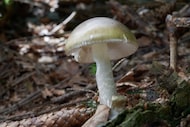
Tabibi also recommended getting to know the highly poisonous mushrooms that are common in your area, such as the destroying angel in North Texas. Learning to avoid those mushrooms in particular can help you feel more confident about other finds.
Related
Through this work, Tabibi hopes to expand people’s understanding of the potential benefits of fungi and help foster a renewed interest in conservation.
“Foraging in general has been kind of a lost art that’s starting to reappear and gain popularity,” he said, “and I think that’s because people are tired of the same existence that they feel like they’ve been stuck in and they want to experience something new.”