
With schools out for winter break, San Diego literacy experts say the time away from school and with family is an ideal time for children to build a strong foundation for lifelong reading habits.
The key is getting kids motivated, and experts consulted by The San Diego Union-Tribune shared tips for fun, engaging ways families can do that with readers of all ages.
It can be especially motivating for younger children to spend time reading with grandparents, neighbors or older siblings and cousins, says Allison Ohle, the executive director of the Diamond Educational Excellence Partnership, a program by community groups to improve outcomes for public school students in southeastern San Diego.
“If reading is a family activity, and it’s something that happens on the laps of people who love you,” she said, “you build a positive association with the habit and the activity of reading.”
Reading also creates topics for conversation within your family, and helps young readers build empathy by discussing the motivations of characters in books.
“You’re talking about what’s happening in the stories,” Ohle added. “You’re talking about people’s feelings in the stories.”
It also offers parents and other relatives the chance to give children targeted support in areas they’re struggling, whether that’s in reading — like comprehension or sounding out words — or in social and emotional development.
“Engaging your child in any kind of patient and slow activity, which reading is, (helps) build mental muscles that are really critical for patience, emotional self-regulation, relating to other people, mental health — all that stuff,” she said.
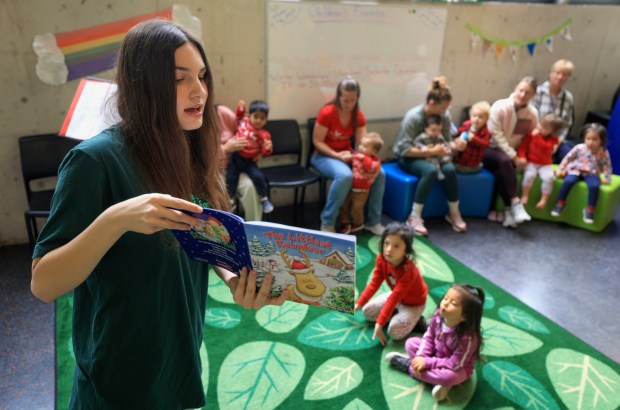 Raquel Rosenthal of the Trinity Theatre Company reads “The Littlest Reindeer” to children at the Children’s Library at the San Diego Central Library on Saturday, Dec. 20, 2025. (Hayne Palmour IV / For The San Diego Union-Tribune)
Get the whole family involved
One key to keeping your family’s habit sustainable: Make sure kids see the adults in their lives reading regularly, too.
That’s one of the big goals of the San Diego Public Library’s winter reading challenge, explains Emily Derry, the library’s supervising librarian for youth and family services. The challenge is for readers of all ages, because they want to make sure adults keep reading, too.
“If they’re reading and their kids are seeing them reading, then they’re more likely to become lifelong readers themselves,” she said.
It doesn’t matter what language you or your kids are reading in, or how strong a reader you are — just the practice reading is valuable, experts say.
Reading in any language builds literacy skills, Derry notes. Adults who are learning English can learn alongside their children as they go through picture books. And adults who aren’t strong readers themselves can still help kids learn by making up stories based on pictures, Ohle adds.
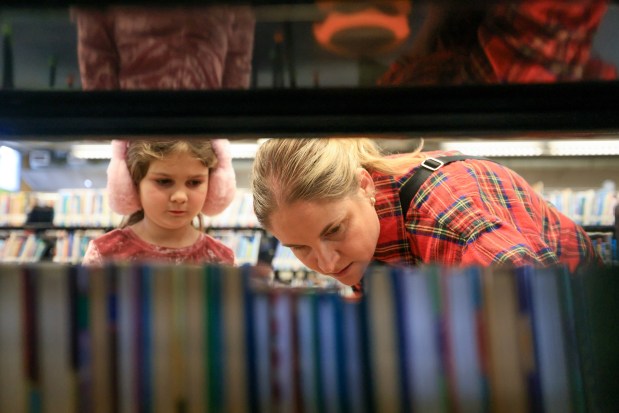 Meier Neal, who came to the San Diego Central Library with her parents from Poway to celebrate her eighth birthday, looks at children’s books with her mother Danielle Neal at the San Diego Central Library on Saturday, Dec. 20, 2025. (Hayne Palmour IV / For The San Diego Union-Tribune)
And if a child is interested in a book too advanced for their reading level, don’t steer them away from it — that’s a great opportunity for you or another relative to read to them, says Terri King Hunt, the director of impact and learning at Just Right Reader, a company that makes books designed for literacy development.
“There is a lot of power in reading aloud to children,” she explains. “It builds vocabulary and builds background knowledge — which is very, very key in helping students be able to comprehend what they read.”
Make reading fun
To get young children associating books with fun, store their board books with their other toys, encouraging them to treat reading as an activity like any other, suggests Stephanie Contreras, a literacy analyst with the San Diego Public Library’s READ/San Diego literacy instruction service.
“Get kids just looking at books the same way they would look at their Barbie dolls or anything else,” she said.
Some of the library’s own events do something similar. For instance, this Saturday at 10:30 a.m., it’s hosting a storytime and craft hour at the Central Library.
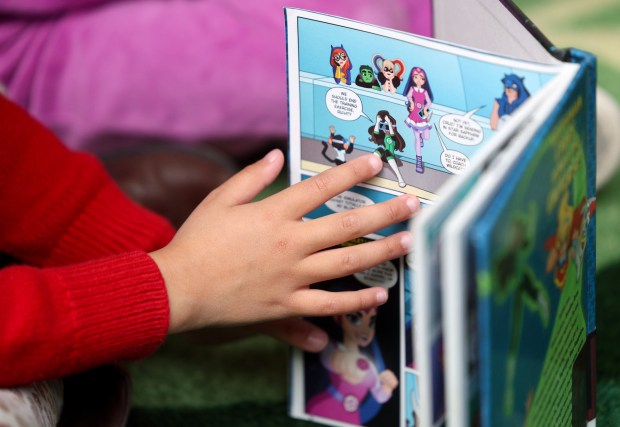 A young girl looks at a book at the Children’s Library at the San Diego Central Library on Saturday, Dec. 20, 2025. (Hayne Palmour IV / For The San Diego Union-Tribune)
Make going to the library a fun activity of its own, too — and let kids pick out books on their own, advises Mandy Perry, a family literacy assistant at the library.
“Take them to the library,” she said. “They will explore.”
For instance, Perry recently discovered one of her young daughters likes cookbooks. She’ll read the books with her parents and make bookmarks for the recipes she wants to cook.
“We’ll read it together and learn, like, math and literacy, all together,” she said.
Create a game
Short of reading books and newspapers, there are plenty of other activities that will help develop reading skills. Experts who spoke with the Union-Tribune recommended a few.
If kids are into carols or poems like “A Visit from St. Nicholas,” those will help develop their reading skills, too. That’s because rhyming and singing are important to building phonological awareness, explains Ohle.
King Hunt plays a game with her family where everyone, adults included, tries to read in the most places in a day, in something like a scavenger hunt — at the kitchen table, under the table, in the bathroom, under a blanket.
“Now, kids are in a competition to see if they can beat Mom and Dad in all of the places that they read,” she said.
There’s no need to limit those games to time at home.
When you eat at a restaurant, make the meal a reading game — have your kids find all the letters of their name on the menu, Ohle suggests. When you take your kids grocery shopping, have them identify what sound each item starts with, and what letter is associated with it.
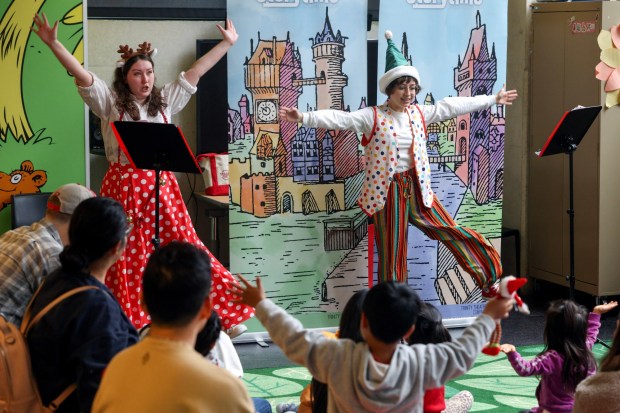 Astrid Pett, left, and Sophia Seafidi of the Trinity Theatre Company act out “The Littlest Reindeer” for children at the San Diego Central Library on Saturday, Dec. 20, 2025. (Hayne Palmour IV / For The San Diego Union-Tribune)
If you’re traveling for the holidays, create a game from what you see along the roadside: Have kids try to find and point out all the letters in the alphabet, in order, on signs while you’re in the car or on a train or bus. That’s a game Ohle says she still plays with her kids, even now that they’re in college.
And make an activity of writing holiday cards to friends and family — and of course thank-you notes for the gifts they receive.
Develop sustainable habits
Especially with young children, it’s important to make reading a habit, one that you carve out dedicated time for, experts told the Union-Tribune.
“On a certain day, at a certain time, we’re just going to sit down and read,” said Nancy Sasaki, the president and chief executive of United Way of San Diego County. Her organization’s United for Literacy initiative aims to help kids acquire literacy skills.
Having a scheduled routine means the reading will happen, and kids know not to expect to do something else during that time, adds King Hunt.
But that habit should be something that works for the whole family. Her own family is going on a cruise over the holidays, and on vacation, they might average just a page or two a day.
“I’m not going to say we’re going to read every day for 30 minutes,” she said. “That is not realistic.”