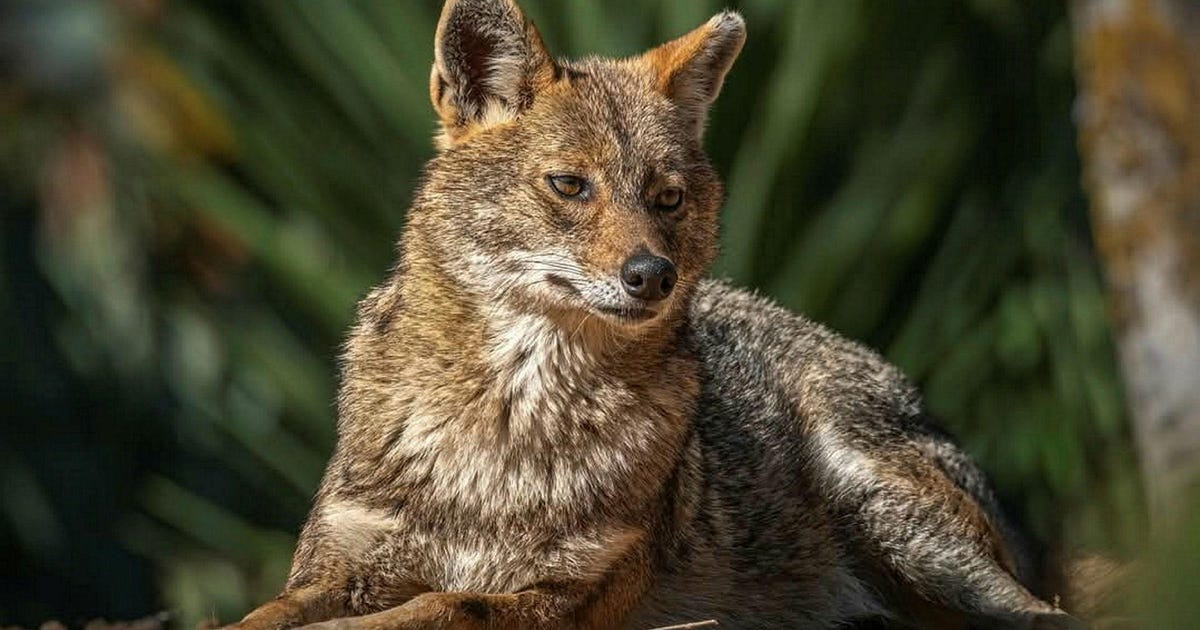
Jackals have made Tel Aviv their permanent home thanks to a steady supply of food and ample shelter, according to findings presented Tuesday at the “Jackals in the Urban Space” conference organized by the Tel Aviv-Yafo Municipality.
Estimates indicate that several hundred jackals now live within the city limits, roaming all areas – from the northern neighborhoods to Jaffa and even the city center. In most cases, the jackals enter residential neighborhoods to search for food and then return to open spaces, primarily around the Yarkon River.
 Close
Close
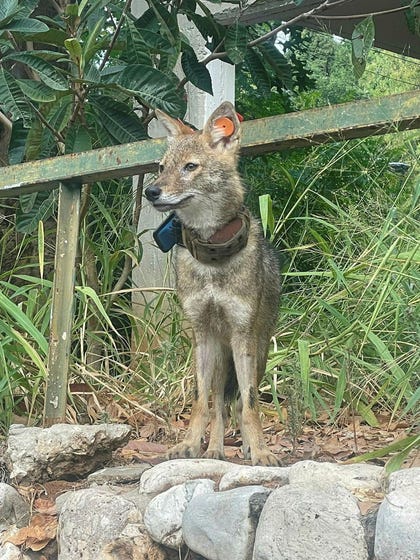
A jackal fitted with a tracking device. Credit: Maria Lander Binyamin
A jackal fitted with a tracking device. Credit: Maria Lander Binyamin
Municipal monitoring of the jackal population, conducted in collaboration with Prof. Dan Malkinson of the University of Haifa, is still in its early stages. So far, 16 jackals have been captured and fitted with tracking devices. Among the findings is that many jackals regularly rely on cat feeding stations as a food source. The municipality is working to persuade residents who feed cats to adopt measures that prevent jackals from accessing the food.
Tracking data also revealed that some jackals travel no more than 200 meters in a 24-hour period. These animals mainly roam the area between the Yarkon River and the site of the former Sde Dov airport. Jackals in the wild typically cover an average distance of more than two kilometers a day. The limited movement of these urban jackals suggests that they have learned to depend on the readily available food and shelter in the city, effectively becoming permanent residents.
 Close
Close
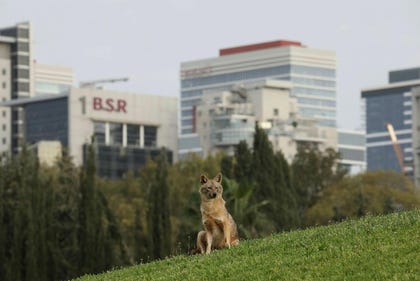
A jackal in Yarkon Park. The animals have accustomed to close proximity to humans. Credit: Ofer Vaknin
A jackal in Yarkon Park. The animals have accustomed to close proximity to humans. Credit: Ofer Vaknin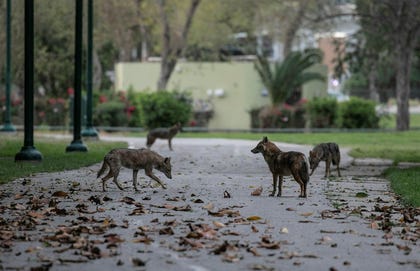 Close
Close
Jackals in Yarkon Park during the COVID-19 period. Some jackals in the city do not travel more than 200 meters over the course of a day. Credit: Ofer Vaknin
Jackals in Yarkon Park during the COVID-19 period. Some jackals in the city do not travel more than 200 meters over the course of a day. Credit: Ofer Vaknin
The growing presence of jackals was first documented in Ramat Gan in 2020, and today they are also commonly seen in neighborhoods near the Yarkon. Within Yarkon Park, jackals have become accustomed to close proximity to people and are often spotted approaching event venues in search of food. Across the city, they find plentiful nourishment in garbage bins and at cat feeding points.
“We are trying to encourage a culture of responsible feeding,” said Dr. Nuriel Shuv, head of the municipality’s veterinary department. “This includes using elevated feeders with narrow openings that jackals cannot access, and feeding in bowls that are collected afterward by the feeders.” He added that the municipality has launched a pilot program using such feeders in one of Tel Aviv’s northern neighborhoods.
 Close
Close
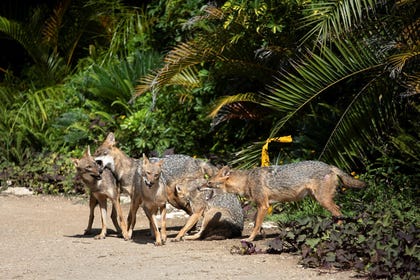
A pack of jackals in Tel Aviv, in 2023. Credit: Moti Milrod
A pack of jackals in Tel Aviv, in 2023. Credit: Moti MilrodRelated Articles
Another challenge discussed at the conference is persuading residents to stop deliberately feeding jackals. Some residents do so regularly, which further increases the animals’ dependence on the urban environment.
The Tel Aviv-Yafo Municipality and the Israel Nature and Parks Authority have decided to avoid population-control measures that involve lethal means, such as shooting. However, both organizations agree that the number of jackals in urban areas should be reduced as much as possible through limiting food sources, improving waste management and changing cat-feeding practices.
The primary reasons for preventing jackals from entering the city are to reduce the risk of rabies outbreaks and to avoid conflicts between jackals and humans. As part of these efforts, the municipality is currently distributing baits containing rabies vaccines throughout the city.
“What’s clear is that we’re not going anywhere, and neither are they,” said Uri Naveh, deputy head of the Science Division at the Israel Nature and Parks Authority.