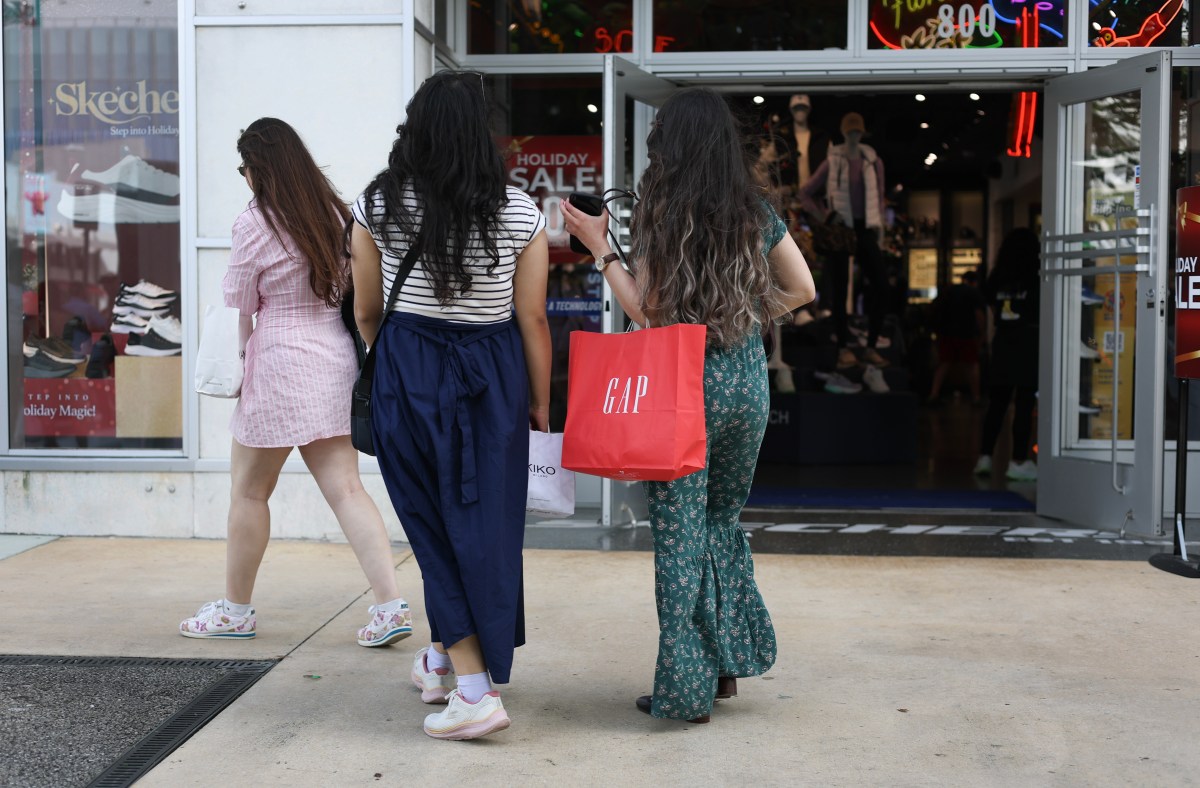
The U.S. economy ended 2025 looking like two different countries at once. Output is roaring ahead, but jobs are barely moving. Economists say the phenomenon—a nation expanding faster than it can hire—is not a fluke. It’s the shape of what’s coming next.
The Commerce Department’s third-quarter data told the story clearly. The economy grew at a 4.3 percent annual rate, the fastest in two years, while monthly job creation averaged just 51,000.
For decades, that combination would have seemed impossible. Now, some economists warn it could become the new normal.
Lawrence J. White, an economist at New York University’s Stern School of Business, said the disconnect is structural.
“The economy can expand without hiring much,” he told Newsweek. “We’re building a system that runs faster than it employs. That’s a long-term shift, not a one-year blip.”
The data show how that shift is taking shape. Household consumption climbed 3.5 percent, accounting for more than half of total growth, but much of that spending came from upper-income households. Investment in automation and artificial intelligence also played an outsized role, according to Joseph Brusuelas, chief economist at RSM.
“The great decoupling of jobs and growth will take some explaining to the American public,” Brusuelas wrote on X. “That interplay is going to be the major economic narrative next year.”
In a deeper analysis published Tuesday on RSM’s Real Economy Blog, Brusuelas described a powerful but uneven recovery driven by automation, high-income consumption, and AI-related capital spending. He noted that nominal GDP expanded 8.2 percent, while real private demand—a measure that excludes trade and inventory effects—rose 3 percent. Inflation held near 3 percent.
Despite those strong headline figures, he warned that hiring continues to lag. “The economy and financial markets will continue to expand at a strong clip,” he wrote, “but job creation will remain tepid.”
Americans seem to agree. Unemployment ticked up to 4.6 percent in November, and consumer sentiment, tracked by the University of Michigan, has fallen to levels typically seen during recessions.
“Households don’t experience GDP,” White said. “They experience prices, wages, and hours worked. Right now, all three feel out of sync with the official data.”
When Growth No Longer Means Hiring
The U.S. economy has added just under 500,000 jobs so far this year, down sharply from 1.6 million during the same period in 2024. The unemployment rate has risen through the second half of the year, reaching 4.6 percent in November — the highest level since 2021.
The weaker hiring pace isn’t just a sign of a cooling labor market. Economists say it points to broader structural changes in how growth translates into jobs. Trump’s second-term fiscal policy, featuring large corporate tax cuts and the full expensing of capital investments, has accelerated a long-running trend toward capital-intensive growth.
Firms can now write off the cost of equipment and software almost immediately, encouraging investment in technology instead of labor.
“The policy framework is designed for investment-led expansion,” White said. “That means the returns show up in productivity and profits before they show up in hiring.”
At the same time, the Federal Reserve’s higher-for-longer interest rate stance has dampened small-business borrowing, giving larger firms an advantage. The result is a two-tier economy: big corporations are automating and scaling efficiently, while smaller employers remain cautious about adding workers.
RSM’s Middle Market Business Index, which tracks midsize companies, shows that hiring intentions remain flat even as business confidence improves.
“That’s an important signal,” Brusuelas said in his report. “The middle market typically drives job creation during expansions. The fact that it’s not now tells you this recovery is different.”
Economists compare the current moment to earlier “jobless recoveries,” particularly in the early 2000s, when productivity outpaced employment. But they note that today’s pattern is broader, touching manufacturing, logistics, and services alike.
“The difference now is scale,” Foudy said. “AI and digital automation are spreading across nearly every sector. The productivity gains are real, but the employment payoff is delayed—maybe by years.”
Brusuelas expects that trend to continue. The October government shutdown will likely trim up to 1.5 percentage points off fourth-quarter growth, but he still projects expansion “well above the long-term trend” through 2026, powered by tax incentives and private investment. Inflation will stay sticky, and the labor market will remain soft.
Prosperity Without Perception
For the White House, the paradox is now as much political as economic. The administration points to GDP growth and stock market highs as proof of success, yet voters remain skeptical. Polling shows that most independents and lower-income Republicans feel worse off financially than a year ago.
Economists warn that this disconnect—between measurable strength and lived experience—can shape public opinion as powerfully as any recession.
“It’s not that people deny the data,” White, the NYU Stern professor, said. “It’s that they don’t feel represented in it.”
Following Democrats’ sweeping victories in the off-year elections in November, the administration has worked to reassure voters that inflation is under control. The White House doubled down after the release of the third-quarter GDP report, presenting the results as proof that Trump’s economic strategy is delivering.
“The doubters, naysayers, panic-mongers, and liberal media have been proven wrong—again,” White House press secretary Karoline Leavitt said in a statement celebrating the new economic data. “Trust in Trump. The president’s pro-growth policies are working, and the best is yet to come.”
But that message appears to be falling flat. With the 2026 midterms approaching, the perception gap could prove politically costly for Republicans. According to The Economist/YouGov’s latest tracking poll, 60.4 percent of independents now say the economy is “getting worse”—one of the highest levels since the summer of 2022.
White said the situation resembles the final years of the Biden administration: the data looks strong, but voters don’t feel it. “Trump is defending high prices while insisting the economy is better,” White said. “That’s a tough sell politically.”