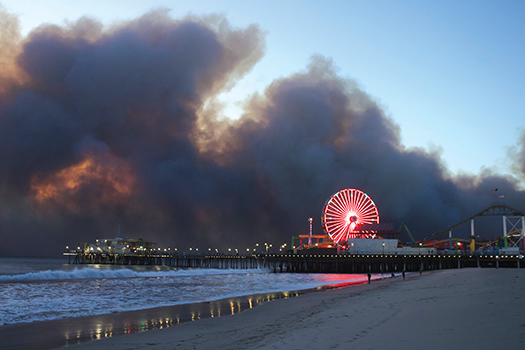
Smoke from the Palisades fire darkened the sky on Jan. 7 as flames devastated entire communities. (photo by Tabor Brewster)
Seven days into 2025, the biggest disaster since the 1994 Northridge earthquake devastated the city, setting the stage for a long recovery that is still unfolding a year later. As the strongest winds in decades barreled down on the city on Jan. 7, 2025, tens of thousands of people were forced to flee the Pacific Palisades, Malibu, Altadena and Pasadena as wildfires swept through entire neighborhoods, destroying everything in their path. A day later on Jan. 8, the winds continued relentlessly, fanning flames in Runyon Canyon during the Sunset fire, forcing thousands more to flee northern Hollywood for safety. While the Sunset fire was largely extinguished by the next morning, the Palisades and Eaton fires were not fully contained for 24 days. In the end, 31 people lost their lives in the devastating January wildfires and more than 16,000 homes and buildings were destroyed.
Nearly everyone in Los Angeles, Beverly Hills and West Hollywood knows someone who was impacted by the tragedy, the effects of which will be felt for years to come. Reports estimate that the Palisades and Eaton fires caused $8.9 billion in lost economic output in L.A. County. The cost to rebuild will be in the billions.
In the aftermath of the blaze, the spirit of resiliency took shape almost immediately – even before the flames were fully extinguished. In Hollywood, the Magic Castle hosted a relief effort for fire survivors a week after the fires started, allowing victims to select clothing and necessities donated by the community. The city of West Hollywood activated its WeHo Responds network, accepting donations and routing them to organizations providing fire relief. The city of Beverly Hills launched a similar relief effort, accepting donations and supporting those who were sheltering at the Dream Center in Hollywood. The relief efforts continued throughout the following months in an effort to provide aid to as many people as possible.
The city and county of Los Angeles also stepped in quickly, declaring an emergency and offering $31.7 million in immediate financial assistance to victims. Over the following months, the Federal Emergency Management Agency made more than $3 billion available for homeowners, renters and businesses impacted by the disaster, and the state of California provided nearly $2.5 billion. As the year progressed, the devastating wildfires continued to make headlines, placing them among the most far-reaching disasters that shaped the Los Angeles area in 2025. As the start of 2026 approaches, the effort to recover and rebuild is still unfolding and will remain an important story in the future of the city.
While the fires dominated the headlines over the past year, many other people and events shaped the cities of Los Angeles, Beverly Hills and West Hollywood. Several major projects were approved or began construction, while others entered final stages. New leaders took the reins in West Hollywood and Beverly Hills, while changes in the federal government also shaped the community. With the new year only days away, here is a look back on the dynamic forces that had an impact in 2025.
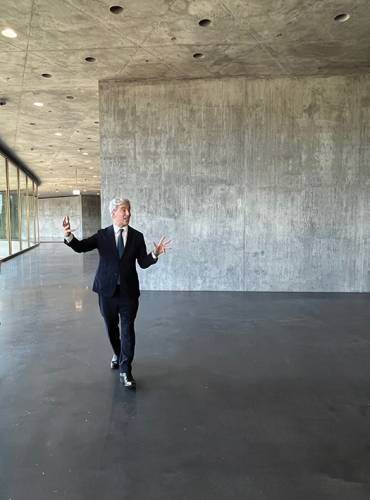
LACMA CEO and Wallis Annenberg Director Michael Govan explained key design details during a preview of the David Geffen Galleries in July. (photo by Karen Villalpando)
Los Angeles
The landscape is changing in many neighborhoods of Los Angeles, most prominently in the Miracle Mile, where the Los Angeles County Museum of Art’s new David Geffen Galleries are poised to open in spring 2026. The sweeping glass and concrete building spanning Wilshire Boulevard temporarily welcomed the public for a preview last June, where a first-of-its-kind performance by composer and jazz saxophonist Kamasi Washington turned the entire empty building into an acoustic musical instrument. The galleries are currently closed while LACMA’s collection of art is installed ahead of the grand opening in April, but the new building has already become an unmistakable landmark shaping the local skyline.
Another project rolled closer to completion in Los Angeles in 2025 – the Metro D Line subway extension. The first segment of the line from Wilshire/Western to Wilshire/La Cienega was initially scheduled to open by the end of 2025, but systems testing required the opening be pushed back to sometime during the first quarter of 2026. Once the entire length of the nine-mile new transit line to Westwood opens in late 2027, the subway will whisk riders between Downtown Los Angeles and the Westside in approximately 25 minutes.
Homelessness and the government response to the crisis were also at the forefront in 2026, with L.A. County notching a slight reduction in numbers in the annual Homeless Count. Still, more than 72,000 people remain homeless countywide, showing the dire need for proactive programs and a steady approach. To better provide services and reach more people more effectively, the Los Angeles County Board of Supervisors pulled more than $300 million in annual funding from the Los Angeles Homeless Services Authority and redirected it into a new county department to address homelessness that is expected to be fully operational by July 1, 2026. The city of Los Angeles is also exploring the possibility of creating its own homelessness department, signaling a change in the way local government addresses the persistent issue of homelessness and getting more people into housing.
The city of Los Angeles was also impacted by changes in the federal government during the past year, with actions by the Trump administration and Congressional Republicans directly affecting thousands of residents. The actions included reductions or the initial withholding of funding for a variety of programs, from medical services and food assistance for low-income people to programs for the LBGTQ+ community. U.S. Reps. Laura Friedman (D-Glendale) and Ted Lieu (D-Torrance) spent considerable time fighting for community-serving programs, which essentially provide a lifeline to a large segment of the population.
Federal immigration raids also impacted the greater Los Angeles area in 2025, with California National Guard members deployed around federal buildings in downtown Los Angeles and Westwood, and immigration enforcement operations unfolding across the city. Thousands of protesters demonstrated against the operations in downtown L.A. The U.S. Department of Homeland Security announced in early December that more than 10,000 people were arrested in Los Angeles immigration operations since June. The masked federal agents have spread fear throughout the city’s immigrant communities, and although state and local leaders stepped up legal attempts to block the raids and support people who have been impacted, the operations appear to continue in 2026.
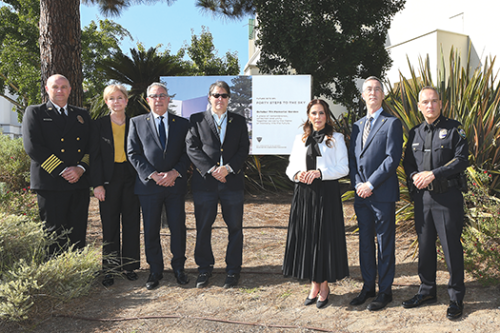
The Beverly Hills City Council appeared alongside public officials to dedicate the Oct. 7 memorial. (photo courtesy the city of Beverly Hills)
Beverly Hills
2025 was a dynamic year in Beverly Hills characterized by new building projects and new leadership. Mayor Sharona Nazarian took the reins on the City Council, becoming the first Iranian American woman to lead the city as mayor and connecting with the community through programs such as Straight Talk With Sharona and Spotlight With Sharona. The City Council took an unprecedented step by splitting the vice mayorship between Councilmen John Mirisch and Craig Corman. The one-time change was deemed necessary due to the city’s rotating mayoral system and the schedule for council elections. Mirisch has announced that he intends to challenge the city’s term limits and possibly run for another term on the City Council.
New projects were a significant story in Beverly Hills, with multiple proposals coming before the Planning Commission and council for buildings taller than would normally be allowed. Because the city of Beverly Hills was out of compliance with the state housing element for three years between 2021-24, a state law kicked in known as the builder’s remedy that allows developers to bypass city zoning restrictions and construct larger housing projects. Nine builder’s remedy projects were approved in Beverly Hills.
The city also moved forward with plans for construction of a permanent memorial to the victims of the Oct. 7, 2023, attacks in Israel. Titled “Forty Steps to the Sky: A Memorial of Light and Memory,” a sculpture and pavilion will be located at the south side of the Beverly Hills Public Library at the northeast corner of Rexford Drive and Burton Way. The city is contributing $500,000 for the memorial and is currently collecting private donations to fund the $1.5 million project.
The Beverly Hills Unified School District was frequently in the news in 2025, undergoing increased scrutiny over lawsuits alleging racism and other improprieties. BHUSD Superintendent Michael Bregy abruptly resigned in February, and the school board appointed Dr. Alex Cherniss in April to lead the district forward. The BHUSD faces multiple lawsuits that are currently making their way through the legal system in 2026.
Metro’s subway project will bring a new station to Wilshire/La Cienega in 2026, and a new station to Wilshire Boulevard and Beverly Drive when the second segment opens the following year.
The One Beverly Hills project is moving ahead on 17.5 acres of land on the western edge of the city. The City Council approved up to $550 million bonds for the project in 2025, and One Beverly Hills is scheduled for phased completion starting in late 2027, bringing new luxury residences and hotels, retail and dining to the city, as well as lush gardens and public open spaces.
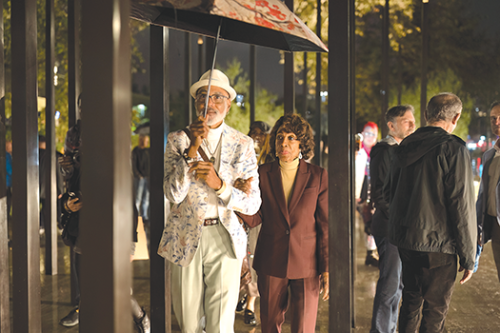
Rep. Maxine Waters (D-Los Angeles, right) attended the opening of West Hollywood’s STORIES: The AIDS Monument in November. (photo by Jon Viscott)
West Hollywood
West Hollywood remained a dynamic and rapidly evolving city in 2025, maintaining its progressive values and unwavering support for all people, particularly those from marginalized groups. The center of the LGBTQ+ community in Southern California, West Hollywood welcomed more than 100,000 people to its OUTLOUD Music Festival and Pride celebration and parade in June 2025. The event marked the third year the city produced its own Pride celebration and was considered a huge success.
New leadership took center stage in West Hollywood in 2025, with Mayor Chelsea Byers taking the helm on the City Council for the first time, and Councilman Danny Hang serving his first year. Hang was recently elected as the city’s vice mayor, a role he will assume in 2026. Longtime city leader John Heilman will become West Hollywood mayor for a record ninth time next year, marking a historic dedication to city service dating to West Hollywood’s founding in 1984.
Jackie Rocco was selected to replace retiring city manager David Wilson. At the West Hollywood Sheriff’s Station Capt. Fanny Lapkin succeeded longtime sheriff’s Capt. Bill Moulder.
Traffic safety was one of the top issues in West Hollywood over the past year, particularly along Fountain Avenue. On July 10, 27-year-old bicyclist Blake Ackerman died after being struck by a hit-and-run driver on the street. A 70-year-old motorist was later arrested and is facing charges. The collision and death sparked a heated community debate over bike lanes and public safety improvements on Fountain Avenue that resulted in the City Council voting 3-2 in September to advance the Fountain Avenue Streetscape Project, which will bring dedicated bike lanes and traffic lane reductions to the busy thoroughfare.
West Hollywood also capped a decades-long effort to create a memorial to those who lost their lives during the HIV/AIDS epidemic when “STORIES: The AIDS Monument” opened in November in West Hollywood Park. The memorial consists of 147 bronze pillars called traces that represent people who died as well as those who showed support, marched and attended protests and vigils.
With 2025 nearly in the rear-view mirror, the coming year is already shaping up to be another period of growth and change. With the new LACMA museum and subway opening, projects advancing in Beverly Hills, an upcoming city of Los Angeles election and the never-ending stream of changes in all aspects of government and society, 2026 promises to be another dynamic year in the city’s long and vibrant history.