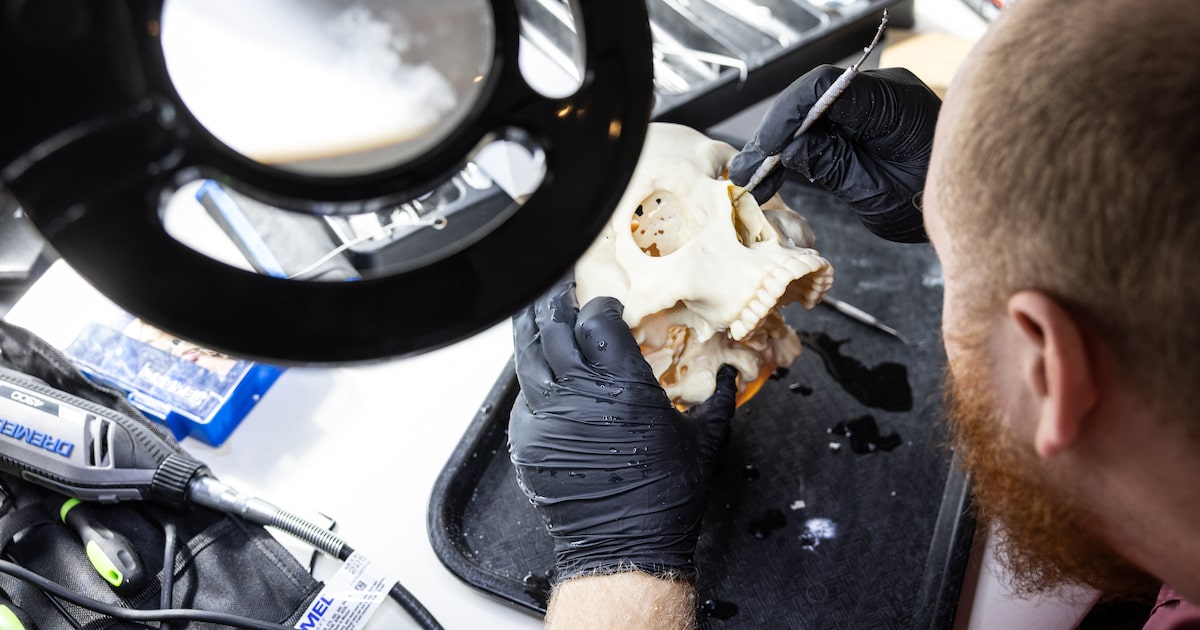
Nancy Hairston once used her 3D-animation, digital-sculpting and computer-aided-design skills to help Mattel make Bratz Dolls.
Now the 57-year-old president, CEO and owner of Dallas-based MedCAD is refocusing her artistic and tech know-how to reconstruct skulls and faces disfigured by major surgeries, gunshots, car accidents and other traumas.
Since starting her company on a wing and a prayer in 2007, Hairston has crafted more than 10,000 one-of-a-kind cranial, facial and lower-jaw implants for patients around the globe.
“We have the talent and the tools to bring a new way of doing surgery to the forefront,” Hairston said, holding a jawbone implant at MedCAD’s offices and design studio near Fair Park.
Business Briefing
“We don’t make anything that sits on a shelf in inventory. Custom means six or seven variations, and you pick the best fit. We don’t make those.”
The name MedCAD doesn’t exactly roll off the tongue, but its origin is simple: Med for medical and CAD for computer-aided design.
Hairston ends 2025 on a prosperous note with revenues approaching $15 million and predictions of exponential growth next year when two — soon to be three — orthopedic implants certified by U.S. Food and Drug Administration kick in.
“We’re growing like crazy,” Hairston said.
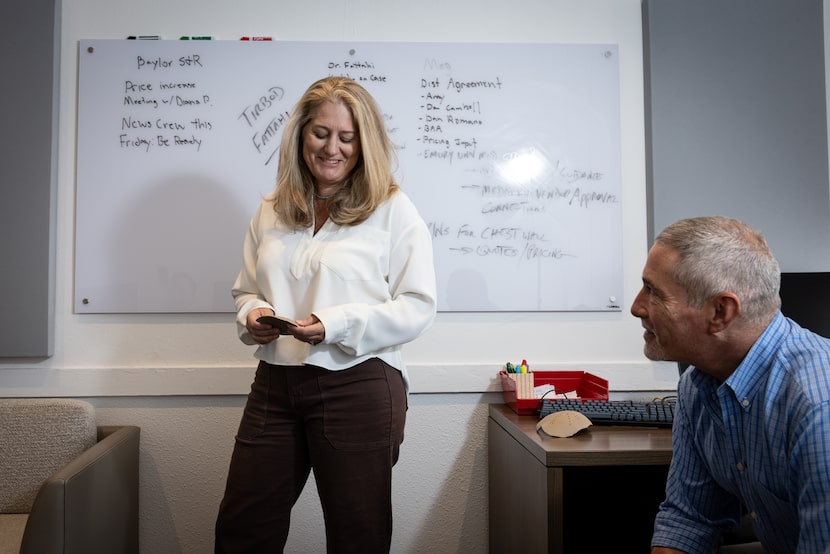
Nancy Hairston, MedCAD president and CEO, looks at a cranial implant with Alan Klompus, senior product manager, in their office on Sept. 12, 2025, in Dallas.
Angela Piazza / Staff Photographer
Brian Buss, executive vice president, said MedCAD is running at a 40% year-over-year clip. “But venturing into the orthopedic field is likely to make us a bigger dot on the map.”
Horrors of war
Hairston’s life-changing moment in 2025 had nothing to do with making money.
She recently returned from an eight-day mission in Ukraine, accompanying four U.S. reconstructive and ocular surgeons who operated on dozens of horrendously disfigured patients in Kyiv and Lviv.
The U.S. team worked in tandem with Ukrainian surgeons and staff under the constant threat of Russian ballistic missiles. “We squeaked by until we had to spend our last night in a shelter,” she said.
The mission also included Jorge Corona, a Dallas ophthalmologist who specializes in oculoplastic and orbital surgery.
“Nancy was brave enough to come all the way to Kyiv and Lviv,” Corona said, adding that having Hairston in the operating rooms to consult with the surgical teams was highly beneficial. “She has a tremendous level of energy, but also, she’s an incredible team player. When Nancy needed to be mindful, calm and collected, she always was.”
Hairston had donated titanium implants and intricate surgery plans for two previous missions used to reconstruct 11 soldiers and civilians’ mangled faces. But this was her first trip to see the horror firsthand and help implant her devices into five victims in the operating room.
“The injuries are so brutal,” Hairston said. “You walk into the hospital and everyone is missing an eye, maybe two. And it’s not just soldiers. It’s civilians, too. Women are coming from other parts of the country where they are getting pummeled and their faces are horribly disfigured. Blasts by drones are really devastating to the tissues of the face.
“It was heartbreaking, sad and all so senseless.”
Sculpting meets CAD
Hairston was born at Baylor Hospital in 1968 — the youngest of six siblings in a Catholic, three-generations-old Dallas family. Her grandfather was a surgeon at Parkland Hospital, and her father owned a produce company at the Farmers Market.
“I was fascinated by anatomy and loved to paint, draw and sculpt,” Hairston recalled. “I didn’t think I had the brains to be a doctor. I had difficulty in math and sciences, so I took everything that Ursuline [Academy] provided in photography and art.”
That self-assessment seems a tad ludicrous today.
After earning her degree in sculpture from Loyola University in 1990, Hairston interned at Mary Kay Cosmetics in Dallas, which was using cutting-edge 3D animation modeling to make presentations for its sales representatives.
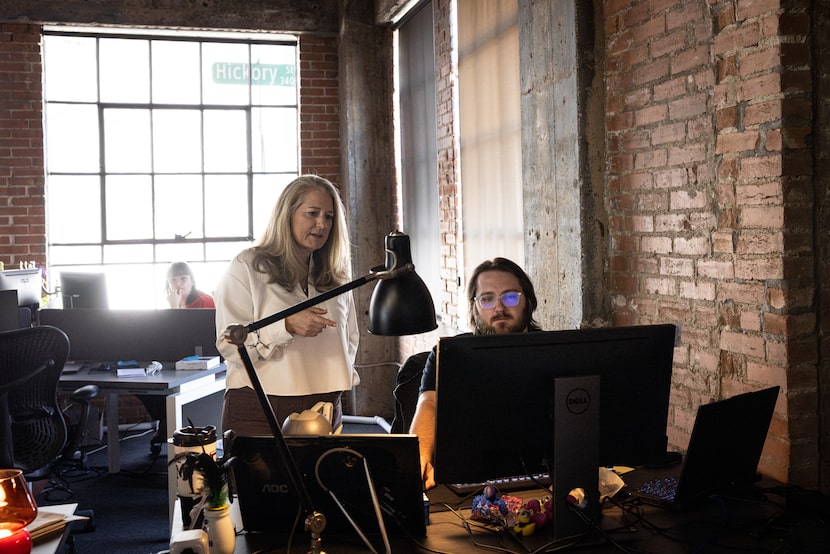
Nancy Hairston, MedCAD president and CEO, speaks with Preston White, a biomedical designer, in their office on Sept. 12, 2025, in Dallas.
Angela Piazza / Staff Photographer
“That’s how I got exposed to modeling on a computer,” Hairston said. “I was just an intern and taught myself how to do it.”
Another lesson came when Mary Kay saw her wearing pants on the elevator and sent her home to put on a dress.
Hairston went to work for the company in Toronto that invented Mary Kay’s software. During her seven years there, she picked up expertise in special effects, business animation and video game development.
In 2000, Hairston launched her own product development company: Bratz Dolls — “the trashy cousin to Barbie” — for Mattel, playsets for Disney and Fisher-Price and housewares for Williams Sonoma.
She weaned herself off toys and housewares while she bootstrapped her medical implant business with the help of two angel fund rounds.
Today, the bulk of MedCAD’s revenue comes by supplying global medical giants with patient-specific implants and surgery instructions — the biggest being Zimmer Biomet, which specializes in orthopedic reconstructive products.
MedCAD also has direct-to-hospital relationships with Baylor Scott & White Health in Dallas and Memorial Hermann Health System in Houston.
“When you have cancer of the jaw, you’ve got to get it out now,” she said, snapping her fingers. “So everything we do is quick turn. For Baylor and Hermann, we’ll ship it by the end of the day.”
All of MedCAD’s raw materials — including titanium, biomedical plastic and resin — are subject to tariffs. She’s been able to renegotiate contracts with suppliers in the United Kingdom, Scandinavia and Germany.
The big hit has been the rapidly escalating price of resin from Israel, used in her 3D prints.
Her biggest problem is scaling growth — not just financially but also talent. She has 67 employees. Those who play a part in engineering and designing surgical cases need to be able to blend science and technology with art.
“We have technologists who are engineers but can color outside of the box. They’re like the digital hands of the surgeon,” she said. “And we have people with artistic backgrounds like me who can be taught the medical side.”
As the company grows, Hairston might consider financial opportunities to scale the company. “But we are very comfortable where we are at the moment,” she said.
Buss got to know his now-boss when he was co-founder of a medical device company and Hairston provided 3D printing expertise for products his company was bringing to market.
“Nancy needed what pretty much anybody growing a medical device company needs,” said Buss, who came to work as executive vice president for her 13 years ago. “It’s really difficult to lead a medical device company from a start-up to a mid-term growth level. To go from $1million to $20 million takes a certain mindset, and I had experience with that twice.”
He said Hairston is the best networker that he’s ever met and listens.
“She’s able to process a lot of input and come up with the right decision that’s not necessarily the most democratic,” Buss said. “She knows when to buck the trend and take the path least taken.”
Meet Nancy Hairston
Title: President, CEO of MedCAD
Age: 57
Born: Baylor Hospital, Dallas
Resides: Dallas
Education: Ursuline Academy of Dallas, 1986, Bachelor of Arts, sculpture, Loyola University, 1990.
Professional: Board of Trustees, Loyola University
Personal: Longtime life partner
SOURCE: Nancy Hairston
MedCAD
Founded: 2007
Ownership: Nancy Hairston, two small angel investors
Headquarters: Dallas near Fair Park
Manufacturing plant: Plano
Products and services: Titanium implants for cranial and facial reconstruction; implants for lower extremities expected in 2026; detailed surgical plans for implants
Employees: 67, dispersed in different time zones
Annual revenue: Approaching $15 million
Sources: Nancy Hairston, MedCAD
 Dallas-Fort Worth business datebook for the week of Dec. 28
Bowl games, economic reports and holiday closings.
 The top Dallas-Fort Worth business stories of 2025 hint at what’s coming for 2026
For better or worse, this year reshaped North Texas’ economy in many ways.
 Dallas CEO ventures into Ukrainian warzones
What Nancy Hairston found wasn’t a ‘smoldering hellscape.’