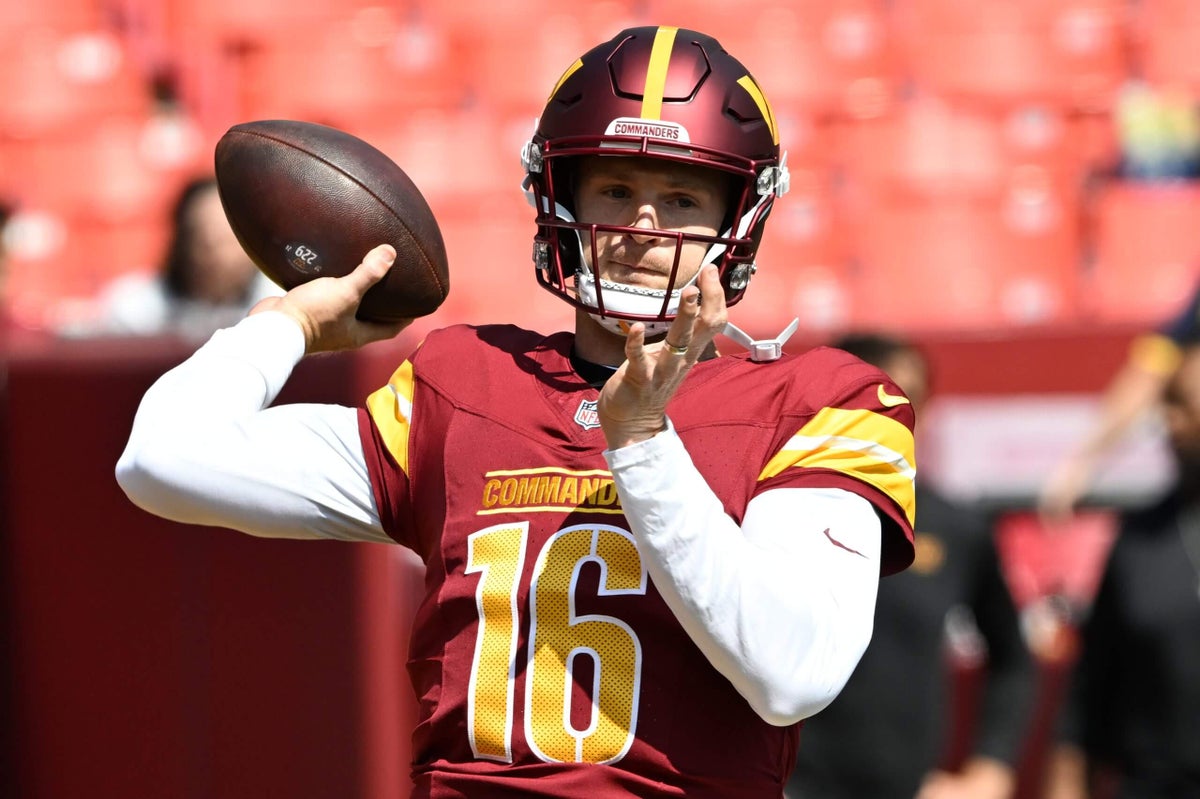
ASHBURN, Va. — Jeff Driskel didn’t have enough time to unpack, let alone to unlearn everything he drilled the past seven weeks.
In the span of 12 hours earlier this week, he went from being a practice squad quarterback standing on the sidelines during the Arizona Cardinals’ Week 16 loss to the Atlanta Falcons, to becoming the Washington Commanders’ impromptu backup for their Christmas Day game against the Cowboys — with only three days to prep.
He received word just minutes before kickoff Sunday, then hopped on a red-eye flight to the D.C. area Monday morning, landing just in time to take a physical and join the Commanders’ morning meetings before taking the field for a walkthrough and then practice.
His locker had yet to receive a nameplate and instead was designated by the two suitcases parked in front.
“It’s way more common than people think,” he said with a grin. “You get used to it.”
Such is the life of the emergency signing, players acquired on short notice to step in for depth or even a starting role and make it all somehow look seamless, as if they had practiced for months, not hours, with teammates whose names they’ve yet to fully learn.
Common? Sure — in the NFL, where injuries are all but guaranteed each weekend.
But easy? Hardly. The trick is making it appear so. Behind the scenes, NFL teams do this weekly, with emergency lists of free agents and practice squad players, and a well-rehearsed operation involving staffers from multiple departments bringing in new players on a moment’s notice.
The Indianapolis Colts did it earlier this month when they signed 44-year-old Philip Rivers out of retirement and elevated him from the practice squad to start his first game in 1,800 days.
In 2023, the Vikings did it after losing starter Kirk Cousins to an Achilles injury. They acquired Joshua Dobbs in a trade with the Cardinals and turned to him five days later, without him taking a single practice rep with the starters.
Washington was home to another emergency addition in 2020, when quarterback Taylor Heinicke, a little-known reserve who was finishing up a mathematics degree while sleeping on his sister’s couch, signed to the practice squad. Much like Dobbs in Minnesota, Heinicke quickly became a cult hero in Washington, throwing for 306 yards and one touchdown and running for another in a wild-card playoff loss to Tom Brady and the Tampa Bay Buccaneers.
A year later, the Commanders signed quarterback Garrett Gilbert off the New England Patriots’ practice squad to start a late-season game in Philadelphia — after he had only one practice with the team.
“When Garrett got here, fresh off the practice squad, the game plan was already in,” receiver Terry McLaurin recounted. “So, he got here and now we’re trying to get on the same page. That was probably the hardest situation I probably experienced, but then we went into the game against a great Philly team and completed deep balls and made it a competitive game.”
Plucking a new guy off the street or off another team’s practice squad is an almost daily occurrence in the NFL. But little about it feels routine to those involved.
Driskel is the latest to experience it in Washington, but hardly the only one.
Thirty Washington players (including those who were already ruled out for Thursday’s game) have missed a combined 139 games because of injuries, forcing the team’s personnel and operations departments to find help in unique ways. They signed a contingency punter (Mitch Wishnowsky) for a few days, later brought in an emergency kicker, picked up a receiver and pass rusher minutes before boarding a flight to Spain, and added a long snapper (Zach Triner) for all of three days.
Driskel arrived with a clear advantage over the others: familiarity.
He spent the 2024 season with the Commanders as their third-string quarterback and was called back this week when Marcus Mariota suffered hand and quad injuries in their loss to the Eagles. With Jayden Daniels, the team’s true starter, shut down for the season, and Sam Hartman having zero regular-season snaps in his career (he signed to the active roster on Wednesday), Washington needed reinforcement for the final two games.
Driskel is well-versed in Kliff Kingsbury’s system and knows the staff and much of the roster.
That wasn’t the case for him two years ago, when the Cleveland Browns signed him off the Cardinals’ practice squad and he started several days later, in the season finale against the Cincinnati Bengals. Cleveland had already punched its ticket to the playoffs, so it opted to rest its starters for the last game and put it on Driskel’s shoulders.
“I was not familiar with that building, so I had to introduce myself to everybody,” he said.
Josh Johnson, who will start his first game in three years on Thursday when the Commanders host the Cowboys, knows the routine probably better than anyone, having been with a record 14 teams in his 17-year pro football career. He was the late bloomer in high school, the non-scholarship quarterback in college, a fifth-round pick and the last QB on the initial depth chart as an NFL rookie. And in most of his years since, he’s been the backup or emergency guy.
“Most of the opportunities that came for me, something happened — something went wrong with the starter or … something happened to the backup,” he said. “And so for me, it’s been a unique experience, but it’s been one that I don’t take for granted.”
But to be thrown in a game just days after arriving is undoubtedly difficult.
In 2021, the Ravens plucked Johnson off the Jets’ practice squad because Lamar Jackson was dealing with an ankle injury. Johnson started 11 days later, throwing for 304 yards, a pair of touchdowns and a pick in a 41-21 loss to the Bengals.
Johnson played the role of emergency QB again the following season with the San Francisco 49ers. He was Brock Purdy’s backup a week after signing, then was tabbed as his replacement in the NFC Championship Game the following month.
“My first time getting in the huddle with the guys was in the NFC Championship,” he recalled.
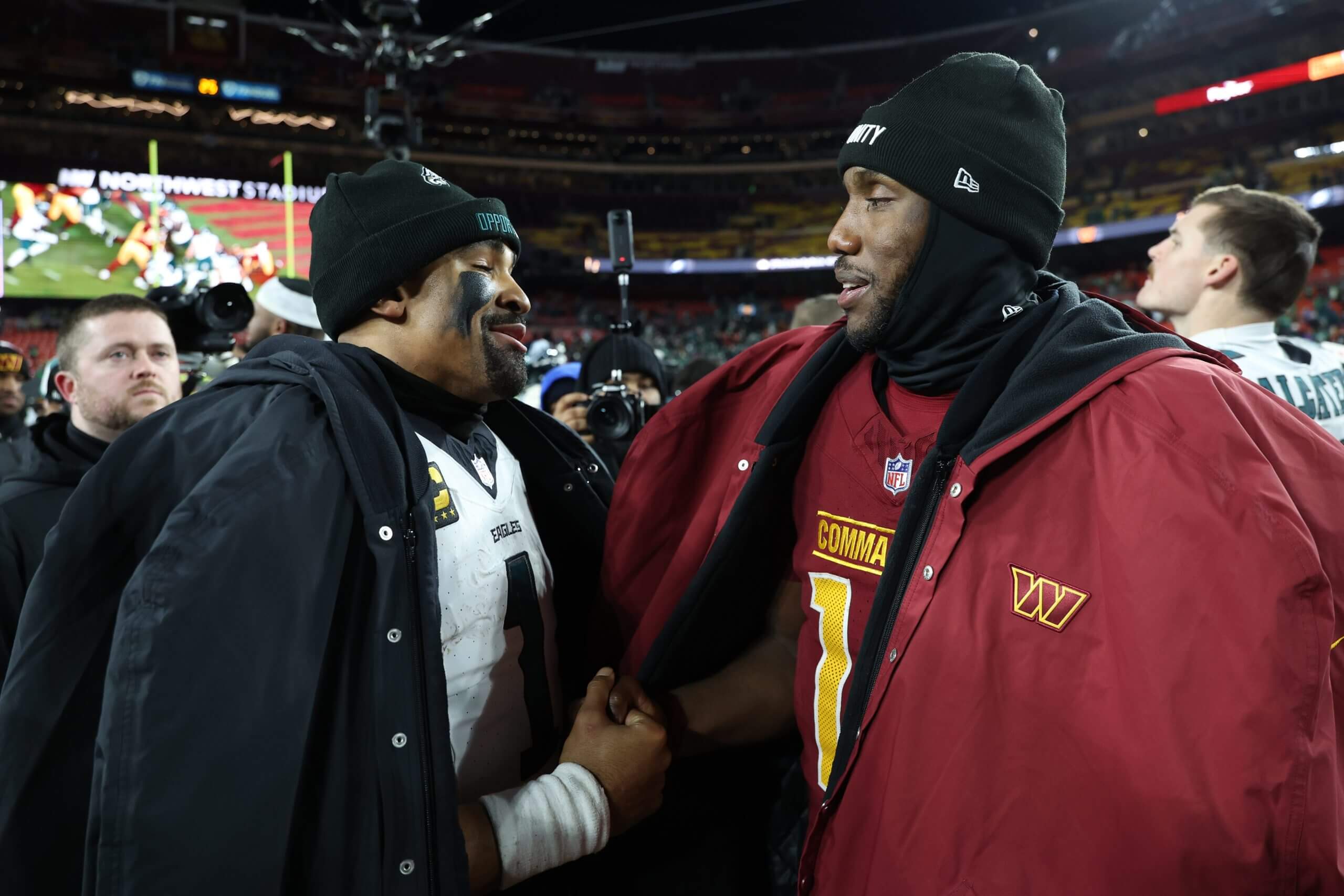
Josh Johnson, right, was pressed into action during a Commanders loss to Jalen Hurts and the Eagles. (Geoff Burke / Imagn Images)
Which is exactly what he experienced last Saturday, when he came off the bench for the Commanders in the second half of their loss to the Eagles. Despite being with the team for eight months, the third quarter of that game was the first time he had been in a huddle with McLaurin and the first time Washington’s starters heard his cadence. Third-string quarterbacks don’t get first-team practice reps during the season.
“There’s not too much I can say or dictate or whatever, because we were in the fourth quarter of the game, the end of the game, and everybody was already in the flow,” Johnson said of his 22 snaps against the Eagles. “I’m trying to get up to speed to them. So this week, I’m just trying to go through the process and be as intentional with everything as possible so we can go out there and play fast and play well.”
Stepping in as the emergency quarterback may be among the tougher tasks in the NFL. But being the new guy on short notice certainly isn’t limited to that position.
Washington, like every club, has a deep list of emergency replacements — free agents and practice squad players — that is updated continuously throughout the season and serves as its guide when players are lost to injury or illness.
Timing matters, though. A lot.
Injuries suffered during Sunday night, and especially Monday night, games can often make it more challenging for a team to arrange a workout and visit with a potential signing before other teams in need. And if he does come in for a workout, the later kickoff dictates a later arrival, later physical and later start for the player to get into a new routine.
Few, if any players, had less time to prepare than Matthew Wright, the journeyman kicker who agreed to fly to Kansas City ahead of Washington’s Monday night meeting with the Chiefs in Week 8.
The Commanders’ starter at the time, Matt Gay, informed the team days earlier that he was dealing with a back issue, which gave Washington enough time to find a contingency plan if he was unable to play.
Wright has built a career on being an emergency replacement. He spent a brief period in San Francisco when Commanders general manager Adam Peters was its assistant general manager, and spent time in Detroit when Commanders assistant GM Lance Newmark was the Lions’ director of player personnel. He also had experience kicking at Arrowhead Stadium, one of the most notoriously difficult places to kick because of the weather and noise.
Knowing Wright could be a contingency option, the Commanders’ equipment managers made sure to bring the right helmet, pads, kicking cleats and a uniform in case he signed, according to team sources familiar with the operation. Wright flew to Kansas City that Sunday night, and on Monday morning, the day of the game, he underwent a physical and signed a practice squad contract at the team hotel. He was immediately elevated and on the field in a Commanders uniform hours later — but only for kickoffs and a single extra-point attempt, which he made. Washington didn’t attempt any field goals.
“If you’re going to come here and get a win, you’re not going to do it with a bunch of field goals,” Quinn said after Washington’s 28-7 loss that night. “I knew that and we knew that. That was not a reflection on the situation.”
Wright was released the following day.
The logistics of bringing in a replacement player or a new guy for depth has become almost an everyday occurrence in the NFL. In Washington, the process is a multi-department collaboration, with the player personnel and football operations departments leading the way.
Usually, it’s a fairly standard ordeal — except when it’s not.
Like when Washington was trounced by the Detroit Lions in a Sunday game that ended around 7:30 p.m. ET, and was on a plane to Madrid the next evening.
The Commanders wanted to sign defensive end DeMarcus Walker, whom they worked out earlier, and receiver River Cracraft, who was with the team for a brief period during the preseason, to their practice squad for depth after injuries ravaged both positions.
In the weeks leading up to the international game, Washington’s personnel and football operations departments made it a stipulation that they would consider only players with valid passports so they could travel with the team for its week-long stay in Spain.
Walker had one, because he was expecting a workout with the Indianapolis Colts and they had requested two forms of identification to get him on the payroll. He happened to grab his passport as one, and then plans changed.
Cracraft had his, too — but little else.
He was in California when his agent called around 5 a.m. PT that Monday to share the news. The Commanders called shortly after and told him he had a flight at 7 a.m., leaving no time to pack a suitcase. So Cracraft grabbed a book bag and raced out the door, making his flight (and its connections). He arrived in time to take a physical and sign his contract in the hangar at Dulles International Airport before hopping on another flight with the team to Madrid.
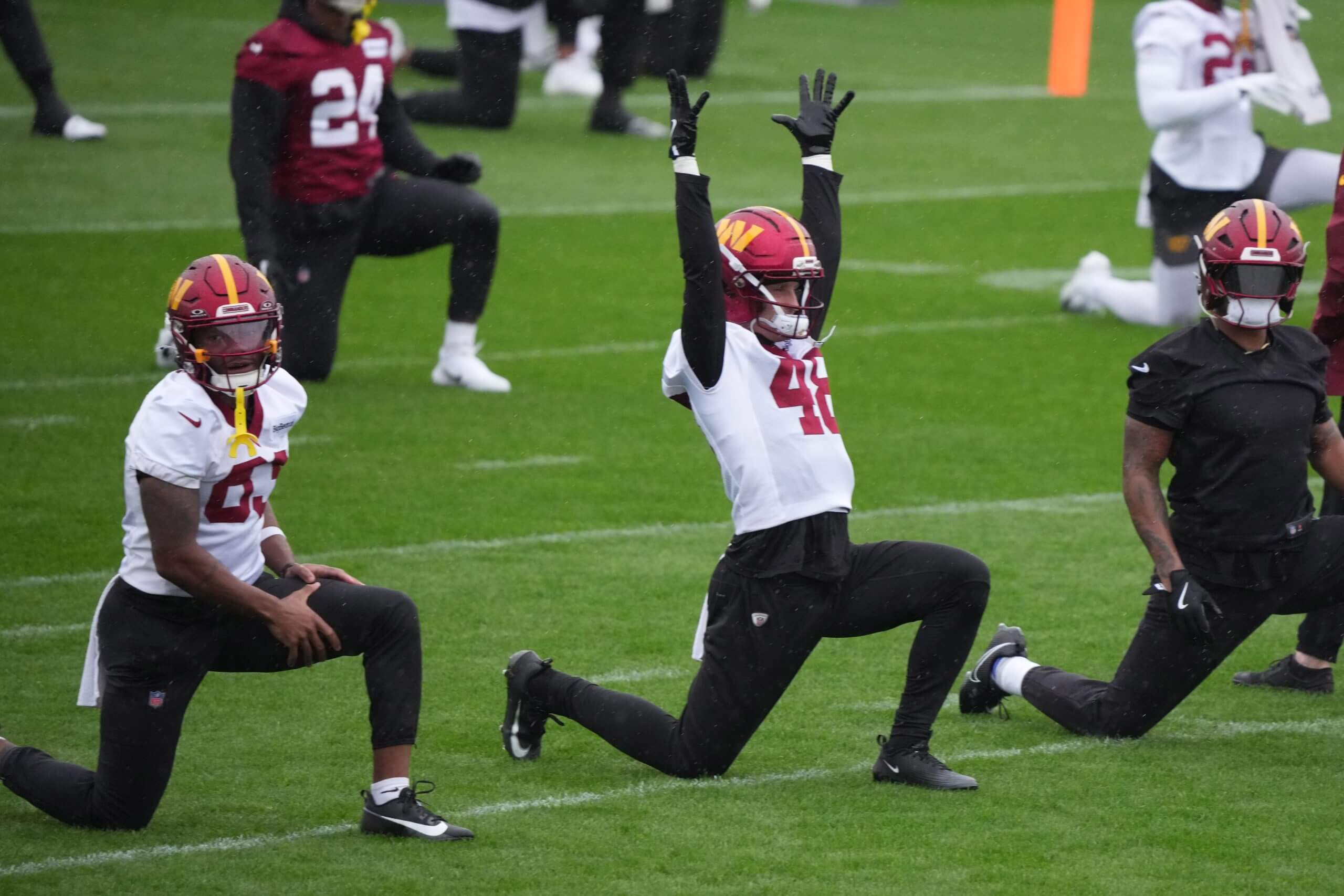
River Cracraft (48) stretches before a Commanders practice in Madrid. (Kirby Lee / Imagn Images)
Knowing Cracraft would be arriving with very few of his belongings, co-equipment manager Justin Brooks brought additional sweats and team gear to get him through the week. And to help him get up to speed with the offense, receivers coach Bobby Engram and offensive assistant Andre Coleman often worked early and stayed late until Cracraft got comfortable.
“I just feel like that’s pretty rare, especially for a guy like me, being in the league for as long as I’ve been and having been in different rooms now,” Cracraft, 31, said. “For them to invest in a guy that comes in Week 11 … you just don’t expect a lot of attention. So to get it was like, wow.”
But there are few ways to make the emergency lifestyle an easy one in the NFL. Over a seven-day span, Cracraft spent more than a full 24 hours in the air, with trips to D.C., Spain, California and back to D.C. again.
“It’s a sleepless one,” Johnson said. “… It’s very challenging. There’s so much unknown. To me, you have to find a balance of accepting what it is and still going out there and trying to perform to the best of my ability. That’s just the nature of the situation. … You got to roll with it, or you can go home.”